The Barcode: A Simple Invention That Changed the World
Look around you. Chances are, within arm's reach, there is at least one barcode. On your coffee mug, your laptop charger, the book on your desk, the medicine in your cabinet. Barcodes are everywhere — over 6 billion barcodes are scanned every single day worldwide. Yet most people have never stopped to think about how they work, where they came from, or why there are so many different types.
This article is a deep dive into the world of barcodes. We will explore their surprising history, break down the technology behind them, compare every major barcode type, show you how to generate your own with Python, and look at where barcode technology is heading. Whether you are a developer, a business owner, or simply curious, this guide has something for you.
Fun Fact: The first item ever scanned with a barcode was a 10-pack of Wrigley's Juicy Fruit chewing gum at a Marsh supermarket in Troy, Ohio, on June 26, 1974. That pack is now on display at the Smithsonian Institution.
The Fascinating History of Barcodes
1949: The Idea — Morse Code on the Beach
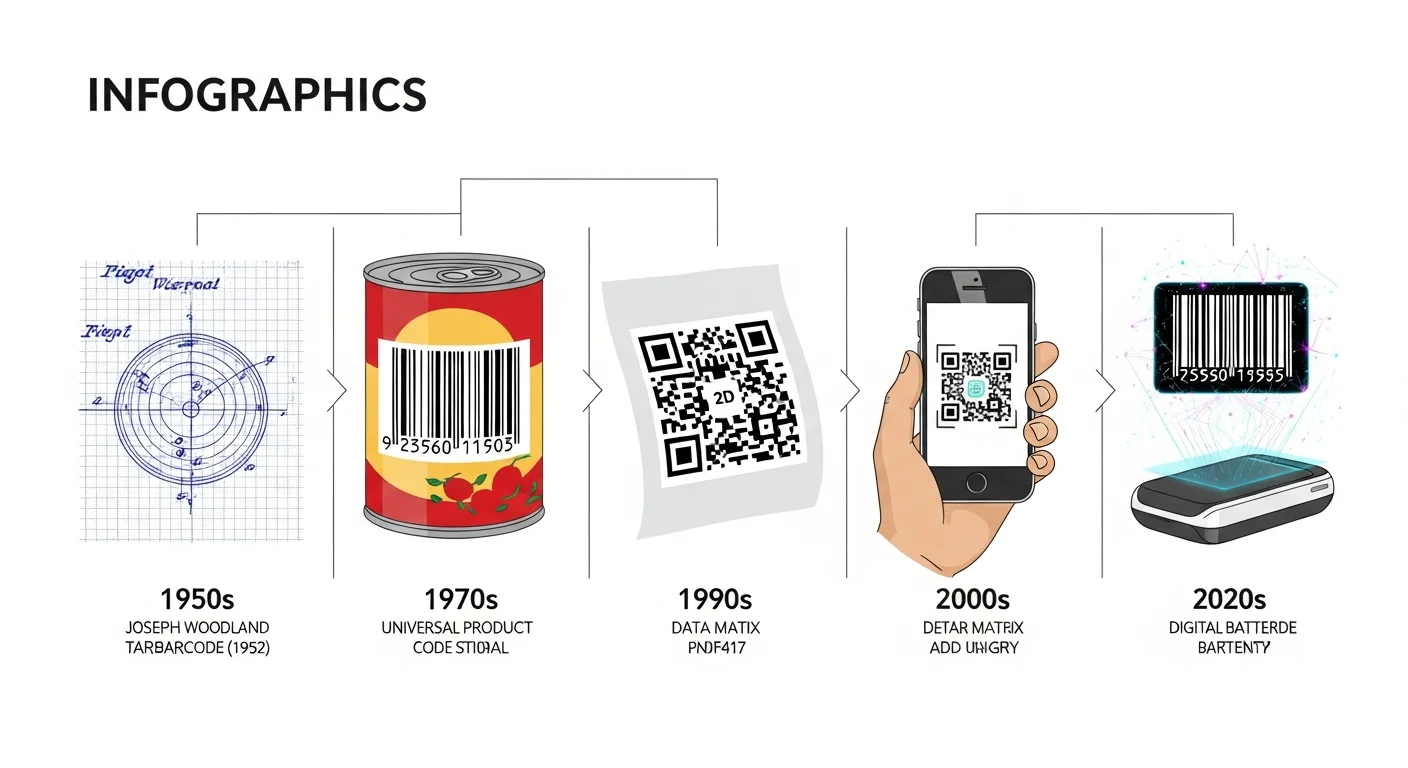
The barcode story begins with a graduate student named Norman Joseph Woodland. While sitting on Miami Beach, he dragged his fingers through the sand and realized that the dots and dashes of Morse code could be extended into thin and thick lines. On October 20, 1949, he and his partner Bernard Silver filed U.S. Patent 2,612,994 for a "Classifying Apparatus and Method" — the first barcode patent. Interestingly, their original design was not the rectangular bars we know today, but a circular bull's-eye pattern.
Source: Smithsonian Magazine — The History of the Bar Code
1966: The Railroad Experiment
The first large-scale use of barcode-like technology was not in a grocery store — it was on railroad cars. The Association of American Railroads adopted the KarTrak system, which used colored reflective stripes on the sides of rail cars to identify them automatically. The system was eventually abandoned due to maintenance issues (the stripes got dirty), but it proved the concept of automated identification.
1971: The Grocery Industry Gets Serious
By the early 1970s, the US grocery industry was losing millions of dollars to checkout inefficiencies. A consortium of grocery chains formed a committee to develop a standard product identification code. IBM assigned engineer George Laurer to develop a barcode that could be easily printed and scanned. Laurer chose the now-iconic rectangular bar pattern instead of Woodland's bull's-eye, creating the Universal Product Code (UPC).
1974: The First Scan
At 8:01 AM on June 26, 1974, cashier Sharon Buchanan at a Marsh Supermarket in Troy, Ohio, scanned the first UPC barcode. The product? A 10-pack of Wrigley's Juicy Fruit chewing gum, priced at 67 cents. The era of automated retail had begun.
1994: The QR Code Revolution
In Japan, an engineer named Masahiro Hara at Denso Wave (a Toyota subsidiary) invented the Quick Response (QR) Code. Originally designed to track car parts during manufacturing, QR codes could store vastly more data than traditional barcodes. Crucially, Denso Wave chose not to exercise their patent rights, making QR codes free for anyone to use — a decision that changed the world.
Source: QR Code.com — History of QR Code
2020s: Barcodes Go to Mars
NASA's Perseverance rover, which landed on Mars in February 2021, uses a system of Data Matrix codes to track and identify its rock sample tubes. Barcodes have literally left the planet.
How Barcodes Actually Work
1D Barcodes: The Classic Lines
A traditional 1D barcode encodes data in the widths and spacings of parallel lines. Here is how scanning works:
- The scanner emits light (usually a red laser or LED) across the barcode
- Black bars absorb the light, white spaces reflect it back
- A photodetector measures the pattern of reflected light over time
- The decoder chip converts the light/dark pattern into a digital signal
- Character mapping translates the signal into numbers or characters using the barcode's encoding standard
Every 1D barcode includes start and stop characters (so the scanner knows where data begins and ends), quiet zones (blank space on either side), and usually a check digit calculated using a mathematical formula to catch scanning errors.
Did You Know? Most 1D barcodes can be scanned upside down. The scanner simply reads the pattern in reverse and flips it.
2D Barcodes: Data in Two Dimensions
Two-dimensional barcodes store data in both horizontal and vertical patterns — using squares, dots, or other geometric shapes arranged in a matrix. This allows them to store hundreds of times more data than 1D barcodes in the same physical space. They also include built-in error correction, meaning a damaged or partially obscured 2D barcode can often still be read.
QR codes, for example, use Reed-Solomon error correction and can recover from up to 30% damage to the code. This is why you can place a logo in the center of a QR code and it still works.
Every Major Barcode Type Explained
1D Barcode Types
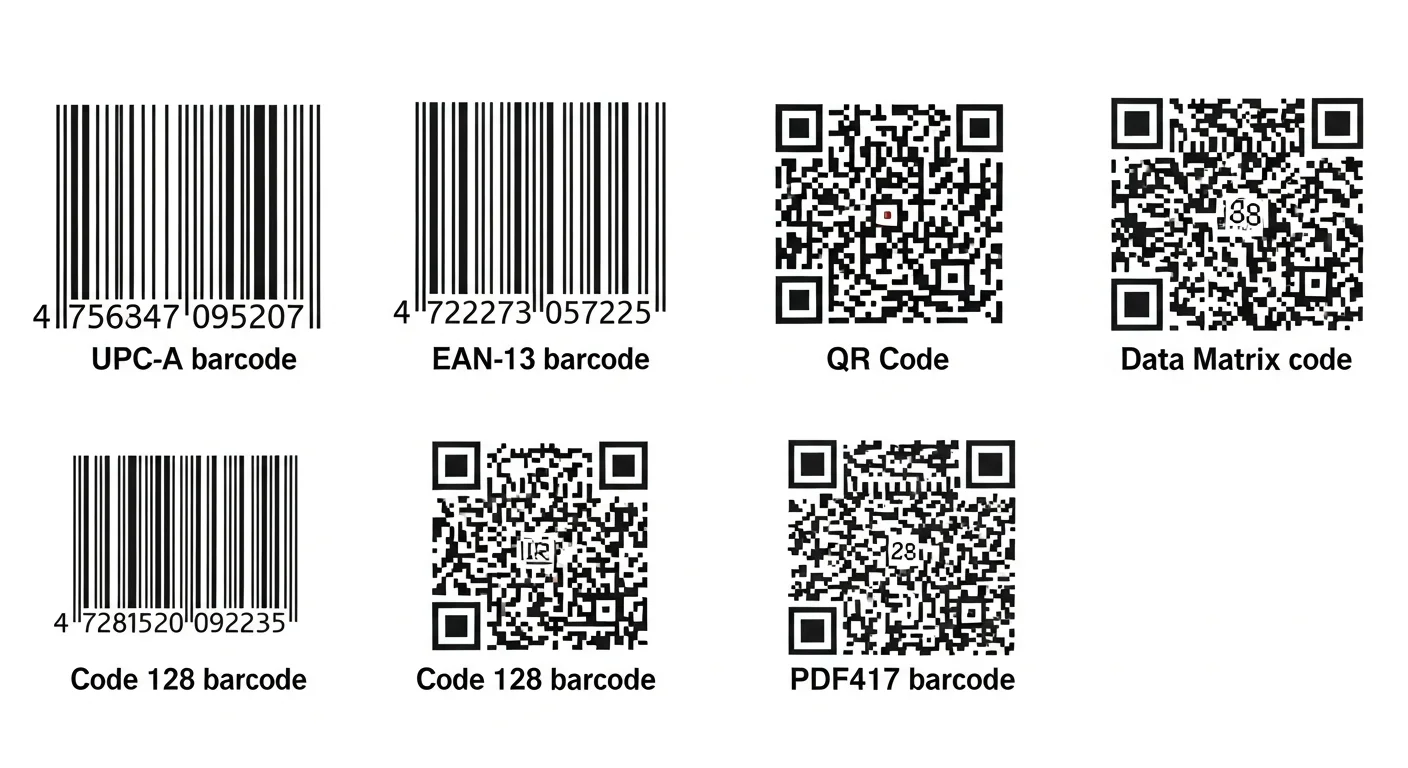
| Type | Characters | Data Capacity | Primary Use | Invented |
|---|---|---|---|---|
| UPC-A | Numeric only | 12 digits | US/Canada retail products | 1973 |
| UPC-E | Numeric only | 6 digits (compressed) | Small retail items | 1973 |
| EAN-13 | Numeric only | 13 digits | International retail (Europe, Asia) | 1977 |
| EAN-8 | Numeric only | 8 digits | Small international products | 1977 |
| Code 39 | Alphanumeric + symbols | Variable (low density) | Military, healthcare, automotive | 1974 |
| Code 128 | Full ASCII set (128 chars) | Variable (high density) | Shipping, logistics, packaging | 1981 |
| Interleaved 2 of 5 | Numeric only (pairs) | Variable | Warehousing, distribution | 1972 |
| Codabar | Numeric + 6 symbols | Variable | Blood banks, libraries (legacy) | 1972 |
| GS1-128 | Full ASCII | Variable + AI data | Supply chain, traceability | 1989 |
| ISBN | Numeric (EAN-13 variant) | 13 digits | Books worldwide | 1970 |
2D Barcode Types
| Type | Max Data Capacity | Error Correction | Primary Use | Invented |
|---|---|---|---|---|
| QR Code | 7,089 numeric / 4,296 alphanumeric | Up to 30% (Level H) | Marketing, payments, mobile apps | 1994 |
| Data Matrix | 2,335 alphanumeric | Reed-Solomon ECC 200 | Electronics, healthcare, aerospace | 1987 |
| PDF417 | 1,850 alphanumeric | 2 to 512 error correction words | ID cards, boarding passes, licenses | 1991 |
| Aztec Code | 3,832 numeric / 3,067 alpha | 5% to 95% configurable | Transport tickets (Deutsche Bahn, etc.) | 1995 |
| MaxiCode | 93 alphanumeric | Reed-Solomon | UPS package sorting | 1992 |
| Micro QR | 35 numeric / 21 alpha | Up to 25% | Small component marking | 2004 |
Surprising Barcode Facts You Probably Did Not Know
- The number 666 myth: Some people claimed UPC barcodes contain the number 666 in their guard bars. This is false — the guard bars (the longer lines at the start, middle, and end) are structural markers and do not encode any number.
- Country of origin: The first 2-3 digits of an EAN-13 barcode indicate the country where the barcode was registered, not where the product was manufactured. A barcode starting with 690-699 means it was registered in China, but the product could be made anywhere.
- The world's smallest barcode: In 2021, researchers at the University of Washington created a barcode just 7 micrometers wide — smaller than a red blood cell — using nanofabrication techniques.
- Barcode art: Japanese designer Takashimaya created an entire art movement around barcodes, turning them into illustrations of cityscapes, trees, and animals while keeping them scannable.
- Self-checkout saved barcodes: When self-checkout terminals became popular in the 2000s, barcode technology became even more critical because customers needed to be able to scan items themselves.
- The GS1 organization manages barcode standards globally and has issued over 1 billion unique product codes.
Source: GS1 — Global Barcode Standards
How to Generate Barcodes with Python
Generating barcodes programmatically is surprisingly easy. Python has excellent libraries for both 1D and 2D barcode generation. Here are practical examples:
Generating 1D Barcodes (EAN-13, Code 128)
# Install: pip install python-barcode Pillow
import barcode
from barcode.writer import ImageWriter

# Generate EAN-13 barcode
ean = barcode.get("ean13", "5901234123457", writer=ImageWriter())
ean.save("product_barcode")  # Saves as product_barcode.webp
print("EAN-13 barcode generated!")

# Generate Code 128 barcode
code128 = barcode.get("code128", "SHIP-2026-00142", writer=ImageWriter())
code128.save("shipping_label")
print("Code 128 barcode generated!")

# Generate UPC-A barcode
upc = barcode.get("upca", "012345678905", writer=ImageWriter())
upc.save("retail_product")
print("UPC-A barcode generated!")
Generating QR Codes
# Install: pip install qrcode[pil]
import qrcode

# Simple QR code
qr = qrcode.QRCode(
    version=1,
    error_correction=qrcode.constants.ERROR_CORRECT_H,  # 30% error correction
    box_size=10,
    border=4,
)
qr.add_data("https://dargslan.com")
qr.make(fit=True)

img = qr.make_image(fill_color="#131921", back_color="white")
img.save("website_qr.webp")
print("QR code generated with high error correction!")
Generating Data Matrix Codes
# Install: pip install pylibdmtx Pillow
from pylibdmtx.pylibdmtx import encode
from PIL import Image

# Encode data into Data Matrix
encoded = encode(b"PART-2026-X7R-4K7")
img = Image.frombytes("RGB", (encoded.width, encoded.height), encoded.pixels)
img.save("component_datamatrix.webp")
print("Data Matrix code generated!")
Reading/Decoding Barcodes
# Install: pip install pyzbar Pillow
from pyzbar.pyzbar import decode
from PIL import Image

# Decode any barcode from image
img = Image.open("product_barcode.webp")
results = decode(img)

for result in results:
    print(f"Type: {result.type}")
    print(f"Data: {result.data.decode()}")
    print(f"Position: {result.rect}")
For a complete deep dive into barcode programming with Python, including batch generation, custom styling, database integration, and building a full inventory management system, check out our book Python Barcodes: A Comprehensive Guide available in our store.
Source: python-barcode Documentation | qrcode on PyPI
Barcodes in Different Industries
Healthcare
Barcodes save lives. The FDA mandates that all prescription drugs in the US carry a National Drug Code (NDC) barcode. Hospitals use barcode scanning to verify the "five rights" of medication administration: right patient, right drug, right dose, right route, right time. Studies show that barcode-assisted medication administration reduces errors by up to 86%.
Source: FDA — Drug Supply Chain Security Act
Aerospace and Defense
Every component in a commercial aircraft is tracked with a barcode or Data Matrix code. Boeing uses over 10 million barcodes in the production of a single 787 Dreamliner. The US Department of Defense uses the IUID (Item Unique Identification) standard with Data Matrix codes to track military assets globally.
Logistics and Supply Chain
The global logistics industry processes over 100 billion barcode scans per year. The GS1-128 barcode standard enables end-to-end supply chain tracking, encoding not just product identity but also batch numbers, expiration dates, serial numbers, and shipping information in a single barcode.
Retail and E-Commerce
Beyond the checkout counter, retailers use barcodes for inventory management, loss prevention, price updates, and supply chain optimization. Amazon's fulfillment centers scan barcodes at an estimated rate of hundreds of millions of times per day across their global network.
1D vs 2D Barcodes: The Ultimate Comparison
| Feature | 1D Barcodes | 2D Barcodes |
|---|---|---|
| Data capacity | 20-25 characters max | Up to 7,089 characters |
| Data types | Usually numbers only | Numbers, text, URLs, binary |
| Size efficiency | Gets wider with more data | Compact regardless of data |
| Error correction | Check digit only | Built-in redundancy (up to 30%) |
| Scanning direction | Horizontal only (1 direction) | Any angle, any direction |
| Scanner type | Laser scanner sufficient | Camera/imager required |
| Printing cost | Very low | Low |
| Damage tolerance | Low — any bar damage = failure | High — can tolerate partial damage |
| Speed of scanning | Very fast | Fast (slightly slower) |
| Database required? | Yes (barcode is just a key) | Optional (can embed full data) |
| Best for | Retail POS, simple identification | Mobile apps, complex data, marketing |
The Future of Barcodes
GS1 Digital Link
The next evolution of barcodes is already here. GS1 Digital Link embeds a web URL directly into a 2D barcode (usually a QR code), turning every product into an internet-connected entity. Scanning a GS1 Digital Link barcode can show product information, nutritional data, allergen warnings, sustainability information, authenticity verification, and promotional offers — all from a single scan.
Source: GS1 — Digital Link Standard
The Sunrise 2027 Initiative
GS1 has announced that by 2027, all retail point-of-sale systems worldwide should be capable of scanning 2D barcodes (QR codes) in addition to traditional 1D barcodes. This is known as the Sunrise 2027 initiative and represents the biggest change in retail barcode technology in 50 years.
Invisible and Embedded Barcodes
Companies like Digimarc are developing invisible watermark barcodes that can be embedded across an entire product package. Instead of a visible barcode occupying packaging space, the entire surface becomes scannable. This technology is already being tested by major retailers including Walmart.
Blockchain + Barcodes
Several startups are combining blockchain technology with barcodes to create unforgeable product authentication. Each barcode links to an immutable blockchain record, making it possible to verify product authenticity from factory to consumer.
How to Get Your Own Barcodes for Products
- Join GS1: Register with your local GS1 organization (GS1.org) to get a unique company prefix
- Assign product numbers: Using your GS1 prefix, create unique GTIN (Global Trade Item Number) for each product
- Generate barcode images: Use GS1's tools or Python libraries to create barcode images
- Print and apply: Add barcodes to packaging, labels, or digital products
- ISBN for books: If you are selling books, you need an ISBN number which is a special type of EAN-13 barcode. Register with your national ISBN agency.
Pro Tip: For digital products like eBooks, you can use custom identifier systems (like our DSIN codes at Dargslan) instead of traditional retail barcodes. The principles are the same — unique identification, check digits, and scannable encoding.
Conclusion: The Humble Line That Runs the World
From Norman Woodland drawing lines in the sand on Miami Beach in 1949 to NASA's barcodes on Mars in 2021, the barcode has had an extraordinary journey. It is one of those rare inventions that is so successful, it has become invisible — literally embedded in the fabric of modern commerce, healthcare, logistics, and technology.
The next time you scan a QR code at a restaurant or a cashier scans your groceries, take a moment to appreciate the elegant simplicity of this technology. Those black and white lines — or squares — represent one of the most impactful inventions of the 20th century, and they are still evolving.
Want to learn more about barcode programming? Check out our comprehensive book Python Barcodes: A Comprehensive Guide to Understanding, Generating, and Decoding — covering everything from basic generation to building complete inventory management systems with barcode technology.