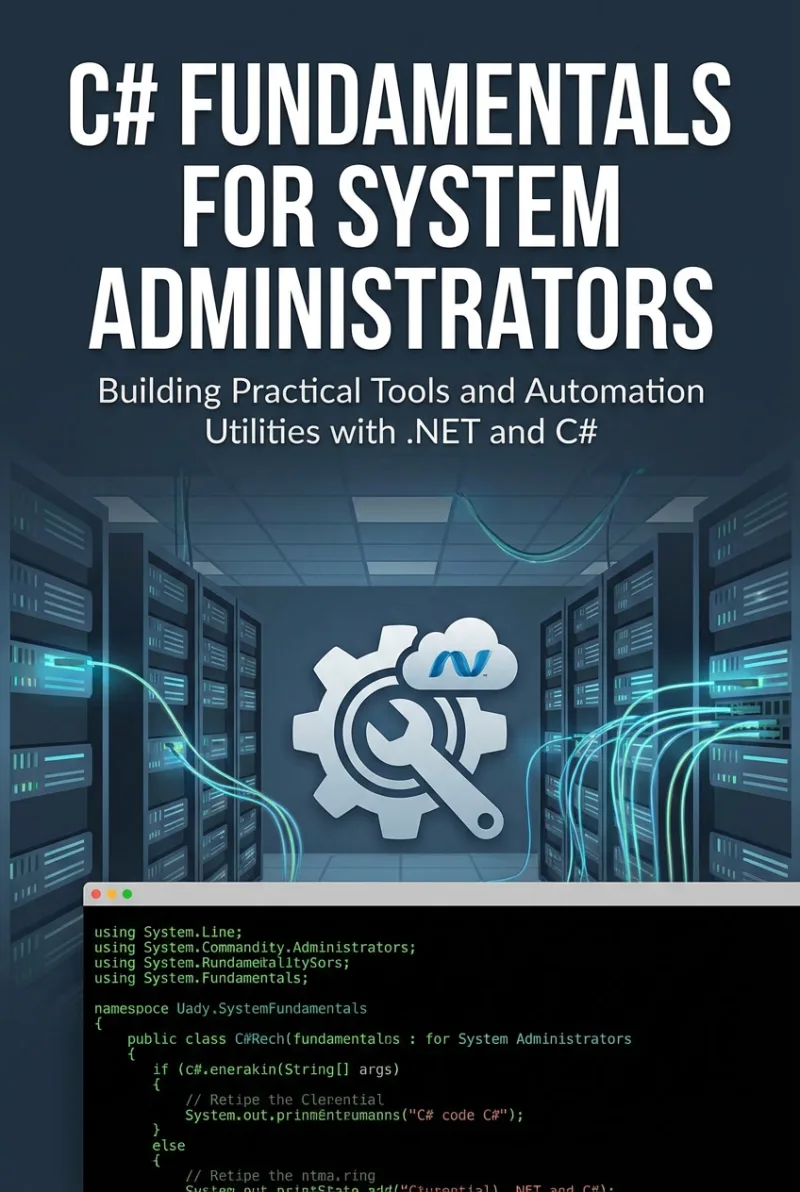
C# Fundamentals for System Administrators
Building Practical Tools and Automation Utilities with .NET and C\#
What's Included:
At a Glance
C# Fundamentals for System Administrators is a professional C# eBook by Asher Vale, 474 pages, available as an instant PDF and EPUB download for €12.90 with lifetime access and free updates. Building Practical Tools and Automation Utilities with .NET and C\#.
- Length: 474 pages
- Format: PDF and EPUB (instant download)
- Language: English
- Topic: C#
- Edition: 1st Edition
- Price: €12.90
Key Highlights
- Learn C# fundamentals through sysadmin tasks—not abstract theory
- Build practical CLI utilities you can ship as executables
- Work with files, directories, processes, and structured data
- Automate APIs, cloud services, and internal platforms
- Write safe error handling and predictable tool behavior
- Use configuration and environment patterns that scale across machines
- Publish and maintain tools over time (versioning, updates, repeatability)
- Integrate C# tools into existing PowerShell/Bash workflows
- Appendices with templates, snippets, and a learning roadmap
Overview
Build practical sysadmin tools with C# and .NET. Learn fundamentals through real admin tasks: files, processes, CLI utilities, APIs, cloud automation, and safe error handling.
The Problem
Sysadmins live in automation—but scripts can hit a ceiling. Over time, shell scripts grow long, batch files become fragile, and “quick fixes” turn into business-critical tooling that is difficult to maintain.
Common pain points include:
- Automation logic becomes hard to read and error-prone
- Weak structure makes refactoring risky
- Error handling is inconsistent and failures are hard to diagnose
- Parsing data and building reusable utilities feels messy
- Sharing automation across teams turns into copy/paste chaos
- Shipping tools reliably (versioning, configuration, updates) becomes painful
At that point, you don’t need “more scripting tricks.” You need a stronger foundation for building tools.
The Solution
C# Fundamentals for System Administrators teaches the core building blocks of C# and .NET with a single goal: help you build practical admin tools that are reliable, maintainable, and easy to distribute.
You’ll learn fundamentals in a progressive way, then apply them to real sysadmin scenarios:
- Core C# language fundamentals (types, control flow, functions, collections)
- .NET fundamentals for files, processes, configuration, and structured data
- CLI tool building so your utilities behave predictably
- HTTP + API automation for internal systems and cloud services
- Exception handling and safe failure strategies
- Publishing tools your team can actually run and trust
The result: fewer fragile scripts, stronger tooling, cleaner automation, and a foundation that supports long-term infrastructure work.
About This Book
C# Fundamentals for System Administrators is a practical, sysadmin-focused introduction to C# and .NET for building reliable tools and automation utilities. It’s designed for IT professionals who already automate with scripts—but now need more structure, safety, and maintainability than shell, batch, or one-off scripts can comfortably provide.
This is not a book about becoming a software developer. It is a book about learning the fundamentals—the language building blocks and core .NET skills that let you create stronger internal utilities, repeatable automation, and production-ready admin tools that you can version, test, and ship.
Why C# for Sysadmins?
There’s a point where scripting becomes fragile: logic grows complex, error handling turns messy, performance becomes unpredictable, and maintainability drops. C# gives you:
- Structure for complex automation tasks
- Strong typing to reduce mistakes and hidden bugs
- Better error handling and predictable control flow
- Fast, distributable tools you can ship as a single executable
- Deep Windows + cross-platform support with modern .NET
Fundamentals, Through Real Admin Work
This book teaches C# in the context you actually care about: infrastructure tasks, automation, and internal utilities. You’ll start with core language fundamentals—variables, types, input, control flow—then apply them to sysadmin tasks such as:
- File and directory management
- Processing structured data (JSON, CSV, configuration formats)
- Running system commands and capturing output safely
- Building command-line tools with predictable behavior
- Calling APIs and automating internal/cloud services
- Handling failures cleanly with exceptions and validation
- Shipping and maintaining tools over time
Built to Be Practical and Maintainable
Throughout the book, the focus is on clarity over cleverness. Examples are readable, pragmatic, and designed to work in real environments. You won’t find enterprise architecture lectures. You will find patterns and practices that help your automation survive long after it leaves your laptop.
Who This Book Helps Most
If you’re a system administrator, infrastructure engineer, or IT professional with scripting experience (PowerShell, Bash, Python, or batch) and you want to learn C# from the ground up—this book gives you a structured path to build dependable tools without drowning in unnecessary theory.
Master the fundamentals, and you’ll be surprised how far they take you: faster troubleshooting, safer automation, cleaner utilities, and a smoother path toward DevOps engineering.
Who Is This Book For?
- System administrators who want stronger automation than scripts can provide
- Infrastructure engineers building internal utilities and operational tooling
- PowerShell/Bash/Python users who want to level up into compiled tools
- IT pros who maintain shared scripts and need reliability, structure, and versioning
- DevOps/SRE-minded admins building repeatable workflows and tooling
- Windows-focused admins who want deeper native tooling—and cross-platform options
Who Is This Book NOT For?
- Readers looking for advanced enterprise architecture, design patterns, or “clean architecture” theory
- Experienced C# developers who already know .NET tooling, packaging, and automation patterns
- People who only want copy/paste scripts with no interest in learning fundamentals
- Those seeking game development, UI-heavy apps, or ASP.NET web development as the main focus
Table of Contents
- When Scripting Is Not Enough
- Setting Up a C# Development Environment
- Variables, Data Types, and Input
- Control Flow and Logic
- File and Directory Management
- Working with Structured Data
- Running System Commands
- Building CLI Tools
- Making HTTP Requests
- Automating Cloud and Internal Services
- Exceptions and Error Handling
- Configuration and Environment Handling
- Building and Publishing Applications
- Maintaining Admin Tools
- Combining C# with Scripting
- From System Administrator to DevOps Engineer
- Appendix: C# Syntax Cheat Sheet (Admin Edition)
- Appendix: Common Admin Tool Templates
- Appendix: File and Process Handling Snippets
- Appendix: API Client Template Example
- Appendix: C# for Infrastructure Learning Roadmap
Requirements
- Basic scripting experience (PowerShell, Bash, Python, or batch) is helpful but not required
- Comfort with command-line usage and administrative tasks (files, logs, services)
- No prior C# or .NET knowledge needed—concepts start from zero
- Recommended: a Windows or Linux machine with the .NET SDK installed for hands-on practice