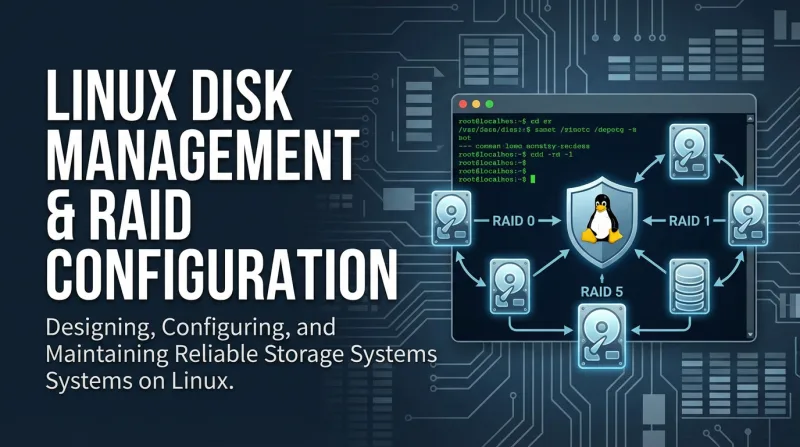
Linux Disk Management & RAID Configuration
Designing, Configuring, and Maintaining Reliable Storage Systems on Linux
What's Included:
At a Glance
Linux Disk Management & RAID Configuration is a professional Linux Storage eBook by Bas van den Berg, 315 pages, available as an instant PDF and EPUB download for €12.90 with lifetime access and free updates. Designing, Configuring, and Maintaining Reliable Storage Systems on Linux.
- Length: 315 pages
- Format: PDF and EPUB (instant download)
- Language: English
- Topic: Linux Storage
- Edition: 1st Edition
- Price: €12.90
Key Highlights
- Linux storage architecture explained clearly
- Partitioning strategies for production servers
- Deep dive into LVM configuration and resizing
- Comprehensive RAID level comparison
- Software RAID with mdadm step-by-step
- Combining RAID and LVM for flexible storage
- Performance tuning techniques
- Backup and recovery planning
- Disk failure troubleshooting procedures
- Production-ready storage best practices
Overview
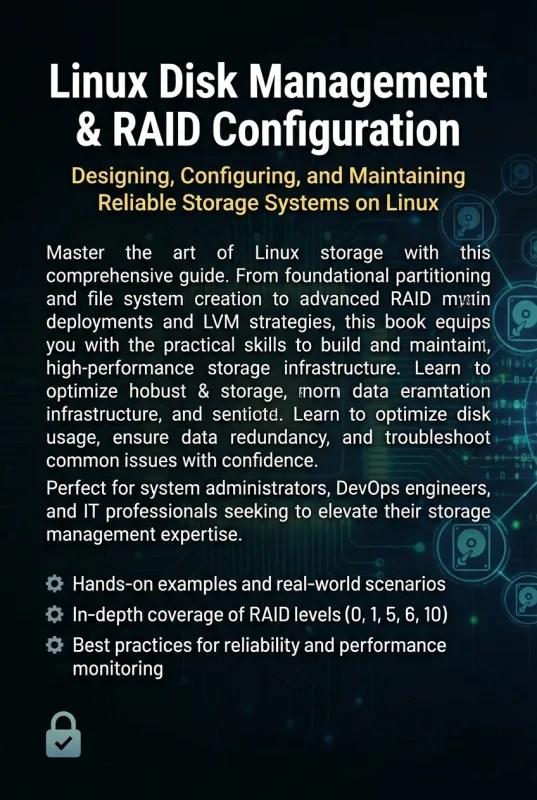
Master Linux disk management and RAID configuration. Learn partitioning, filesystems, LVM, software RAID, performance tuning, and failure recovery for production systems.
The Problem
Many Linux administrators manage disks reactively — expanding partitions when full or rebuilding RAID arrays after failures.
Without architectural understanding, storage becomes fragile and difficult to maintain.
The Solution
This book provides a structured approach to Linux disk management and RAID configuration, combining theory, design thinking, and practical commands for reliable production systems.
About This Book
Linux Disk Management & RAID Configuration is a comprehensive, hands-on guide to designing, configuring, and maintaining reliable storage systems on Linux.
Every Linux server ultimately depends on storage. Applications, databases, and services rely on disks that must be structured, protected, and monitored correctly. Yet many administrators approach disk management reactively — expanding partitions when they fill up or rebuilding RAID arrays only after failures occur.
This book changes that approach by teaching storage architecture deliberately and systematically.
Understand the Linux Storage Stack
You begin by mastering how Linux interacts with block devices, partitions, filesystems, and logical volume layers. You will understand:
- How the Linux kernel handles block storage
- Partitioning strategies (MBR vs GPT)
- Filesystem design decisions
- Layered storage architecture thinking
Before executing commands, you will understand why those commands matter.
Master Logical Volume Management (LVM)
LVM transforms rigid disk layouts into flexible storage pools. This book teaches you to:
- Create and extend volume groups
- Resize logical volumes safely
- Plan storage growth strategies
- Manage snapshots
- Recover from misconfigurations
LVM becomes not just a tool, but a design capability.
Design and Configure RAID Properly
RAID is often misunderstood or misapplied. You will learn:
- RAID levels explained clearly (0, 1, 5, 6, 10)
- Trade-offs between performance and redundancy
- Building software RAID arrays with mdadm
- Monitoring RAID health proactively
- Replacing failed disks safely
Rather than copying configurations, you will design RAID systems appropriate for real production workloads.
Combine RAID and LVM for Flexible Resilience
One of the most powerful aspects of Linux storage is the ability to layer RAID and LVM together. This book walks through production-grade architectures that combine:
- RAID for redundancy
- LVM for flexibility
- Filesystem tuning for performance
Go Beyond Configuration: Operations & Recovery
True storage mastery means knowing what to do when things fail.
This book includes:
- Performance tuning strategies
- Backup architecture planning
- Disk failure troubleshooting
- RAID recovery procedures
- Production storage best practices
Storage reliability is not about hope. It is about preparation.
By the end of this book, you will think like a storage architect, not just a command executor.
Who Is This Book For?
- Linux system administrators
- DevOps engineers managing Linux infrastructure
- IT professionals responsible for server storage
- Students preparing for Linux engineering roles
- Anyone designing resilient Linux storage systems
Who Is This Book NOT For?
- Complete Linux beginners
- Users unfamiliar with the Linux command line
- Readers seeking desktop Linux tutorials
Table of Contents
- Understanding Linux Storage Architecture
- Planning Disk Layouts
- Disk Partitioning in Practice
- Creating and Managing Filesystems
- LVM Architecture Explained
- Managing and Resizing LVM Storage
- RAID Fundamentals
- Designing RAID for Real Use Cases
- Creating Software RAID Arrays
- Managing and Monitoring RAID Arrays
- Combining RAID and LVM
- Storage Performance and Optimization
- Backup and Recovery Strategies
- Troubleshooting Disk and RAID Failures
- Storage Best Practices for Production
- From Disk Management to Storage Architecture
Requirements
- Basic familiarity with Linux command-line usage
- Access to a Linux system (virtual machine recommended)
- Fundamental understanding of server administration concepts