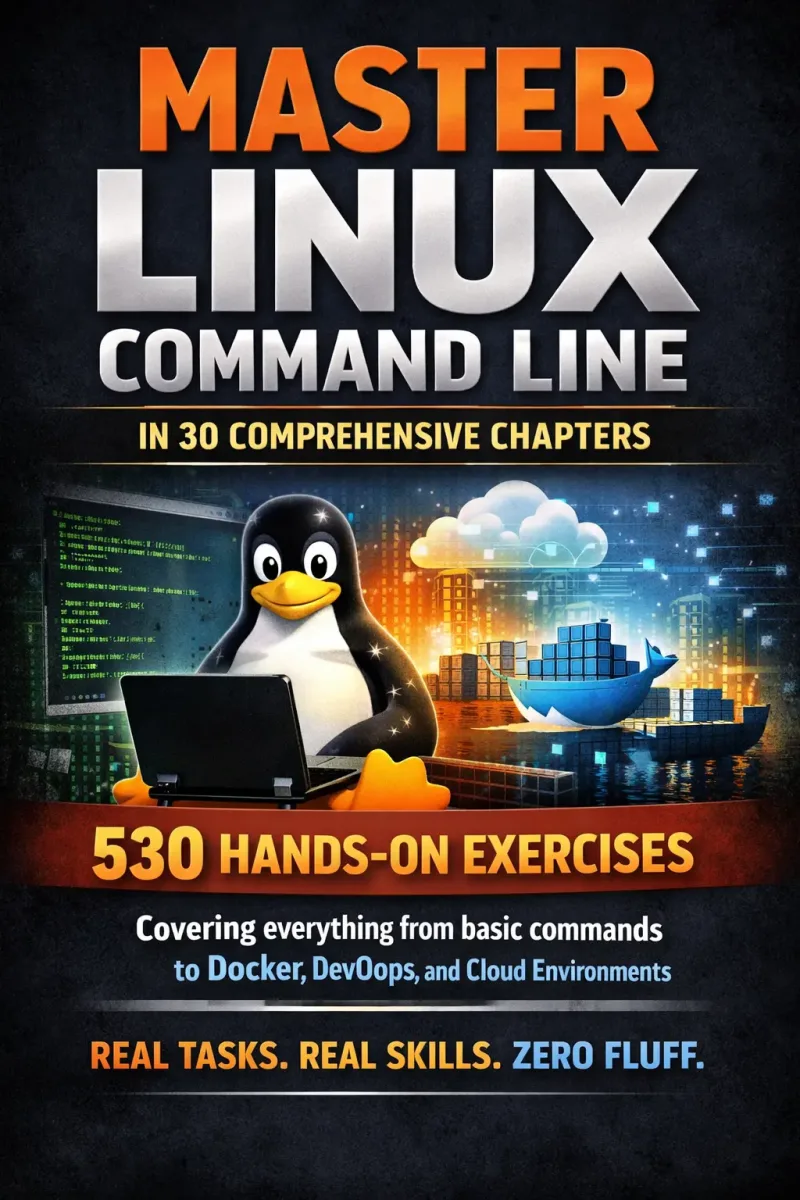
Master Linux Command Line in 30 Comprehensive Chapters
Master Linux Command Line in 30 Comprehensive Chapters
What's Included:
At a Glance
Master Linux Command Line in 30 Comprehensive Chapters is a professional Linux Administration eBook by Darky, 1187 pages, available as an instant PDF and EPUB download for €19.90 with lifetime access and free updates. Master Linux Command Line in 30 Comprehensive Chapters.
- Length: 1187 pages
- Format: PDF and EPUB (instant download)
- Language: English
- Topic: Linux Administration
- Edition: 1st Edition
- Price: €19.90
Key Highlights
- 520+ practical Linux exercises
- 30 comprehensive chapters
- Real-world system administration scenarios
- Covers security, Docker, cloud, and DevOps
- Hands-on command-line mastery
Overview
A hands-on Linux command line workbook with 520 practical exercises across 30 chapters. Master Linux administration, scripting, networking, security, Docker, and DevOps fundamentals.
The Problem
Many learners know Linux commands but struggle to apply them in real-world administration, troubleshooting, and automation scenarios.
The Solution
This book delivers 250 hands-on Linux exercises that build real command-line and system administration skills through practical challenges.
About This Book
Learn Linux the Way Professionals Do – Through Practice
Master Linux Command Line in 30 Comprehensive Chapters is a hands-on, exercise-driven guide designed to transform you from a Linux beginner into a confident command-line user and system administrator. Instead of passive reading, this book challenges you to actively work with Linux through 520 carefully structured practical exercises that reflect real-world scenarios used by professionals.
Linux powers modern IT infrastructure: cloud platforms, servers, containers, DevOps pipelines, cybersecurity systems, and embedded environments. Yet many learners struggle to bridge the gap between memorizing commands and actually understanding how Linux systems work in production. This book was created to close that gap.
Why This Book Is Different
Most Linux books explain commands. This book teaches skills.
Every chapter focuses on hands-on problem solving. You don’t just learn what a command does—you learn when, why, and how to use it in realistic administration and troubleshooting scenarios. By completing the exercises, you build muscle memory, confidence, and a deep understanding of Linux system behavior.
The structure is progressive. You start with basic navigation and file management, then advance through users, permissions, services, networking, security, scripting, containers, cloud environments, and DevOps practices.
What You Will Master
By completing the 30 chapters and exercises, you will gain practical competence in:
- Linux command-line navigation and core utilities
- File systems, permissions, ownership, and attributes
- Text processing and data manipulation using sed, awk, grep, and jq
- User and group administration with security best practices
- Process management, system monitoring, and performance analysis
- Systemd service management, timers, and troubleshooting
- Networking fundamentals and advanced diagnostics
- Firewalls, SELinux, AppArmor, and Linux security hardening
- Disk, filesystem, LVM, backup, and recovery strategies
- Shell scripting from basics to advanced automation
- Package management across major Linux distributions
- Docker and container fundamentals
- Cloud-based Linux environments and CLI tools
- Version control with Git
- Working with APIs and web services from the command line
- DevOps fundamentals and CI/CD concepts
Designed for Real-World Linux Administration
The exercises in this book are inspired by real tasks performed by Linux system administrators, DevOps engineers, security professionals, and cloud engineers. You’ll practice diagnosing problems, configuring systems, securing services, automating workflows, and optimizing performance—exactly the skills required in professional environments.
Each exercise has a clear objective and encourages exploration, experimentation, and problem-solving rather than rote execution. This makes the book ideal for self-study, lab environments, training programs, and certification preparation.
Who This Book Is For
- Linux beginners who want hands-on experience
- System administrators building real-world skills
- DevOps engineers strengthening Linux foundations
- Students preparing for Linux certifications
- Developers working in Linux-based environments
- IT professionals transitioning into cloud or infrastructure roles
Long-Term Value
The skills you gain from this book apply across distributions and environments—from Ubuntu and Debian to RHEL, AlmaLinux, cloud servers, and containers. The focus on concepts and workflows ensures your knowledge remains relevant as Linux continues to evolve.
This is not just a book—it’s a practical training program in Linux mastery.
Author: Darky
Publisher: Dargslan s.r.o.
Who Is This Book For?
- Linux beginners
- System administrators
- DevOps engineers
- IT students and certification candidates
- Cloud and infrastructure professionals
Who Is This Book NOT For?
- Readers looking for theory-only explanations
- Users unwilling to practice hands-on
- Non-technical audiences
Table of Contents
- Basic Commands
- File and Directory Management
- Text Processing and Editing
- User and Group Management
- Process Management
- Systemd and Services
- Monitoring and Performance
- Networking and Security
- Shell Scripting
- Containers, Cloud, and DevOps
Requirements
- Basic computer knowledge
- Access to a Linux system or VM
- No prior Linux experience required