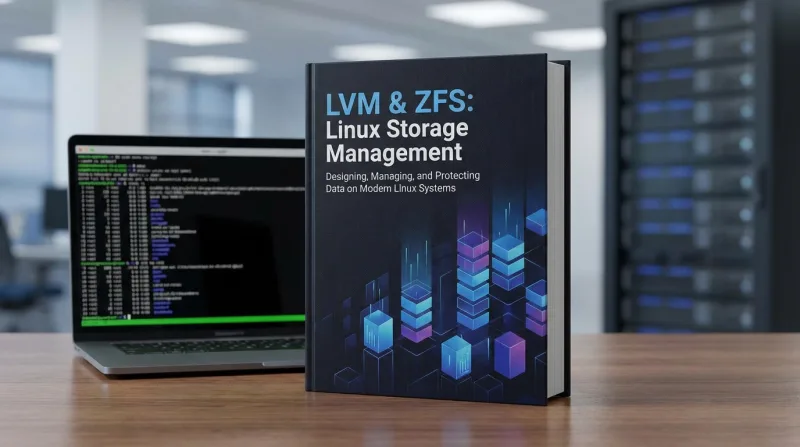
LVM & ZFS: Linux Storage Management
Designing, Managing, and Protecting Data on Modern Linux Systems
What's Included:
At a Glance
LVM & ZFS: Linux Storage Management is a professional Linux Storage eBook by Miles Everhart, 309 pages, available as an instant PDF and EPUB download for €12.90 with lifetime access and free updates. Designing, Managing, and Protecting Data on Modern Linux Systems.
- Length: 309 pages
- Format: PDF and EPUB (instant download)
- Language: English
- Topic: Linux Storage
- Edition: 1st Edition
- Price: €12.90
Key Highlights
- Complete understanding of Linux storage layers
- Practical LVM volume design and resizing
- Deep ZFS architecture and pool management
- Snapshot and clone strategies
- Data integrity and scrubbing practices
- Production-ready storage deployment patterns
- LVM vs ZFS architectural comparison
Overview
Master Linux storage management with LVM and ZFS. Learn modern volume design, snapshots, data protection, integrity, and production-ready storage architecture.
The Problem
Linux storage is often treated as an afterthought. Administrators create partitions, mount filesystems, and hope they never need to resize, migrate, or recover under pressure.
Without proper planning, failures lead to downtime, data corruption, or complex emergency recovery procedures.
The Solution
This book provides a structured, architectural approach to Linux storage management using LVM and ZFS.
You will learn to design resilient storage systems, implement snapshot strategies, protect data integrity, and deploy production-ready storage environments with confidence.
About This Book
LVM & ZFS: Linux Storage Management is a comprehensive, practical guide to designing, managing, and protecting data on modern Linux systems. Whether you are running enterprise servers, virtualization clusters, home labs, or cloud-based infrastructure, storage reliability is the foundation upon which everything else depends.
When disks fail, partitions fill unexpectedly, or databases require urgent recovery, the quality of your storage architecture determines whether the situation becomes routine maintenance or catastrophic data loss. This book was written to ensure you are prepared long before those 2 AM emergencies arrive.
The first part of the book builds a strong foundation in the Linux storage stack. You will understand how physical disks, partitions, filesystems, volume managers, and block devices interact. Rather than treating storage as a collection of commands, this book teaches you how to think architecturally about data layout, redundancy, growth planning, and failure domains.
From there, you dive deeply into Logical Volume Manager (LVM). LVM remains one of the most widely deployed storage technologies in Linux environments. You will learn how to design volume groups, create and resize logical volumes safely, manage snapshots, and implement backup strategies. More importantly, you will understand the architectural trade-offs LVM introduces and where its boundaries lie.
The heart of the book focuses on ZFS — a modern storage system that fundamentally redefines how Linux handles data integrity and reliability. ZFS combines filesystem logic, volume management, and integrity verification into a unified architecture. You will learn how to design ZFS pools, create datasets with granular properties, manage snapshots and clones efficiently, and leverage ZFS’s built-in checksumming to protect against silent data corruption.
Unlike many surface-level guides, this book goes beyond basic commands. You will explore:
- ZFS pool design strategies (mirror, RAID-Z, hybrid layouts)
- Performance considerations including ARC, compression, record sizes, and caching
- Data integrity models and scrubbing practices
- Snapshot-based backup workflows
- Monitoring and operational maintenance
- Production deployment best practices
You will also gain a direct, practical comparison between LVM and ZFS, allowing you to make informed architectural decisions rather than relying on tribal knowledge or online debates. The book explains not just how to configure each system, but why one might be more appropriate than the other depending on workload and risk tolerance.
By the final chapters, you will think beyond simple administration and begin approaching storage design from an infrastructure architect’s perspective. You will understand trade-offs between flexibility, performance, reliability, and operational complexity — knowledge that separates routine administrators from trusted infrastructure engineers.
This book is ideal for Linux system administrators, DevOps engineers, SREs, infrastructure architects, and advanced home lab builders who want to design storage systems that are resilient, maintainable, and production-ready.
If you manage data on Linux systems, this book will fundamentally change how you approach storage — from reactive troubleshooting to deliberate architectural design.
Who Is This Book For?
- Linux system administrators
- DevOps engineers and SREs
- Infrastructure architects
- Homelab builders working with ZFS
- IT professionals managing production servers
Who Is This Book NOT For?
- Complete Linux beginners
- Users looking for GUI-based storage tools
- Readers without basic command-line experience
Table of Contents
- Understanding Linux Storage Layers
- Storage Planning and Design Principles
- LVM Architecture Explained
- Creating and Managing LVM Volumes
- Resizing and Managing Storage with LVM
- LVM Snapshots and Backup Strategies
- ZFS Architecture and Philosophy
- Creating and Managing ZFS Pools
- ZFS Datasets and Properties
- ZFS Snapshots and Clones
- Data Integrity and Scrubbing
- Storage Performance Tuning
- Monitoring and Maintenance
- LVM and ZFS in Production Environments
- Comparing LVM and ZFS
- From Storage Administrator to Infrastructure Architect
Requirements
- Basic Linux command-line knowledge
- Familiarity with filesystems and disk partitions
- Access to a Linux system or virtual machine for practice