Bash Scripting Beginner's Complete Guide
Download This Cheat Sheet
Enter your email to download the PDF for free.
About This Cheat Sheet
Bash Scripting Beginner's Complete Guide is a structured 3-6 page guide that walks you from "I have never seen this before" to "I can solve real problems on my own". Each section builds on the previous and includes worked examples.
Bash Scripting Beginner's Complete Guide covers Bash — the default shell on most Linux distributions and macOS, and the universal scripting language of automation, CI/CD, and operations. It is written for sysadmins, DevOps engineers, SREs, developers writing build/deploy scripts, and anyone living in a terminal who need accurate, working syntax without wading through documentation. This particular sheet zooms in on Scripting — the parts of Bash that come up most often in real work. A comprehensive 6-page Bash scripting reference covering variables, conditionals, loops, functions, string manipulation, arrays, input handling, and practical script templates for automation. Perfect for system administrators and developers who automate tasks on Linux and macOS. Covers scripting fundamentals through advanced patterns, with practical examples you can use immediately in your daily workflow.
Every command, flag, and pattern in this sheet has been validated against current stable releases as of 2026. Where syntax differs between distributions, versions, or platforms, both forms are shown so you can copy-paste safely regardless of the environment you are working in. The PDF is print-ready in both A4 and US Letter formats and remains free to download forever.
What's Inside the PDF
- Scripting — the practical commands and patterns you actually use in production Bash work.
- Most-used commands grouped by task, not alphabetically, so you find what you need by intent.
- Common flag combinations with one-line comments explaining what each option actually does.
- Real-world examples that show inputs and expected outputs, not contrived hello-world snippets.
- Edge cases and gotchas that the official documentation buries on page 47.
- Print-friendly layout that works equally well on screen and on paper next to your monitor.
When to Use This Cheat Sheet
- 1Writing automation scripts that wrap CLI tools, parse output, and handle errors gracefully.
- 2Composing one-liners with pipes, `awk`, `sed`, `grep`, `xargs`, and `jq` to wrangle text and JSON.
- 3Building CI/CD pipeline steps that need to be portable across Linux runners.
- 4Operating in restrictive environments where Python is not installed and Bash is the only available tool.
- 5Reviewing and debugging legacy shell scripts with arcane syntax.
Key Concepts to Master
Word splitting
Unquoted variable expansions are split on whitespace. Always quote: `"$var"` not `$var`. This single rule prevents 80% of shell bugs.
Exit codes
Every command returns 0 (success) or non-zero (failure). Check `$?` or use `&&`/`||` to chain conditionally.
Subshells and process substitution
`(cmd)` runs in a subshell with isolated variables. `<(cmd)` provides a file-like input. Both are essential for clean composition.
Parameter expansion
`${var:-default}`, `${var/pattern/replacement}`, `${var##prefix}`, `${var%%suffix}` — the manual is dense but worth a careful read.
Set options
`set -euo pipefail` at the top of every script stops on errors, undefined variables, and pipeline failures. This is non-negotiable for production scripts.
Pro Tips from Practitioners
- Lint every script with ShellCheck. It catches quoting bugs, missing variables, and bad practices instantly.
- Prefer `[[ ]]` over `[ ]` for conditionals — it is safer and supports regex matching.
- Use `printf` instead of `echo` for portability and control over formatting.
- When a script grows beyond 200 lines, rewrite it in Python or Go. Bash is for orchestration, not application logic.
- Always quote variable expansions: `cp "$src" "$dst"` not `cp $src $dst`. Spaces in filenames are real.
Related Books for Deeper Learning
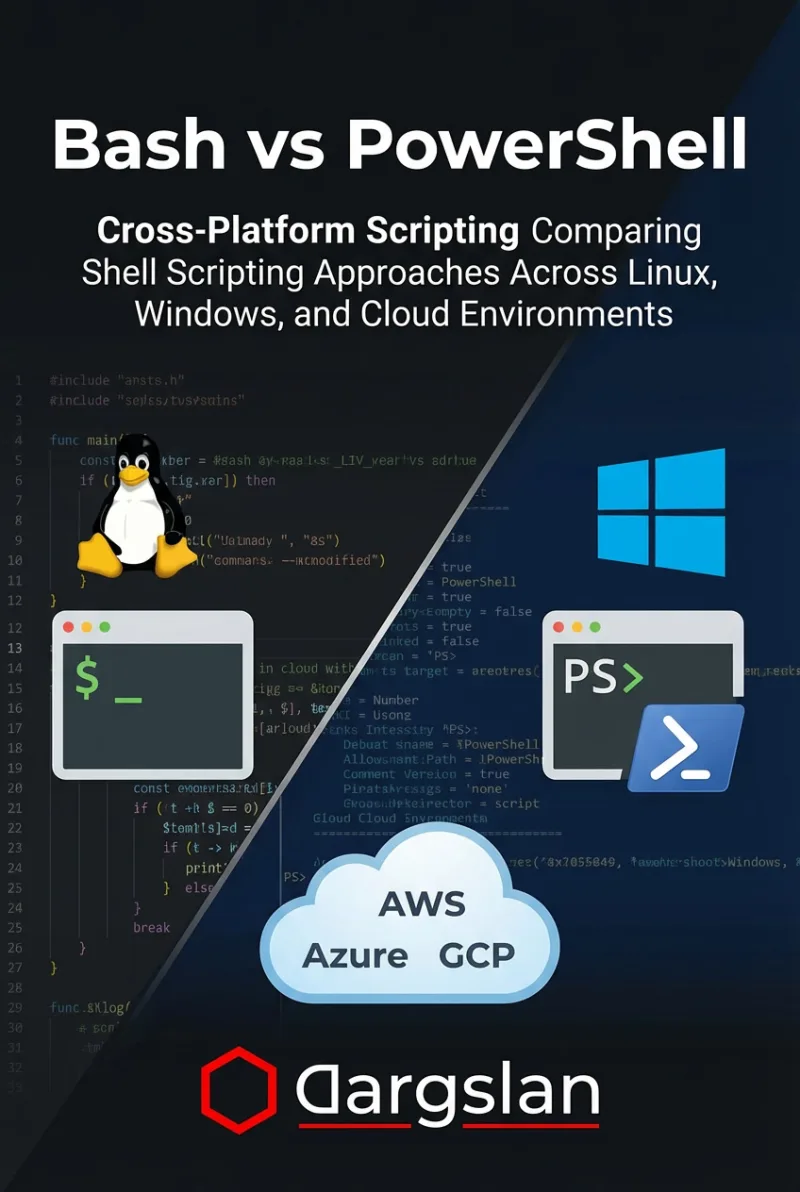
More Cheat Sheets
Interactive Linux Commands Reference
Explore 232+ commands with syntax, examples, options, and pro tips.
Frequently Asked Questions
What is the Bash Scripting Beginner's Complete Guide?
The Bash Scripting Beginner's Complete Guide is a free, professionally designed PDF reference covering Bash. It is curated by practitioners and validated against current stable releases as of 2026.
Do I need prior experience to use this guide?
No. The Beginner's Complete Guide assumes only basic comfort with a terminal or development environment. Each section introduces concepts before showing commands.
Why does my script work in Bash but not in sh?
Bash adds extensions on top of POSIX `sh` — arrays, `[[ ]]`, process substitution, brace expansion. If you must support `sh`, set the shebang to `#!/bin/sh` and run ShellCheck with `-s sh`.
How do I parse JSON in Bash?
Use `jq`. It is purpose-built for JSON, ships with most distributions, and combines naturally with pipes: `curl -s api/x | jq -r .field`.
Is Bash still relevant in 2026?
Yes. Despite the rise of Python and Go for serious automation, every Linux server, container, and CI runner has Bash. It is the universal glue.
What is the safest shebang to use?
`#!/usr/bin/env bash` is the most portable — it picks up Bash from `PATH` regardless of where it is installed (handy on macOS where `/bin/bash` is ancient).
Is this cheat sheet really free?
Yes, completely free. We ask for your email so we can let you know when new cheat sheets are released and to keep our spam-detection systems happy. You can unsubscribe in one click at any time.
Can I print and share this cheat sheet?
Yes — print it, pin it to your wall, share it with your team, hand it out at meetups. The only thing we ask is that you do not strip the Dargslan attribution or republish the PDF as your own work.