The enterprise Linux landscape has undergone dramatic shifts since Red Hat's controversial decision in 2023 to restrict public access to RHEL source code. What was once a simple ecosystem — RHEL as the commercial product, CentOS as the free clone — has evolved into a complex three-way competition between Red Hat Enterprise Linux (RHEL), AlmaLinux, and Rocky Linux, each with distinct philosophies, governance models, and approaches to enterprise compatibility.
For IT decision-makers in 2026, understanding the nuances between these three distributions is critical. The choice impacts licensing costs, vendor lock-in, compliance requirements, support availability, and long-term infrastructure strategy. This guide provides an honest, technically grounded comparison to help you navigate the enterprise Linux landscape.

1. The Historical Context: How We Got Here
Understanding where these distributions came from is essential to understanding where they are going.
The CentOS Era (2004-2021)
For nearly two decades, the enterprise Linux ecosystem followed a simple pattern: Red Hat developed RHEL as a commercial product, released the source code under GPL, and the CentOS project rebuilt it into a free, binary-compatible clone. Enterprises could develop and test on CentOS, deploy on RHEL where they needed support, and maintain perfect compatibility between environments.
This ecosystem was disrupted in December 2020 when Red Hat announced that CentOS 8 would be discontinued in favor of CentOS Stream — a rolling-release distribution that sits upstream of RHEL rather than downstream. CentOS Stream receives changes before they appear in RHEL, making it a development preview rather than a production-stable clone.
The Birth of AlmaLinux and Rocky Linux
Two projects immediately emerged to fill the CentOS void:
Rocky Linux was announced by Gregory Kurtzer — the original founder of CentOS — with the explicit mission of being a 1:1 binary-compatible RHEL clone, exactly as CentOS had been. The project launched Rocky Linux 8.4 in June 2021.
AlmaLinux was created by CloudLinux Inc., a company with over a decade of experience building RHEL-compatible distributions for the web hosting industry. AlmaLinux OS Foundation was established as an independent non-profit to govern the project. AlmaLinux 8.3 launched in March 2021.
The Source Code Controversy (2023)
In June 2023, Red Hat further disrupted the ecosystem by restricting public access to RHEL source code. Previously available through git.centos.org, RHEL source RPMs became accessible only to paying RHEL subscribers through the Red Hat Customer Portal. Red Hat's terms of service also suggested that redistributing this source code could result in subscription termination.
This move forced both AlmaLinux and Rocky Linux to adapt their build processes. Rocky Linux developed creative methods to continue accessing RHEL source code (including using UBI container images and pay-per-use cloud instances). AlmaLinux took a different philosophical approach, pivoting from strict 1:1 binary compatibility to ABI (Application Binary Interface) compatibility — a subtle but significant distinction we will explore below.
2. Compatibility Models: Binary vs. ABI

The most important technical distinction between AlmaLinux and Rocky Linux in 2026 is their approach to RHEL compatibility.
Rocky Linux: Bug-for-Bug Compatibility
Rocky Linux maintains its commitment to being a 1:1 binary-compatible rebuild of RHEL. This means that every package in Rocky Linux is compiled from the same source code as its RHEL counterpart, producing identical binaries. If RHEL has a bug, Rocky Linux has the same bug. If a third-party application is certified for RHEL, it should work identically on Rocky Linux without modification.
This approach provides maximum compatibility but depends on continued access to RHEL source code — a dependency that Red Hat has shown willingness to complicate. Rocky Linux has invested significant engineering effort in maintaining alternative source acquisition methods, but this remains the project's primary strategic vulnerability.
AlmaLinux: ABI Compatibility
After Red Hat's 2023 source code restrictions, AlmaLinux pivoted to an ABI-compatible model. Rather than rebuilding identical binaries from RHEL source, AlmaLinux ensures that its packages expose the same Application Binary Interface — the same function signatures, library versions, and system call behaviors that applications depend on.
In practice, this means applications certified for RHEL will still run on AlmaLinux, but the underlying binaries may differ. AlmaLinux can incorporate its own patches, optimizations, and security fixes independently of RHEL. This approach gives AlmaLinux more freedom and reduces its dependence on RHEL source code access, but introduces a small theoretical risk of compatibility edge cases.
RHEL: The Reference Standard
RHEL itself is the baseline against which both alternatives measure compatibility. For organizations that require formal ISV (Independent Software Vendor) certification — where a vendor explicitly states "our software is supported on RHEL X.Y" — RHEL remains the only distribution that carries those certifications by default. Running on AlmaLinux or Rocky Linux with ISV-certified software technically means running on an uncertified platform, even if the technical compatibility is identical.
| Compatibility Aspect | RHEL | AlmaLinux | Rocky Linux |
|---|---|---|---|
| Compatibility model | Reference (N/A) | ABI-compatible | Bug-for-bug binary clone |
| ISV certifications | Full vendor support | Community-tested, not certified | Community-tested, not certified |
| Package binaries | Original | May differ (same ABI) | Identical to RHEL |
| Custom patches | Red Hat patches | May include own patches | RHEL patches only |
| Source dependency on RHEL | N/A | Reduced (ABI model) | High (requires RHEL source) |
3. Support and Lifecycle
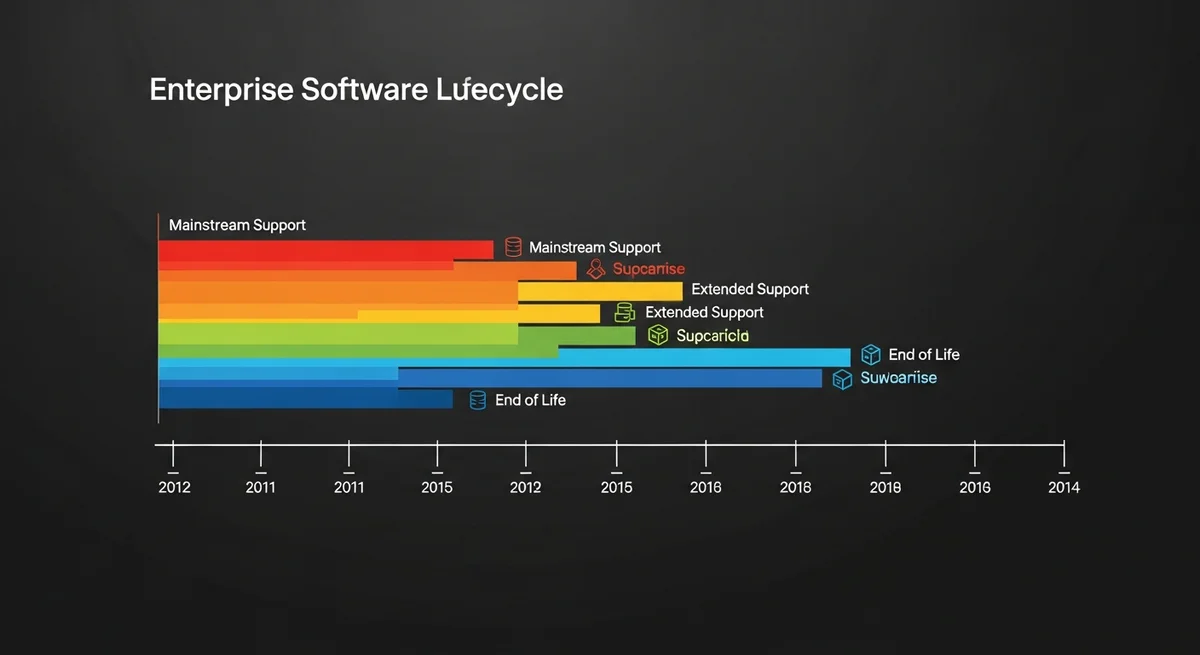
The support model is where these three distributions diverge most dramatically, and it is often the deciding factor for enterprise adoption.
RHEL Support
Red Hat offers comprehensive commercial support with RHEL subscriptions. Each major RHEL version receives 10 years of support (5 years Full Support + 5 years Maintenance Support), with an optional Extended Life Phase for critical fixes. RHEL 9, released in May 2022, receives full support through 2027 and maintenance support through 2032.
RHEL subscriptions include access to Red Hat's extensive knowledge base, certified engineers for support tickets, SLA-based response times, and tools like Red Hat Insights (proactive system analysis), Red Hat Satellite (fleet management), and OpenSCAP compliance scanning. For regulated industries that require vendor-backed support with audit trails, RHEL's support model is unmatched.
The cost, however, is significant. RHEL Server subscriptions start at approximately $349/year for self-support and scale to $1,299/year or more for premium support with 1-hour SLA response times. For large deployments, these costs accumulate rapidly.
AlmaLinux Support
AlmaLinux is completely free to use, redistribute, and modify. The AlmaLinux OS Foundation provides community support through forums, mailing lists, and chat channels. For enterprises requiring commercial support, several third-party companies offer paid AlmaLinux support packages, including TuxCare (from CloudLinux), CIQ, and OpenLogic.
AlmaLinux follows RHEL's 10-year lifecycle, providing security patches and updates in alignment with RHEL's schedule. The AlmaLinux Foundation has committed to maintaining AlmaLinux 9 through 2032, matching RHEL 9's maintenance timeline.
A notable AlmaLinux advantage is the ALBS (AlmaLinux Build System), which is fully open and transparent. Anyone can inspect the build process, verify package provenance, and understand exactly how AlmaLinux packages are produced — a level of transparency that RHEL cannot match.
Rocky Linux Support
Rocky Linux is also free and community-supported. The Rocky Enterprise Software Foundation (RESF) governs the project, and CIQ (founded by Gregory Kurtzer) offers commercial support packages. Rocky Linux matches RHEL's 10-year lifecycle, with Rocky Linux 9 supported through 2032.
Rocky Linux's Peridot build system is open-source, providing similar transparency to AlmaLinux. The project also maintains a robust mirror network and has invested in reproducible builds to verify binary identity with RHEL packages.
| Support Aspect | RHEL | AlmaLinux | Rocky Linux |
|---|---|---|---|
| Cost | $349-$1,299+/year per server | Free (paid support available) | Free (paid support available) |
| Vendor support | Red Hat (IBM) | TuxCare, CIQ, OpenLogic | CIQ, OpenLogic |
| Support lifecycle | 10 years + ELS option | 10 years (matches RHEL) | 10 years (matches RHEL) |
| Security response | Dedicated Red Hat team | Community + CloudLinux team | Community + RESF team |
| Compliance tools | Insights, Satellite, OpenSCAP | OpenSCAP compatible | OpenSCAP compatible |
| SLA availability | Up to 1-hour response | Via third-party contracts | Via CIQ contracts |
4. Governance and Long-Term Viability
For enterprise infrastructure that may run for a decade, the governance structure and financial sustainability of your chosen distribution matters enormously.
RHEL: Corporate-Backed, IBM-Owned
RHEL is developed by Red Hat, a subsidiary of IBM since 2019. This provides massive financial backing and ensures RHEL's continued development for the foreseeable future. However, IBM's ownership also means that RHEL's strategic direction is ultimately driven by corporate interests — as evidenced by the source code access restrictions in 2023.
The risk with RHEL is not that it will disappear, but that its terms may continue to shift in ways that increase cost or reduce flexibility for users. IBM's track record of monetizing acquired technology suggests that RHEL subscriptions will not become cheaper over time.
AlmaLinux: Foundation-Governed, CloudLinux-Originated
AlmaLinux is governed by the AlmaLinux OS Foundation, a 501(c)(6) non-profit with a community-elected board of directors. While CloudLinux Inc. founded the project and remains a significant contributor, the foundation structure ensures that no single company controls AlmaLinux's direction.
The foundation model provides strong governance protections: the project cannot be unilaterally discontinued, its direction is determined by community consensus, and its assets are held in trust for the community. CloudLinux's ongoing commercial interest in AlmaLinux (through TuxCare support offerings) provides financial sustainability without creating corporate dependency.
Rocky Linux: Foundation-Governed, CIQ-Affiliated
Rocky Linux is governed by the Rocky Enterprise Software Foundation (RESF). Gregory Kurtzer's company CIQ is the primary commercial entity supporting Rocky Linux development. The RESF provides governance protections similar to AlmaLinux's foundation, but the project's closer affiliation with a single commercial entity (CIQ) is sometimes cited as a potential concern.
To its credit, the RESF has established clear governance documents and processes for community participation. The project has also attracted contributions from multiple organizations beyond CIQ, including Google, Microsoft, and various cloud providers.
5. Migration Paths and Tooling

One of the most practical considerations is how easy it is to migrate between these distributions — both for initial adoption and for future flexibility.
CentOS to AlmaLinux/Rocky
Both AlmaLinux and Rocky Linux provide mature, well-tested migration tools for converting existing CentOS 7/8 systems. AlmaLinux's almalinux-deploy tool and Rocky Linux's migrate2rocky script perform in-place conversions that replace CentOS-branded packages with their respective alternatives while preserving all user data, configurations, and installed applications.
These migrations are well-documented, extensively tested, and have been performed millions of times across the industry. For organizations still running CentOS 7 (which reached end of life in June 2024), migration to AlmaLinux or Rocky Linux is the most practical path forward.
RHEL to AlmaLinux/Rocky (and Vice Versa)
Converting between RHEL and the community alternatives is also possible. AlmaLinux provides the almalinux-deploy tool for RHEL-to-AlmaLinux conversions, and Rocky Linux offers similar functionality. Going the other direction (AlmaLinux/Rocky to RHEL) requires a RHEL subscription and Red Hat's convert2rhel tool.
This bidirectional migration capability is strategically important: it means choosing AlmaLinux or Rocky Linux today does not permanently lock you out of RHEL if your requirements change in the future. Similarly, organizations currently on RHEL can evaluate the alternatives without committing to a full infrastructure rebuild.
Between AlmaLinux and Rocky Linux
Migrating between AlmaLinux and Rocky Linux is straightforward due to their shared RHEL compatibility base. While there are no official cross-migration tools, the process involves replacing branding packages and repository configurations — a relatively simple operation for experienced administrators.
6. Performance and Hardware Support
In terms of raw performance, all three distributions are essentially identical. They use the same kernel versions (within their respective release branches), the same compiler optimizations, and the same system libraries. Benchmark differences between RHEL 9, AlmaLinux 9, and Rocky Linux 9 are within the margin of measurement error.
Hardware support is also equivalent, as all three distributions use the same kernel and driver stack. If hardware works on RHEL, it works on AlmaLinux and Rocky Linux. Hardware vendor certification, however, is another matter — hardware vendors typically certify their products against RHEL, not against the community alternatives. This distinction matters more for formal compliance documentation than for actual functionality.
7. Cloud and Container Ecosystem
All three distributions are available as official images on major cloud platforms (AWS, Azure, GCP, DigitalOcean) and as container base images on Docker Hub. RHEL's Universal Base Image (UBI) is widely used for container builds and is available free of charge, even without a RHEL subscription.
For container workloads specifically, the choice of host OS matters less than the choice of container base image. Many organizations run AlmaLinux or Rocky Linux as container hosts while using RHEL UBI as their container base image — getting the best of both worlds: free host OS with a commercially supported container runtime.
8. Compliance and Regulated Industries

For organizations in regulated industries (finance, healthcare, government, defense), compliance requirements often drive distribution selection more than technical merits.
RHEL: The Compliance Gold Standard
RHEL holds certifications from numerous regulatory bodies and industry standards: Common Criteria, FIPS 140-2/140-3, DISA STIGs, FedRAMP, and PCI DSS compliance profiles. These certifications represent years of evaluation and documentation that cannot be easily replicated.
For US government contracts requiring DISA STIG compliance, RHEL is often the only officially supported option. While AlmaLinux and Rocky Linux can be configured to meet the same technical requirements (they use the same packages and security configurations), they lack the formal certifications that auditors require.
AlmaLinux and Rocky Linux: Growing Compliance Stories
Both AlmaLinux and Rocky Linux have made progress on compliance tooling. OpenSCAP profiles are available for both distributions, and CIS Benchmarks have been developed for AlmaLinux. However, neither distribution has achieved the breadth of formal certifications that RHEL carries.
For organizations in regulated industries, the practical approach is often a hybrid model: RHEL for systems that require formal certification documentation, and AlmaLinux or Rocky Linux for development, testing, and non-regulated production workloads.
9. Use Case Recommendations
Choose RHEL When:
- Regulatory compliance requires vendor-backed certifications — FIPS, Common Criteria, DISA STIGs
- ISV software requires RHEL certification — Oracle Database, SAP HANA, IBM Db2
- Your organization requires SLA-backed vendor support — 24/7 support with guaranteed response times
- You need Red Hat ecosystem tools — Satellite, Insights, Ansible Automation Platform
- Budget is not the primary concern — the value of Red Hat's support justifies the subscription cost
Choose AlmaLinux When:
- You want a community-governed, foundation-backed distribution — strong governance with no single-company dependency
- ABI compatibility is sufficient — you do not need identical binaries, just compatible ones
- You value build system transparency — ALBS provides complete visibility into the build process
- You need RHEL compatibility at zero cost — for development, testing, or non-critical production
- Web hosting and cloud workloads — CloudLinux's hosting industry heritage benefits these use cases
Choose Rocky Linux When:
- Bug-for-bug RHEL compatibility is essential — identical binaries for maximum compatibility assurance
- You are migrating from CentOS and want the closest spiritual successor — same founder, same philosophy
- Your testing pipeline requires RHEL-identical packages — QA processes that depend on binary identity
- You prefer a distribution with strong historical ties to the CentOS legacy
10. The Verdict: Which One Should You Choose?
The enterprise Linux landscape in 2026 is healthier and more competitive than it has ever been. The end of CentOS forced the community to innovate, and the result is two excellent free alternatives to RHEL that serve different needs and philosophies.
For budget-conscious organizations that need RHEL compatibility without the subscription costs, both AlmaLinux and Rocky Linux are excellent choices. AlmaLinux's ABI-compatible approach provides more independence from Red Hat's source code policies, while Rocky Linux's binary-compatible model offers maximum assurance for RHEL-dependent workloads.
For enterprises with compliance requirements, RHEL remains the safest choice when formal certifications are needed. However, a hybrid approach — RHEL for certified workloads, AlmaLinux or Rocky Linux for everything else — can significantly reduce costs while maintaining compliance where it matters.
For new deployments without legacy constraints, AlmaLinux's foundation governance, transparent build system, and reduced dependence on RHEL source access make it an increasingly compelling default choice for the enterprise Linux ecosystem.
Regardless of which distribution you choose, the fact that painless migration paths exist between all three options means your decision is not irreversible. Start with the distribution that best fits your current requirements, and know that you can adapt as your needs evolve.
Related Resources
Explore these related Dargslan resources for deeper learning:
- Rocky Linux 9 Administration — Complete guide to managing Rocky Linux servers
- AlmaLinux for Beginners — Get started with AlmaLinux from scratch
- AlmaLinux Hosting Mastery — Advanced web hosting on AlmaLinux
- Secure Web Hosting with AlmaLinux 9 — Security-focused hosting guide
- Rocky Linux 9 + Docker + Traefik — Self-hosted platform on Rocky Linux
- AlmaLinux 9 + NGINX + PHP-FPM — High-performance web stack guide
- Browse all 205+ free IT cheat sheets