Python Practice for Beginners: 250 Hands-On Exercises - 2nd Edition (2026)
What's Included:
At a Glance
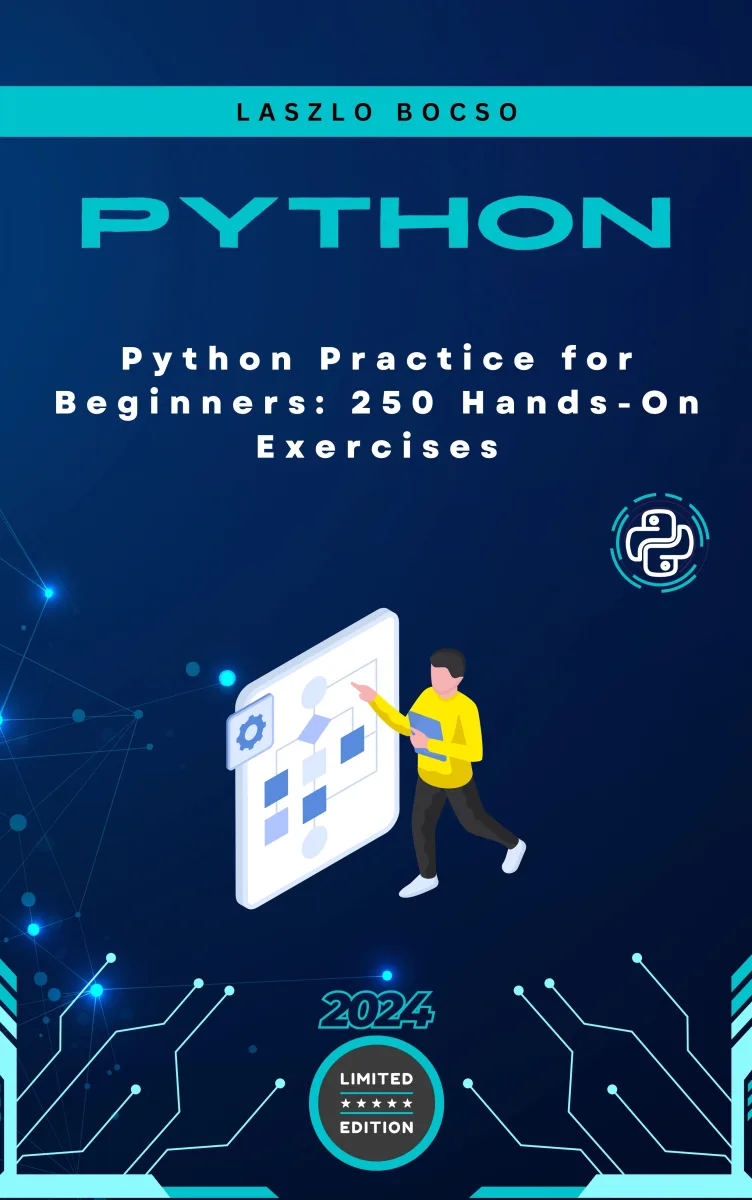
Python Practice for Beginners: 250 Hands-On Exercises - 2nd Edition (2026) is a professional Python eBook by Laszlo Bocso, 149 pages, available as an instant PDF and EPUB download for €8.90 with lifetime access and free updates. Build real Python confidence with 250 graded exercises updated for 2026 (Python 3.12+). Practice syntax, control flow (incl. match/case), functions, data struct...
- Length: 149 pages
- Format: PDF and EPUB (instant download)
- Language: English
- Topic: Python
- Edition: 2nd Edition
- Price: €8.90
Key Highlights
- 2nd Edition (2026) updated for Python 3.12+ best practices
- 250 beginner-friendly exercises with a smooth difficulty progression
- Control flow includes if/elif/else and modern match/case usage
- Type hints introduced where helpful (without overwhelming beginners)
- Modern file handling with pathlib + practical CSV exercises
- Better debugging habits using Python’s improved error messages
- Mini-projects that combine multiple skills into complete programs
- Detailed solutions and expanded appendices (tools, quick reference, resources)
Overview
Build real Python confidence with 250 graded exercises updated for 2026 (Python 3.12+). Practice syntax, control flow (incl. match/case), functions, data structures, strings, pathlib-based file I/O, error handling, and finish with mini-projects + full solutions.
The Problem
Most beginners learn Python concepts in isolation — then struggle to write code independently. Tutorials often create a false sense of understanding: you recognize syntax, but when faced with a blank editor, you don’t know how to start, how to structure the logic, or how to debug errors efficiently.
Without consistent practice, fundamentals remain fragile — and building real projects feels slow, confusing, and frustrating.
The Solution
This book gives you 250 structured, graded exercises that train you to think in Python. You’ll practice the same core ideas in multiple contexts until coding becomes natural — not memorized.
The 2nd Edition updates the content for Python 3.12+, adds match/case, introduces type hints where helpful,
uses pathlib for modern file workflows, and teaches you how to interpret Python’s improved tracebacks to debug faster.
About This Book
Python Practice for Beginners: 250 Hands-On Exercises (2nd Edition — 2026)
Learning Python is easy to start — but most beginners hit a wall when they must write code without copying examples. You may understand loops, functions, or lists in theory, yet struggle to apply them to real problems. This is exactly why this book exists.
Python Practice for Beginners: 250 Hands-On Exercises (2nd Edition — 2026) is a practice-first workbook designed to turn Python fundamentals into real coding skill through repetition, problem-solving, and hands-on implementation. Instead of long theory chapters, you get a structured sequence of exercises that build difficulty gradually — so you grow confidence without overwhelm.
Updated for Python 3.12+ and modern best practices (2026)
Since the first edition, Python has evolved rapidly. Python 3.12 and 3.13 introduced meaningful improvements in performance, error messages, and typing features — and the upcoming Python 3.14 continues that momentum. This 2nd edition reflects the modern ecosystem and teaches you beginner-friendly fundamentals using today’s idioms and tools.
What’s new in the 2nd Edition
- Modern Python 3.12+ practices: updated syntax and idioms, clearer code style, and modern standard library usage.
- Control flow with match/case: exercises include
match/casewhere it makes sense, so you learn current Python patterns. - Type hints throughout: gentle introductions to annotations where pedagogically appropriate — without overwhelming beginners.
- pathlib for file operations: modern file handling with
pathlib, alongside classic approaches for context. - Improved error handling learning: exercises leverage Python’s improved tracebacks and teach you how to read and fix errors faster.
- Expanded appendices: updated quick reference, modern tooling guidance (uv, ruff, VS Code, Jupyter), and learning resources.
- Professional tips & best-practices boxes: real-world advice sprinkled throughout to help you write cleaner, more readable code.
Why this book works
Many Python resources explain concepts well but leave a gap between understanding and doing.
You might know what an if statement is — yet freeze when faced with a real task.
This book closes that gap by training the habits that matter:
- Breaking problems into smaller steps
- Translating ideas into working code
- Debugging systematically (not guessing)
- Writing readable solutions that improve over time
This book isn’t just about getting the right answer — it’s about learning the process of reaching it. That process is what makes you independent as a programmer.
What you will practice (250 exercises)
- Basic Python syntax and operations: variables, output, arithmetic, built-in functions
- Control flow: if/elif/else,
match/case, loops, nested logic - Functions and scope: parameters, return values, reuse, closures (beginner-friendly)
- Data structures: lists, dictionaries, sets, tuples, and common algorithms
- String manipulation: slicing, methods, formatting, practical text tasks
- File I/O: reading/writing files, CSV practice, modern
pathlibworkflows - Error handling: try/except, specific exceptions, else/finally, and a gentle intro to modern patterns
Mini-projects included
At the end, you’ll build small applications that combine multiple skills into complete programs — the step that transforms “I learned Python” into “I can build with Python.”
- Simple calculator
- To-do list application
- Number guessing game
- Text-based adventure game
How to use this book
- Work through chapters sequentially — the difficulty is intentionally progressive.
- Attempt each exercise before reading solutions. Getting stuck is part of learning.
- Use Python 3.12+ and run code in VS Code, PyCharm, a terminal, or platforms like Colab/Replit.
- Compare solutions and aim for correctness + readability, not just “it works.”
- Practice consistently — even 30 minutes a day creates strong results.
Author: László Bocsó (Microsoft Certified Trainer)
Edition: 2nd Edition (2026)
Recommended Python: Python 3.12+
Includes: 250 exercises, mini-projects, detailed solutions, and modern appendices
Who Is This Book For?
- Beginners who know basic Python syntax and want confidence through repetition
- Self-learners who finished tutorials but struggle to write programs alone
- Students who want structured practice to reinforce what they learned
- Career changers preparing for junior Python roles
- Interview prep learners who want to sharpen fundamentals and problem-solving habits
- Educators who need a large, progressive exercise set with solutions
Who Is This Book NOT For?
This book is not aimed at advanced Python developers looking for deep topics such as web frameworks, data science, machine learning, advanced OOP, or large-scale system design.
It’s also not a theory-heavy textbook. The value is hands-on practice: you learn by writing code, not by reading long explanations.
Table of Contents
- Preface to the 2nd Edition: What’s New, Why This Book, Who It’s For
- Introduction: Overview, How to Use This Book, Prerequisites, Setup (2026)
- Chapter 1: Basic Python Syntax and Operations (Exercises 1–30)
- Chapter 2: Control Flow (Exercises 31–70, incl. match/case)
- Chapter 3: Functions and Scope (Exercises 71–100, incl. closures)
- Chapter 4: Data Structures (Exercises 101–140)
- Chapter 5: String Manipulation (Exercises 141–170)
- Chapter 6: File I/O (Exercises 171–200, incl. pathlib and CSV)
- Chapter 7: Basic Error Handling (Exercises 201–230, incl. modern patterns)
- Chapter 8: Mini-Projects (Exercises 231–250)
- Detailed Solutions: Complete Solutions for All Exercises
- Appendix A: Python 3.12+ Quick Reference
- Appendix B: Common Python Errors and How to Fix Them
- Appendix C: Setting Up Your Development Environment in 2026
- Appendix D: Resources for Further Learning
Requirements
- Python 3.12+ installed (recommended for the 2nd Edition)
- A code editor (VS Code or PyCharm recommended) or a terminal workflow
- Basic familiarity with Python syntax (print, variables, simple conditions)
- Willingness to attempt exercises before reading solutions