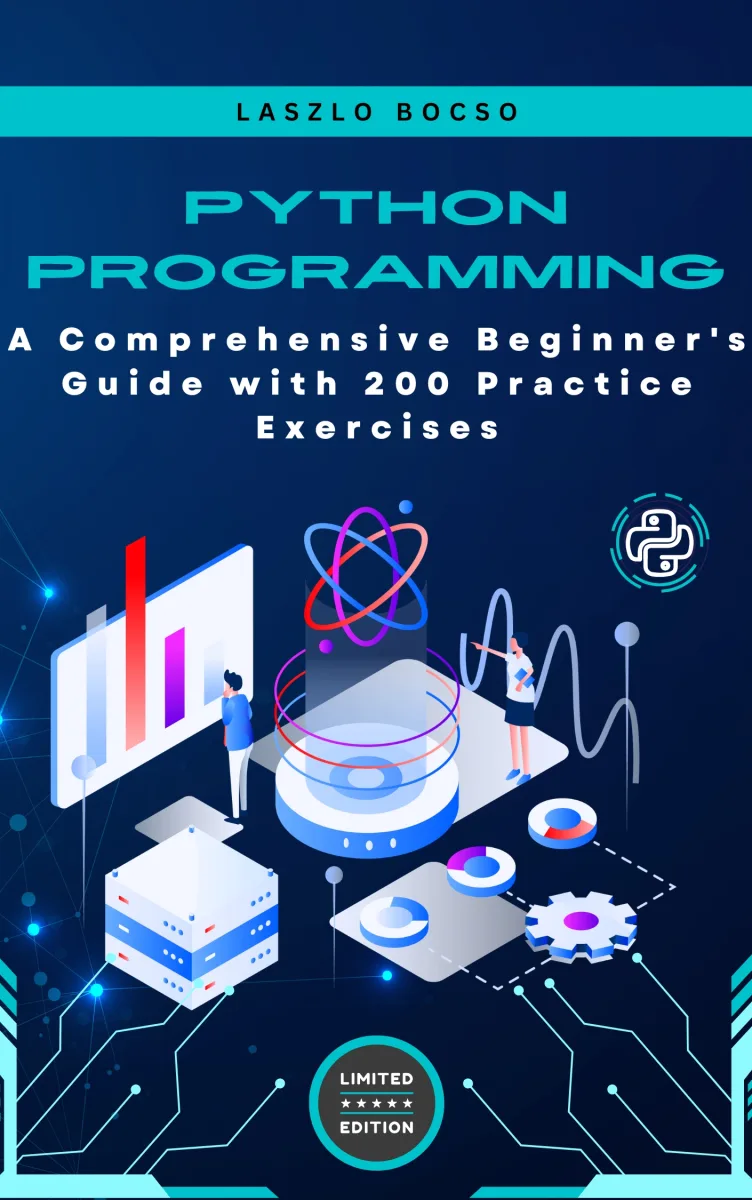
Python Programming: A Comprehensive Beginner's Guide with 200 Practice Exercises
What's Included:
At a Glance
Python Programming: A Comprehensive Beginner's Guide with 200 Practice Exercises is a professional Python eBook by Laszlo Bocso, 429 pages, available as an instant PDF and EPUB download for €9.90 with lifetime access and free updates. Beginner-friendly Python guide with 200 hands-on exercises. Learn syntax, control flow, data structures, OOP, and advanced topics through practical coding. Buil...
- Length: 429 pages
- Format: PDF and EPUB (instant download)
- Language: English
- Topic: Python
- Edition: 1st Edition
- Price: €9.90
Key Highlights
- 200 structured hands-on exercises
- Clear beginner-friendly explanations
- Step-by-step progression from basics to advanced topics
- Object-Oriented Programming fundamentals included
- File handling and exception management training
- Comprehensive integration challenges
- Ideal for self-study or classroom use
Overview
Beginner-friendly Python guide with 200 hands-on exercises. Learn syntax, control flow, data structures, OOP, and advanced topics through practical coding. Build real programming skills step by step.
The Problem
Many beginners struggle with programming because they consume tutorials without practicing enough. They understand examples while reading but freeze when asked to write code independently.
- Too much theory, not enough repetition
- Exercises that are too easy or disconnected
- Lack of progressive difficulty
- No structured problem-solving development
- Confidence gaps when coding alone
Without structured hands-on training, beginners often feel stuck between understanding and application.
The Solution
Python Programming: A Comprehensive Beginner's Guide with 200 Practice Exercises provides a structured training system that bridges theory and real-world coding ability.
- Step-by-step concept progression
- 200 carefully designed practice exercises
- Gradual increase in difficulty
- Clear explanations and practical examples
- Comprehensive integration challenges (Exercises 161–200)
Instead of passively learning Python, you actively build skill through consistent practice and reinforcement.
About This Book
Python Programming: A Comprehensive Beginner's Guide with 200 Practice Exercises is a structured, step-by-step roadmap designed to take you from complete beginner to confident Python programmer through progressive explanation and intensive hands-on practice.
Programming is not a skill learned by reading alone — it is mastered through repetition, experimentation, and solving problems. This book is built around that principle. Each concept is introduced clearly, demonstrated with practical examples, and reinforced through carefully designed exercises that build confidence and technical fluency.
What You'll Learn
- Python installation and environment setup
- Basic syntax, variables, operators, and expressions
- Conditional statements and logical problem solving
- Loops and structured control flow
- Lists, tuples, dictionaries, and sets
- Function design and modular programming
- File handling and exception management
- Object-oriented programming fundamentals
- Regular expressions and advanced constructs
- Generators, comprehensions, and decorators
- 200 structured hands-on practice exercises
Each chapter builds upon the previous one, ensuring that your knowledge grows systematically rather than overwhelming you with complexity.
By the end of this book, you won’t just understand Python — you’ll be able to write real programs with confidence.
Who Is This Book For?
- Complete beginners with no programming experience
- Students preparing for programming courses
- Career changers entering IT or software development
- Self-learners who want structured guidance
- Educators seeking an exercise-rich curriculum
Who Is This Book NOT For?
- Advanced Python developers seeking deep framework coverage
- Readers focused on Django, Flask, or machine learning libraries
- Professionals looking for advanced algorithm theory
Table of Contents
- Introduction to Python
- Basic Syntax
- Operators and Expressions
- Conditional Statements
- Loops
- Control Flow Tools
- Lists
- Tuples
- Dictionaries
- Sets
- Defining Functions
- Scope and Lifetime
- Lambda Functions
- Modules
- Standard Library Modules
- Packages
- Working with Files
- Exception Handling
- Classes and Objects
- Inheritance
- Polymorphism
- Regular Expressions
- List Comprehensions
- Generators
- Decorators
- Basic Exercises (1–20)
- Control Structure Exercises (21–40)
- Data Structure Exercises (41–80)
- Function Exercises (81–100)
- File Handling Exercises (101–120)
- OOP Exercises (121–140)
- Advanced Topic Exercises (141–160)
- Comprehensive Exercises (161–200)
Requirements
- No prior programming experience required
- A computer with Python installed
- Willingness to practice consistently