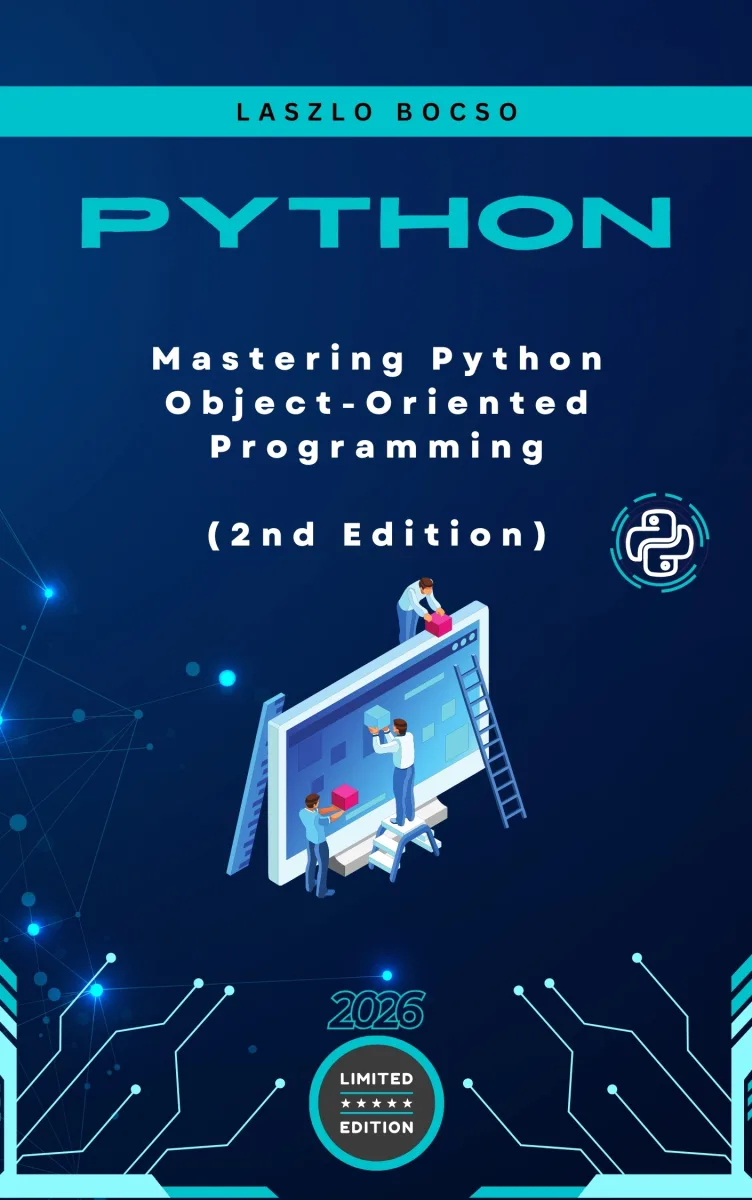
Mastering Python Object-Oriented Programming
What's Included:
At a Glance
Mastering Python Object-Oriented Programming is a professional Python eBook by Laszlo Bocso, 168 pages, available as an instant PDF and EPUB download for €6.90 with lifetime access and free updates. Deep-dive Python OOP guide from fundamentals to advanced topics. Master classes, inheritance, polymorphism, design patterns, testing, refactoring, and metaclass...
- Length: 168 pages
- Format: PDF and EPUB (instant download)
- Language: English
- Topic: Python
- Edition: 1st Edition
- Price: €6.90
Key Highlights
- Complete OOP coverage: fundamentals → advanced Python internals
- Design patterns implemented in Python (practical, not abstract)
- Testing and debugging workflows for OOP code
- Two full real-world projects (e-commerce + library system)
- Optimization and refactoring techniques
- Advanced topics: metaclasses, decorators, __slots__, object model
Overview
Deep-dive Python OOP guide from fundamentals to advanced topics. Master classes, inheritance, polymorphism, design patterns, testing, refactoring, and metaclasses with practical examples and real-world projects.
The Problem
Many developers “use OOP” in Python without truly understanding it. The result is code that works today but becomes fragile, hard to extend, and difficult to test as the project grows.
- Classes used as “data containers” without clear responsibilities
- Inheritance hierarchies that become tangled and brittle
- Hidden coupling that makes testing painful
- Misuse of advanced features (mixins, metaclasses, decorators)
- Refactoring avoided because the design is unclear
Without a structured OOP approach, Python projects often accumulate technical debt quickly.
The Solution
Mastering Python Object-Oriented Programming provides a step-by-step system to build real OOP mastery and use it correctly in Python.
- Clear progression from fundamentals to advanced topics
- Python-specific OOP best practices (not generic theory)
- Design patterns explained in practical, Pythonic form
- Testing-first thinking applied to OOP architecture
- Real projects that force you to design, not just copy examples
By the end, you won’t just recognize OOP concepts — you’ll apply them confidently to build clean, maintainable systems.
About This Book
Mastering Python Object-Oriented Programming is a complete, structured guide to becoming truly fluent in Python OOP — from first principles to expert-level techniques. Object-Oriented Programming is more than “using classes”: it’s a way of thinking that helps you model real-world systems, reduce complexity, and write code that stays maintainable as projects grow.
Python makes OOP approachable, but real mastery requires more than surface knowledge. This book takes you beyond basics and teaches you how Python’s object model actually works, how to avoid common OOP pitfalls, and how to build clean architectures that scale from small scripts to production-grade applications.
What You'll Learn
- Core OOP pillars: encapsulation, abstraction, inheritance, polymorphism
- Classes, objects, attributes, methods, and Python-specific best practices
- Multiple inheritance, mixins, @property, classmethod/staticmethod
- Design patterns (creational, structural, behavioral) implemented in Python
- Object lifecycle, garbage collection, context managers, resource control
- Testing and debugging OOP code with unittest, mocking, and practical workflows
- Two complete real-world projects (e-commerce + library management)
- Optimization and refactoring strategies for maintainable OOP systems
- Advanced topics: metaclasses, decorators in OOP, Python internal object model, __slots__
This book is designed for learners at different levels: beginners build a strong foundation, intermediates learn professional techniques, and experienced developers gain deeper insight into Python’s advanced OOP capabilities.
If you want to write Python code that is not only functional but elegant, scalable, and future-proof — this is your roadmap.
Who Is This Book For?
- Beginners who understand Python basics and want strong OOP foundations
- Intermediate developers who want to write cleaner, scalable architectures
- Advanced programmers who want metaclasses, patterns, and deeper Python object model knowledge
- Students and educators using Python in courses or structured learning
- Developers building real applications who need maintainable design
Who Is This Book NOT For?
- Readers looking for a “quick intro” to classes only
- Developers who want framework-only content (Django/Flask focus)
- People seeking mainly algorithms/data science instead of software design
Table of Contents
- Introduction: What is OOP? History, Benefits, Why Python for OOP?
- Chapter 1: Getting Started with Python OOP (Classes, Objects, __init__, Attributes, Methods)
- Chapter 2: Encapsulation and Abstraction (Access levels, getters/setters, abc module)
- Chapter 3: Inheritance (super(), overriding, multiple inheritance, best practices)
- Chapter 4: Polymorphism (overriding, operator overloading, duck typing)
- Chapter 5: Advanced OOP Concepts (classmethod, staticmethod, @property, mixins)
- Chapter 6: Design Patterns in Python (Singleton, Factory, Builder, Adapter, Decorator, Observer, Strategy, Command)
- Chapter 7: Managing Object Lifecycle (GC, context managers, __del__, resource management)
- Chapter 8: Testing and Debugging OOP Code (unittest, mocking, pdb)
- Chapter 9: Real-World Projects (E-commerce + Library Management case studies)
- Chapter 10: Optimizing and Refactoring OOP Code (bottlenecks, maintainability, tools)
- Chapter 11: Advanced Topics in Python OOP (metaclasses, decorators in OOP, object model, __slots__)
- Conclusion: Recap, Key Takeaways, Next Steps
- Appendices: Built-ins for OOP, FAQs, OOP Cheat Sheet
Requirements
- Basic Python familiarity (variables, functions, simple scripts)
- A Python 3 environment (local install or online IDE)
- Willingness to practice and build small projects while reading