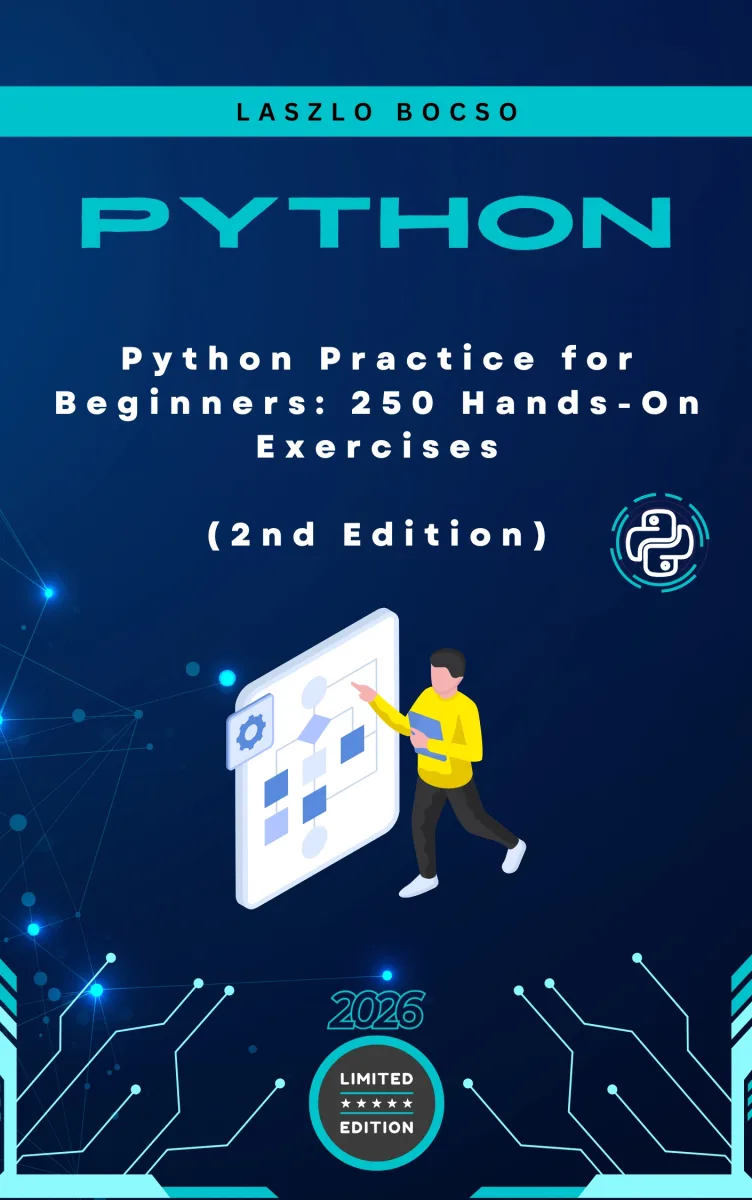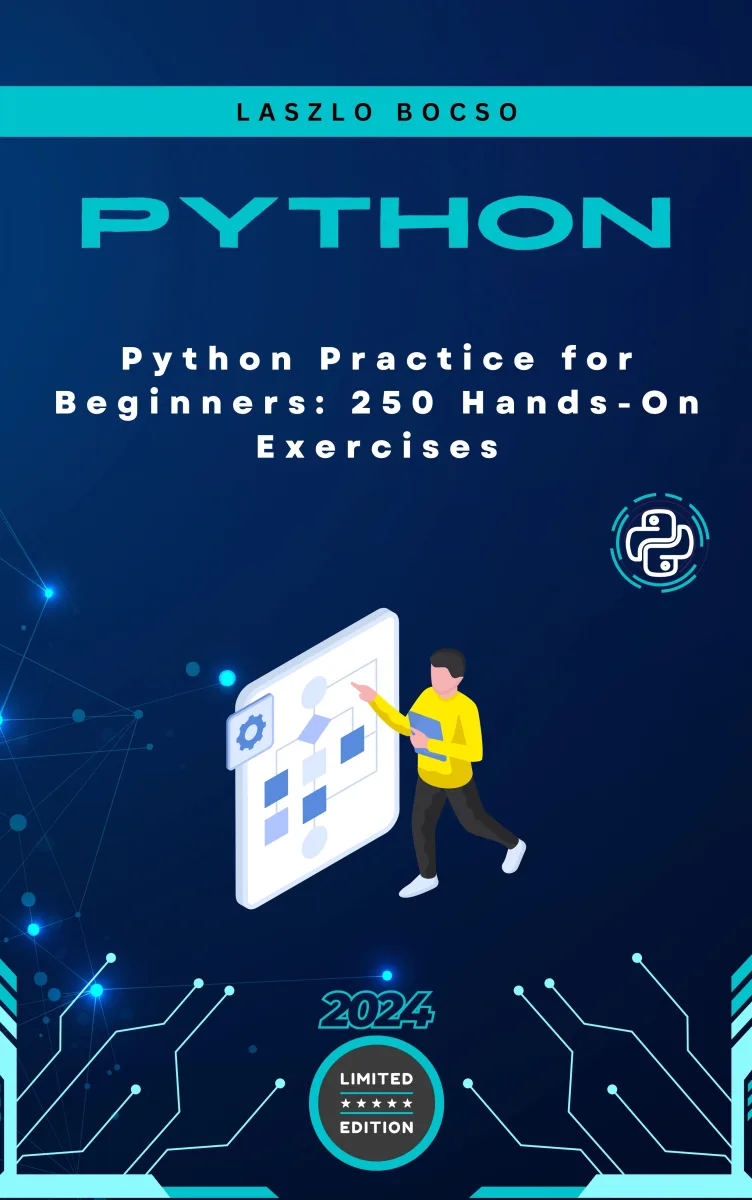
Python Practice for Beginners: 250 Hands-On Exercises
What's Included:
At a Glance
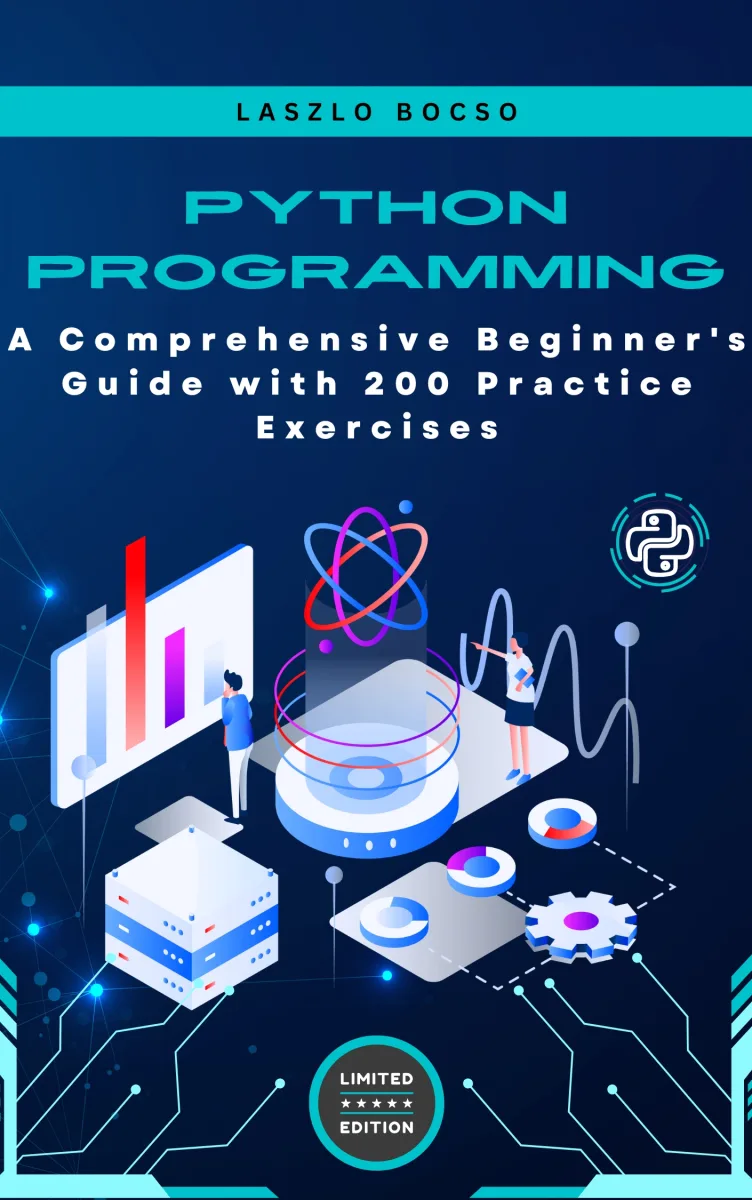
Python Practice for Beginners: 250 Hands-On Exercises is a professional Python eBook by Laszlo Bocso, 219 pages, available as an instant PDF and EPUB download for €8.90 with lifetime access and free updates. Build real Python skills through 250 beginner-friendly exercises. Practice syntax, control flow, functions, data structures, strings, file I/O, and error handli...
- Length: 219 pages
- Format: PDF and EPUB (instant download)
- Language: English
- Topic: Python
- Edition: 1st Edition
- Price: €8.90
Key Highlights
- 250 beginner-friendly exercises with a smooth difficulty progression
- Practice-first approach: learn by writing code, not just reading theory
- Strong coverage of core fundamentals: syntax, control flow, functions, data structures
- Real-world string, file, and CSV tasks to build practical confidence
- Beginner error handling patterns (try/except, else, finally)
- Mini-projects that combine skills into complete programs
- Great for self-study, classrooms, bootcamps, and interview prep
Overview
Build real Python skills through 250 beginner-friendly exercises. Practice syntax, control flow, functions, data structures, strings, file I/O, and error handling—then apply everything in mini-projects with clear, practical learning progression.
The Problem
Many beginners “understand Python” in theory, but struggle to write programs without copying code. Tutorials often teach concepts, yet don’t provide enough repetition to build confidence. As a result, learners get stuck when they face real tasks: they don’t know how to start, how to structure the solution, or how to debug errors.
Without hands-on practice, fundamentals remain fragile — and progress toward real projects becomes slow and frustrating.
The Solution
This book provides 250 structured exercises that train your brain to think in code. You’ll practice the same core concepts in many different ways — gradually increasing difficulty — until writing Python becomes natural.
You’ll also build mini-projects that combine multiple topics into complete programs, helping you transition from “learning syntax” to “building working software.”
About This Book
Python Practice for Beginners: 250 Hands-On Exercises
Learning Python is easy to start — but hard to truly master without practice. Watching tutorials and reading theory can give you confidence, yet many beginners get stuck the moment they have to write code from scratch. This book solves that problem by giving you what most learners need most: consistent, structured, hands-on practice.
Python Practice for Beginners: 250 Hands-On Exercises is built around one simple idea: programming is a skill learned by doing. Instead of long theoretical chapters, you’ll work through carefully designed exercises that strengthen your fundamentals step-by-step — from basic syntax to mini-projects that feel like real coding tasks.
Why this book works
Many Python resources explain concepts well, but leave a gap between understanding and applying. You might know what an if statement is,
yet struggle to use it to solve a real problem. You might understand lists and dictionaries, yet not know how to combine them in a useful program.
This book bridges that gap by training you to think like a programmer:
- Break problems into smaller steps
- Translate ideas into working code
- Debug mistakes confidently
- Write cleaner, more efficient solutions over time
You won’t just “get the right answer.” You’ll learn the process of reaching it — the habit that turns beginners into confident developers.
What you will practice
The exercises cover the core foundations every Python developer must master. Each chapter begins with simple tasks and gradually increases difficulty, so you build momentum and skill without getting overwhelmed.
- Basic Python syntax and operations: variables, printing, arithmetic, built-in functions
- Control flow: if/elif/else, for/while loops, nested logic
- Functions and scope: parameters, return values, reusable logic, variable scope
- Data structures: lists, dictionaries, sets, tuples, and common operations
- String manipulation: slicing, methods, formatting, real-world text tasks
- File I/O: reading and writing files, working with CSV data
- Error handling: try/except, specific exceptions, else/finally patterns
- Mini-projects: small apps that combine multiple skills into working programs
Mini-projects included
To turn practice into real capability, the final chapter includes mini-projects that bring everything together. These projects help you learn how to combine skills into complete programs — which is where many beginners struggle.
- Simple calculator
- To-do list application
- Number guessing game
- Text-based adventure game
How to use this book
To get the best results, attempt each exercise on your own before looking at solutions. Getting stuck is part of learning — debugging and problem-solving are core programming skills. Use the solutions as guidance, then try to write your own variation of the same exercise to reinforce the concept.
This book works well for self-study, classroom practice, coding bootcamps, and interview preparation. You can follow it from Exercise 1 to 250, or jump to the chapter that matches your current learning goals.
Author: László Bocsó (Microsoft Certified Trainer)
Format: Practice-focused exercise book with solutions and mini-projects
Goal: Turn Python fundamentals into real coding confidence through repetition and structured challenges
Who Is This Book For?
- Beginners who know basic Python syntax and want real practice
- Self-learners who finished tutorials but still feel unsure writing code alone
- Students who want structured exercises to reinforce class material
- Career changers building confidence for junior developer roles
- Interview prep learners who want repetition in core Python fundamentals
- Educators who need a large collection of graded beginner exercises
Who Is This Book NOT For?
This book is not ideal if you are looking for advanced Python topics (web frameworks, data science, machine learning, complex OOP). It focuses on beginner fundamentals and practice-driven skill building.
It’s also not for readers who want theory-heavy explanations without exercises. The main value here is repetition and hands-on problem solving.
Table of Contents
- Introduction: Overview, How to Use This Book, Prerequisites
- Basic Python Syntax and Operations (Exercises 1–30)
- Control Flow (Exercises 31–70)
- Functions and Scope (Exercises 71–100)
- Data Structures (Exercises 101–140)
- String Manipulation (Exercises 141–170)
- File I/O (Exercises 171–200)
- Basic Error Handling (Exercises 201–230)
- Mini-Projects (Exercises 231–250)
- Solutions
- Appendices: Quick Reference, Common Errors, Further Resources
Requirements
- A computer with Python installed (Python 3.x recommended)
- Basic understanding of Python syntax (variables, print, simple expressions)
- A code editor (VS Code, PyCharm, or any editor you like)
- Willingness to practice consistently and attempt exercises before reading solutions