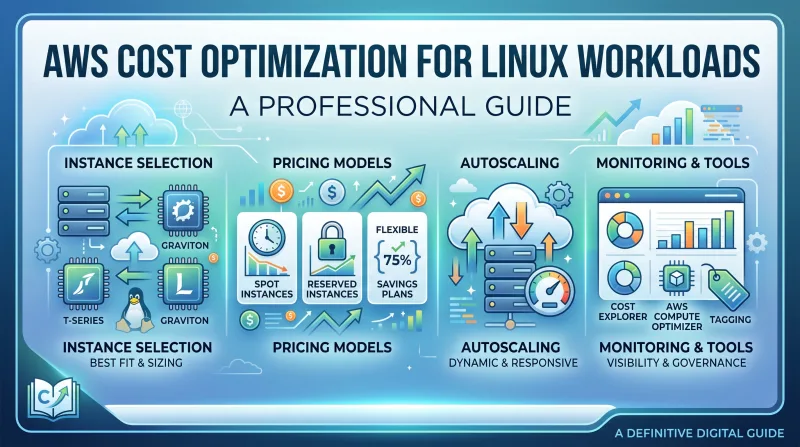
AWS Cost Optimization for Linux Workloads
Cut Your AWS Bill by 30–60% Without Breaking Production
What's Included:
At a Glance
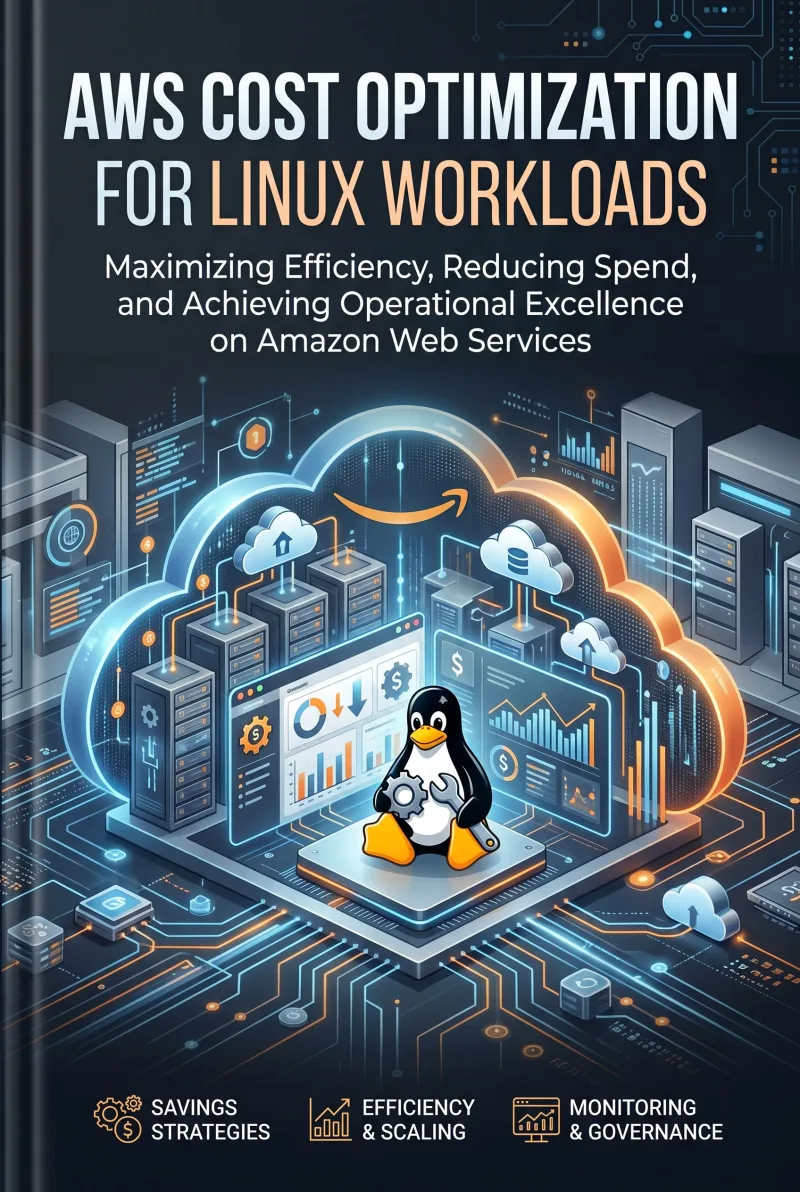
AWS Cost Optimization for Linux Workloads is a professional AWS (Amazon Web Services) eBook by Elliot Mercer, 191 pages, available as an instant PDF and EPUB download for €4.90 with lifetime access and free updates. Cut Your AWS Bill by 30–60% Without Breaking Production.
- Length: 191 pages
- Format: PDF and EPUB (instant download)
- Language: English
- Topic: AWS (Amazon Web Services)
- Edition: 1st Edition
- Price: €4.90
Key Highlights
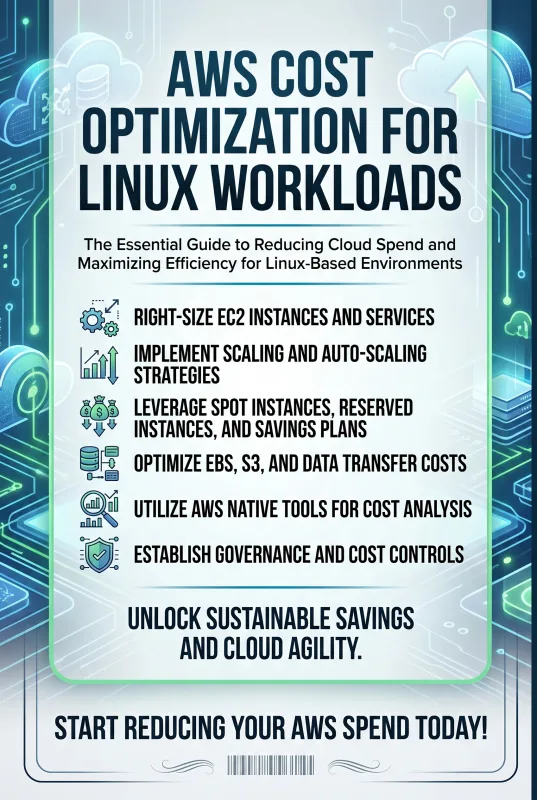
- Proven methodology to cut AWS bills by 30–60% without production impact
- Linux-specific guidance across EC2, EBS, S3, networking, and backups
- EC2 right-sizing workflows that preserve performance and reliability
- Complete waste elimination playbook for idle and forgotten resources
- EBS volume, IOPS, and throughput optimization strategies
- S3 storage class and lifecycle policy deep-dive
- Hidden data transfer costs — how to find them and eliminate them
- Cost-saving architectural patterns built for Linux workloads
- Environment scheduling: stop paying for dev and staging 24/7
- Tagging strategies and governance models that actually scale
- Safe automation patterns that reduce cost without causing outages
- Real-world case studies with measurable before-and-after results
- Lessons learned from cost optimization projects that went wrong
- Practical monitoring approaches so you measure before you cut
- Designed for engineers who ship — zero fluff, maximum signal
Overview
Stop watching your AWS bill grow uncontrollably. This practical guide shows Linux engineers and DevOps teams how to cut AWS costs by 30–60% without sacrificing reliability — through right-sizing, waste elimination, smart architecture, and safe automation.
The Problem
Your AWS bill keeps growing, and nobody on the team can fully explain why. Instances multiply across accounts. EBS volumes linger long after the workloads that needed them are gone. Snapshots pile up from forgotten projects. NAT Gateway and cross-AZ data transfer charges appear from corners of the architecture no one remembers building.
You've tried the obvious fixes — maybe bought some Reserved Instances, maybe deleted a few old resources — but the savings never seem to stick. Meanwhile, finance is asking uncomfortable questions, leadership wants a number, and every engineer on the team has an opinion but no clear plan.
The problem isn't that AWS is expensive. The problem is that cost optimization has never been treated as a real engineering discipline — so waste compounds silently, and every month you pay for decisions that were never really made.
The Solution
AWS Cost Optimization for Linux Workloads gives you a complete, engineer-friendly methodology for systematically reducing your AWS bill by 30–60% — without breaking a single production workload.
Instead of vague frameworks or finance-driven checklists, this book teaches you to see your Linux infrastructure through a cost lens: understanding which architectural choices drive spend, which ones silently waste money, and which ones deliver the best performance per dollar.
You'll get:
- A structured, chapter-by-chapter playbook covering compute, storage, networking, S3, and backups
- Concrete right-sizing techniques that preserve reliability and performance
- Waste elimination strategies for idle resources, forgotten volumes, and orphaned snapshots
- Cost-aware architectural patterns built specifically for Linux workloads
- Safe automation approaches that cut cost without causing outages
- Governance and tagging models that make cost everyone's responsibility
- Real-world case studies with measurable before-and-after results
By the end, you'll have a repeatable system you can apply to any AWS environment — from a single-account startup to a multi-account enterprise landing zone.
About This Book
Take Control of Your AWS Bill Before It Controls You
Every month, thousands of engineering teams open their AWS invoice with a mix of anxiety and confusion. Instances they don't remember launching. Volumes attached to nothing. Snapshots from projects that ended a year ago. NAT Gateway charges that seem to grow on their own. The infrastructure works — but the cost keeps climbing, and nobody can fully explain why.
AWS Cost Optimization for Linux Workloads is the definitive hands-on guide for engineers, SREs, DevOps practitioners, and technical leaders who are tired of watching their cloud spend spiral out of control. Written specifically for teams running Linux workloads on AWS, this book delivers a clear, repeatable methodology for reducing your bill by 30–60% without breaking production.
Cost Optimization Is an Engineering Discipline — Not a Finance Problem
Most teams treat cost as something finance worries about after the fact. This book takes a fundamentally different approach: every idle EC2 instance, oversized EBS volume, forgotten snapshot, and unnecessary cross-AZ data transfer is a technical decision with a financial consequence. When you learn to see your architecture through a cost lens, optimization becomes systematic rather than reactive.
You'll learn to identify the exact architectural choices that drive spend, quietly waste money, or deliver the best performance per dollar — and then you'll learn how to fix them safely, at scale, without destabilizing the workloads your business depends on.
What You'll Learn
This book takes you from understanding to action across 15 focused chapters:
- Why AWS costs spiral — the hidden mechanisms that cause bills to grow quietly over time
- How AWS pricing actually works — beyond the marketing, the real cost model you need to master
- Mapping Linux workloads to cost drivers — know exactly where your money goes
- EC2 right-sizing without breaking production — shrink instances safely with confidence
- Eliminating idle and forgotten resources — the single largest source of avoidable AWS cost
- Storage cost optimization — EBS volumes, IOPS, throughput, and filesystem choices that save thousands
- S3 and backup optimization — lifecycle policies, storage classes, and retention strategies that actually work
- Network and data transfer awareness — catching the costs AWS makes hardest to see
- Cost-saving design patterns — Linux architectures that are cheap by default
- Environment scheduling — stop paying for dev and staging 24/7
- Monitoring before cutting — because you cannot optimize what you cannot measure
- Governance, tagging, and accountability — making cost everyone's responsibility
- Safe automation — scripts and tooling that cut cost without causing outages
- Mistakes that hurt reliability — hard-won lessons from optimization gone wrong
- Real-world projects — complete case studies you can model and adapt
A Practical, Battle-Tested Playbook
This isn't theory. Every chapter is grounded in real-world optimization projects — the successes that cut bills in half and the failures that taught painful lessons. You'll get concrete techniques, command-line examples, architectural patterns, and decision frameworks that you can apply on Monday morning.
The focus stays squarely on Linux workloads: EC2 instance families for Linux, EBS optimization for ext4 and xfs, kernel-level tuning that affects cost, container economics, and the operational patterns that keep Linux environments lean.
Built for Engineers Who Ship
This book respects your time. It doesn't lecture about FinOps frameworks or drown you in theoretical maturity models. It gives you what works, why it works, and how to do it safely — so you can get back to building.
By the end, you'll have a repeatable playbook for reducing and controlling AWS cost at any scale — whether you're managing a single-account startup environment or a multi-account enterprise landing zone.
Stop Overpaying AWS. Start Engineering for Cost.
Your AWS bill is not destiny. It's the output of thousands of small engineering decisions — and every one of them can be optimized. This book shows you how.
Who Is This Book For?
- DevOps engineers and SREs running Linux workloads on AWS who are tired of watching their bill grow
- Cloud architects who want to design cost-efficient Linux infrastructure from day one
- Engineering managers and tech leads who need to answer "why is our bill so high?" with confidence
- Platform and infrastructure teams responsible for AWS cost across multiple accounts or business units
- Startup CTOs and founding engineers who need to extend runway without sacrificing velocity
- Senior Linux sysadmins transitioning from on-prem into cloud-native cost accountability
- FinOps practitioners who want deeper technical grounding in what engineers actually control
- Consultants and contractors tasked with AWS cost reduction projects for clients
Who Is This Book NOT For?
- Absolute AWS beginners — this book assumes working familiarity with EC2, EBS, S3, and basic Linux administration
- Windows-only environments — the focus is specifically Linux workloads; Windows-specific cost patterns are not covered
- Azure or GCP users — while many principles transfer, every example, service, and pricing detail is AWS-specific
- Pure finance or procurement professionals looking for contract negotiation or EDP strategy — this is an engineering book, not a vendor management guide
- Teams looking for a "magic tool" recommendation — this book teaches methodology, not a single SaaS product
- Readers expecting academic FinOps theory — the emphasis is hands-on, practical, and action-oriented
Table of Contents
- Why AWS Costs Get Out of Control
- Understanding the AWS Cost Model
- Mapping Linux Workloads to Cost Drivers
- EC2 Right-Sizing Without Breaking Production
- Eliminating Idle and Forgotten Resources
- Storage Cost Optimization for Linux Systems
- S3 and Backup Cost Optimization
- Network and Data Transfer Cost Awareness
- Cost-Saving Design Patterns for Linux Workloads
- Scheduling and Environment Control
- Monitoring Usage Before Cutting Cost
- Governance, Tagging, and Accountability
- Safe Automation for Cost Reduction
- Cost Optimization Mistakes That Hurt Reliability
- Real-World Cost Reduction Projects
Requirements
- Working familiarity with core AWS services (EC2, EBS, S3, VPC)
- Basic Linux command-line proficiency (bash, common utilities, systemd)
- Understanding of fundamental cloud concepts (regions, AZs, IAM, security groups)
- Access to an AWS account or environment where you can review usage and apply changes
- Ability to read basic shell scripts and AWS CLI commands
- No prior FinOps, cost engineering, or financial background required
- No specific certifications required — practical experience is enough