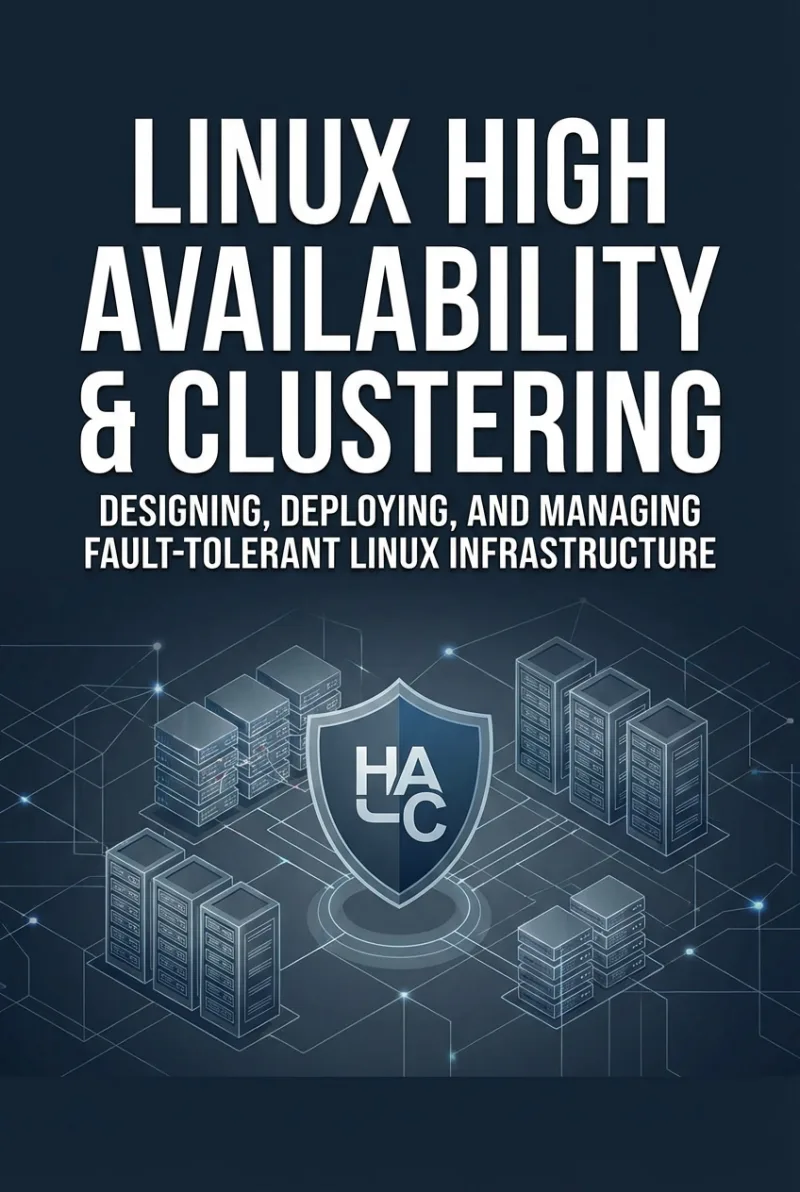
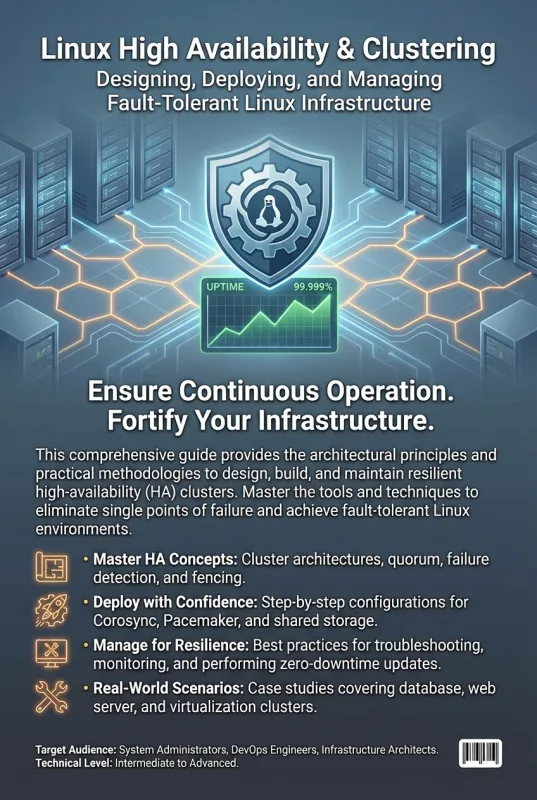



Linux High Availability & Clustering
Designing, Deploying, and Managing Fault-Tolerant Linux Infrastructure
What's Included:
At a Glance
Linux High Availability & Clustering is a professional Linux Servers eBook by Bas van den Berg, 356 pages, available as an instant PDF and EPUB download for €10.90 with lifetime access and free updates. Designing, Deploying, and Managing Fault-Tolerant Linux Infrastructure.
- Length: 356 pages
- Format: PDF and EPUB (instant download)
- Language: English
- Topic: Linux Servers
- Edition: 1st Edition
- Price: €10.90
Key Highlights
- High availability architecture fundamentals
- Corosync cluster communication setup
- Pacemaker resource management configuration
- DRBD real-time replication
- Shared storage strategies
- Fencing and split-brain prevention
- Quorum management and cluster integrity
- HA web service deployment
- HA database architecture
- Cluster monitoring and automation
- Multi-site failover design
- Production-ready HA design frameworks
Overview
Design and deploy fault-tolerant Linux clusters using Corosync, Pacemaker, and DRBD. Build highly available web and database services with fencing, quorum, and multi-site failover.
The Problem
Many Linux environments are built for functionality—not resilience. Services run well under normal conditions, but fail catastrophically when hardware, storage, or networks encounter issues.
Common problems include:
- Single points of failure in web or database services
- Misconfigured clusters vulnerable to split-brain scenarios
- Lack of fencing and quorum safeguards
- Unreliable failover procedures
- No documented failover test plans
Without structured high availability design, outages become longer, riskier, and more expensive.
The Solution
Linux High Availability & Clustering provides a structured, production-focused roadmap to building reliable Linux clusters.
You will learn how to:
- Architect safe and resilient cluster topologies
- Deploy Corosync and Pacemaker correctly
- Implement DRBD replication without risking data integrity
- Configure fencing and quorum policies safely
- Build highly available web and database stacks
- Design and test multi-site failover strategies
The result: predictable failover, protected data, and infrastructure that withstands real-world failures.
About This Book
Linux High Availability & Clustering is a practical guide to designing, deploying, and managing fault-tolerant Linux infrastructure using proven open-source clustering technologies.
Downtime is expensive. Whether you manage web applications, databases, or mission-critical enterprise services, high availability is no longer optional. Linux provides powerful tools to build resilient systems—but those tools must be understood, combined correctly, and tested under failure conditions.
This book shows you how.
Master Linux Clustering Technologies
You will gain deep, practical knowledge of:
- Corosync for reliable cluster communication
- Pacemaker for intelligent resource management
- DRBD for real-time data replication
- Fencing and quorum mechanisms for data protection
Build Real Highly Available Services
Move beyond theory and implement:
- Highly available web services
- Highly available database deployments
- Shared storage and replicated storage strategies
- Load balancing and horizontal scaling models
Design for Failure
Production-ready HA systems require disciplined design. You will learn how to:
- Prevent split-brain scenarios
- Implement safe fencing policies
- Monitor cluster health effectively
- Automate cluster operations
- Design multi-site failover architectures
This book equips you to build Linux infrastructure that survives hardware failures, network partitions, and software crashes.
Who Is This Book For?
- Linux system administrators managing production services
- Infrastructure engineers building resilient platforms
- Site reliability engineers (SREs)
- DevOps professionals implementing failover strategies
- IT architects designing multi-site Linux deployments
Who Is This Book NOT For?
- Beginner Linux users without admin experience
- Readers seeking desktop Linux tutorials
- Developers looking for application-level HA only
- Cloud-only practitioners not working with Linux infrastructure
Table of Contents
- Understanding High Availability Concepts
- Linux Clustering Architecture
- Corosync and Cluster Communication
- Pacemaker Resource Management
- Shared Storage Concepts
- DRBD and Data Replication
- Highly Available Web Services
- Highly Available Databases
- Understanding Fencing
- Quorum and Cluster Integrity
- Monitoring HA Clusters
- Automating Cluster Operations
- Multi-Site High Availability
- Load Balancing and Scaling
- Designing Production-Ready HA Infrastructure
- From System Administrator to Infrastructure Architect
- Appendix: Pacemaker Command Cheat Sheet
- Appendix: HA Design Checklist
- Appendix: Fencing Configuration Template
- Appendix: Failover Test Plan Template
- Appendix: Linux Infrastructure Career Path
Requirements
- Solid Linux system administration experience
- Comfort with the Linux command line
- Access to at least two Linux virtual machines for testing
- Basic networking knowledge