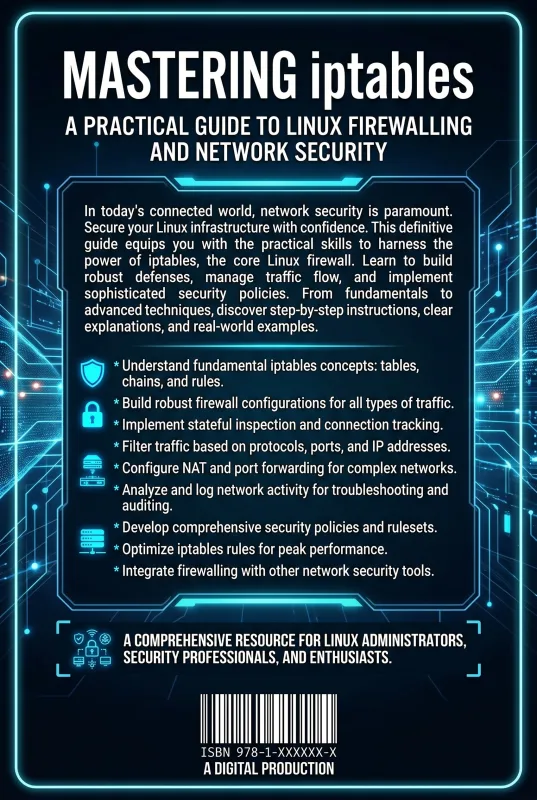
Mastering iptables: A Practical Guide to Linux Firewalling and Network Security
What's Included:
At a Glance
Mastering iptables: A Practical Guide to Linux Firewalling and Network Security is a professional Linux Security eBook by Ethan Marshall, 158 pages, available as an instant PDF and EPUB download for €6.90 with lifetime access and free updates. Master iptables from the ground up. Learn to design, deploy, and maintain robust Linux firewalls — from packet flow fundamentals to advanced NAT, rate limiting,...
- Length: 158 pages
- Format: PDF and EPUB (instant download)
- Language: English
- Topic: Linux Security
- Edition: 1st Edition
- Price: €6.90
Key Highlights
- Complete coverage of iptables — tables, chains, targets, and every major match module
- Deep dive into stateful packet inspection and connection tracking
- Hands-on NAT, masquerading, and port forwarding scenarios
- Practical defenses against SYN floods, brute-force, and DDoS attacks
- Tailored firewall configurations for servers, workstations, and gateways
- Professional logging, monitoring, and troubleshooting techniques
- Automation, persistence, and integration with configuration management
- Real-world projects bringing all concepts together
- Best practices and a roadmap for continued growth in Linux security
- Copy-paste-ready scripts and configuration examples throughout
Overview
Master iptables from the ground up. Learn to design, deploy, and maintain robust Linux firewalls — from packet flow fundamentals to advanced NAT, rate limiting, and real-world hardening scenarios.
The Problem
Linux systems are constantly exposed to network threats — port scans, brute-force attacks, unauthorized connections, and increasingly sophisticated intrusions. Yet most administrators rely on default firewall configurations, copy-pasted rules they don't fully understand, or high-level wrappers that hide what's really happening underneath.
When something goes wrong — a service is unreachable, traffic is mysteriously dropped, or an attack slips through — they're left guessing. The result? Security gaps, downtime, and the constant anxiety of not really knowing whether your firewall is doing its job.
Surface-level tutorials and cheat sheets won't solve this. To truly secure Linux systems, you need to understand how packets flow through the kernel, how iptables rules are evaluated, and how to design defenses that actually work.
The Solution
Mastering iptables gives you the deep, practical understanding needed to design, deploy, and maintain professional-grade Linux firewalls with absolute confidence.
Across 20 carefully structured chapters, you'll progress from networking fundamentals to advanced techniques like stateful inspection, NAT, rate limiting, and attack mitigation. Every concept is explained clearly, reinforced with real commands, and applied to real-world scenarios — from securing single servers to building multi-interface gateways.
By the end of this book, you won't just know iptables commands — you'll understand the principles behind them, allowing you to adapt and design firewall solutions for any environment you encounter.
About This Book
Take Full Control of Your Linux Network Security with iptables
In today's threat landscape, where cyberattacks grow more sophisticated by the day, the ability to control exactly what enters and leaves your Linux systems is no longer a luxury — it is a fundamental skill. Mastering iptables: A Practical Guide to Linux Firewalling and Network Security is the comprehensive, hands-on resource you need to confidently design, deploy, and maintain production-grade firewalls on any Linux system.
Whether you are a system administrator hardening a fleet of servers, a DevOps engineer building secure cloud infrastructure, a security professional auditing network defenses, or a developer who simply wants to understand how Linux networking really works, this book delivers the depth, clarity, and practical guidance you need to truly master iptables.
Why iptables — And Why This Book?
Despite the rise of newer tools like nftables, firewalld, and ufw, iptables remains the foundational firewall technology powering millions of production Linux systems worldwide. Understanding iptables is not just about learning syntax — it's about gaining a deep understanding of how the Linux kernel processes network packets, how connection tracking works, and how to architect security policies that stand up to real-world threats.
This book is built on a simple but powerful philosophy: mastery comes from understanding, not memorization. Rather than throwing commands at you and hoping they stick, every concept is carefully explained, illustrated with real-world examples, and reinforced with hands-on exercises. By the end of this book, you won't just know what to type — you will understand why each rule matters and how to adapt it to any scenario you encounter.
What You Will Learn
Across twenty carefully structured chapters, you will progress from the absolute basics of Linux networking to the most advanced firewall techniques used in enterprise environments:
- Linux Networking Fundamentals — Understand how packets flow through the Linux kernel, the role of the netfilter framework, and the relationship between network interfaces, routing, and filtering.
- iptables Architecture — Master the complete model of tables, chains, and targets. Learn the differences between filter, nat, mangle, raw, and security tables, and when to use each.
- The Complete Command Set — Become fluent in every iptables command, option, and flag. Build, modify, save, and restore rule sets with confidence.
- Stateful Firewalling — Leverage connection tracking (conntrack) to build intelligent firewalls that understand the state of every connection — NEW, ESTABLISHED, RELATED, and INVALID.
- NAT and Port Forwarding — Implement source NAT (SNAT), destination NAT (DNAT), masquerading, and complex port forwarding scenarios for routers and gateways.
- Logging and Monitoring — Configure detailed logging, analyze packet flows, and integrate iptables with system monitoring tools to detect anomalies and intrusions.
- Attack Mitigation — Defend against SYN floods, port scans, brute-force attacks, and DDoS attempts using rate limiting, connection limits, and advanced match modules.
- Real-World Hardening — Apply tailored firewall configurations for web servers, database servers, workstations, multi-homed gateways, and SSH bastion hosts.
- Automation and Persistence — Persist rules across reboots, automate deployment with scripts and configuration management tools, and integrate iptables into CI/CD pipelines.
- Troubleshooting — Systematically diagnose firewall issues using packet tracing, counters, and logs. Learn the techniques professionals use to debug complex rule sets.
A Hands-On, Practical Approach
Theory without practice is useless in the world of system administration. That's why this book is packed with real commands, real configurations, and real scenarios drawn from production environments. Every chapter includes:
- Step-by-step examples you can run on any Linux system
- Complete, copy-paste-ready firewall scripts
- Real-world case studies showing how to solve common problems
- Best practices distilled from years of professional experience
- Troubleshooting tips and common pitfalls to avoid
From Beginner to Expert — A Structured Journey
The book is organized into four progressive parts that take you from foundational knowledge to expert-level mastery:
Part 1 — Foundations (Chapters 1–4): Build a rock-solid understanding of Linux networking, the netfilter framework, and the complete iptables architecture before writing a single rule.
Part 2 — Practical Firewalling (Chapters 5–9): Construct your first working firewalls, filter by ports and addresses, leverage connection state, and implement powerful NAT scenarios.
Part 3 — Advanced Techniques (Chapters 10–12): Add professional polish with comprehensive logging, intelligent rate limiting, and the most powerful match modules iptables has to offer.
Part 4 — Real-World Mastery (Chapters 13–20): Apply everything you've learned to secure servers, workstations, routers, and SSH services. Master troubleshooting, automation, and explore real-world projects that bring it all together.
Who Should Read This Book?
This book is written for anyone who wants to take serious control of their Linux network security. It is especially valuable for system administrators managing Linux servers, DevOps and SRE engineers building secure infrastructure, security professionals auditing and hardening systems, network engineers transitioning to Linux-based firewalling, and advanced Linux users who want to understand how their systems really work under the hood.
While prior Linux command-line experience is helpful, the book starts with networking fundamentals and builds up gradually, making it accessible to motivated beginners while still offering substantial value to experienced professionals.
What Makes This Book Different?
The internet is full of iptables tutorials, cheat sheets, and quick-start guides. So why this book? Because quick fixes don't make experts. This book is for people who want to genuinely understand iptables — to be the person their team turns to when something goes wrong, to be able to design custom solutions for unique environments, and to confidently secure systems that matter.
You won't find recycled blog posts or shallow command listings here. Every chapter has been carefully crafted to build understanding layer by layer, with the kind of depth and clarity you'd expect from a seasoned mentor sitting beside you.
Future-Proof Your Skills
Even as nftables gradually replaces iptables in newer distributions, the concepts you learn in this book — packet flow, stateful inspection, NAT, chain logic, and security policy design — remain directly applicable. Mastering iptables is the fastest path to mastering Linux firewalling in general, and the knowledge you gain here will serve you for years to come.
Start Your Journey to Firewall Mastery Today
Network security is too important to leave to default configurations or copy-pasted rules you don't understand. With Mastering iptables, you'll gain the confidence, knowledge, and practical skills to take full control of your Linux network defenses. Whether you're protecting a single server or an entire datacenter, this book is your trusted companion on the path to true firewall mastery.
Open the first chapter, fire up your terminal, and let's begin.
Who Is This Book For?
- System administrators hardening Linux servers in production
- DevOps and SRE engineers building secure cloud infrastructure
- Security professionals auditing and improving network defenses
- Network engineers transitioning to Linux-based firewalling
- Developers who want to understand how Linux networking really works
- Students and self-taught learners pursuing a career in cybersecurity
- Anyone managing Linux systems who wants real control over network traffic
Who Is This Book NOT For?
- Readers looking for a 5-minute quick-start cheat sheet
- Users who only want a graphical firewall tool with no command-line involvement
- Those who prefer abstraction layers (ufw, firewalld) without understanding the underlying mechanics
- Beginners with no interest in learning Linux command-line basics
- Readers seeking exclusively nftables-focused content (this book covers iptables in depth)
Table of Contents
- Introduction to iptables
- Linux Networking Basics
- Understanding iptables Architecture
- Getting Started with iptables Commands
- Building a Basic Firewall
- Working with Ports and Services
- Source and Destination Filtering
- Connection Tracking
- NAT and Port Forwarding
- Logging and Monitoring
- Rate Limiting and Attack Protection
- Advanced Match Modules
- Firewall Rules for Servers
- Firewall Rules for Workstations
- iptables for Routers and Gateways
- Securing SSH with iptables
- Troubleshooting iptables
- Automation and Persistence
- Real-World Firewall Projects
- Best Practices and Next Steps
Requirements
- A Linux system (any modern distribution — Debian, Ubuntu, CentOS, Fedora, etc.)
- Basic familiarity with the Linux command line
- Root or sudo access to practice firewall configurations
- Fundamental understanding of TCP/IP networking (IP addresses, ports, protocols)
- A text editor of your choice (vim, nano, VS Code, etc.)
- Curiosity and willingness to experiment hands-on