Quick summary: All three give you a flat encrypted network connecting devices across the internet. Tailscale wins on developer experience — zero configuration, automatic NAT traversal via DERP relays, slick ACL system, generous free tier. Raw WireGuard wins on performance and self-control — lowest overhead, fully open source, but you build the NAT traversal and orchestration yourself. ZeroTier sits between them — open core with a SaaS controller, more flexible network topology, and the longest track record. The right choice depends on whether you value zero-effort setup, peak performance, or full control of the control plane.
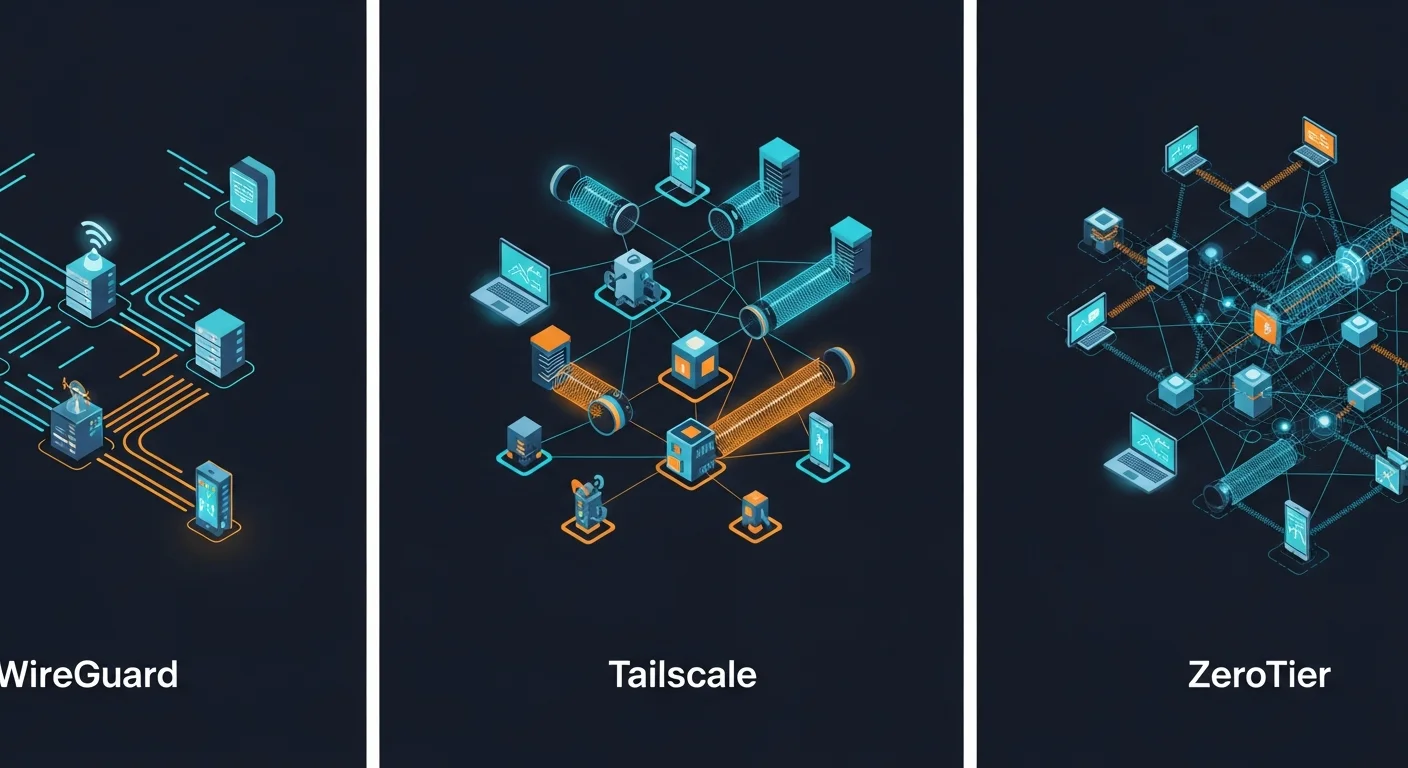
What "Mesh VPN" Actually Means
Traditional VPNs (OpenVPN, IPSec) follow a hub-and-spoke topology: every client connects to a central concentrator, and traffic between two clients hairpins through the concentrator. This works but adds latency, creates a bandwidth bottleneck, and makes the concentrator a single point of failure.
Mesh VPNs flip the model: every device gets a peer-to-peer encrypted tunnel to every other device it needs to talk to. Traffic between two devices goes directly between them, not through a relay. The catch is that establishing those direct tunnels through NAT and firewalls is hard — which is why all three of these tools spend significant engineering effort on NAT traversal.
Modern mesh VPNs share three components:
- A control plane — the orchestration that distributes keys, ACLs, and topology info to nodes.
- A data plane — the actual encrypted tunnels carrying traffic between nodes.
- NAT traversal — STUN-like coordination so peers can find each other through NAT, with relay fallback when direct connection is impossible.
The differences between Tailscale, WireGuard, and ZeroTier come down to how each of these three components is implemented and operated.
Tailscale: The Developer-Experience Champion
Tailscale is built on top of WireGuard. The data plane is unmodified WireGuard; the control plane is Tailscale's own coordination service (closed-source SaaS, with Headscale as an open-source alternative).
Strengths
- Zero-configuration onboarding.
tailscale upand you are on the network. Authentication via existing identity providers (Google, GitHub, Microsoft, Okta, OIDC). - MagicDNS — every node gets a stable DNS name; no need to remember IPs.
- ACLs as code — JSON-based policy file describes who can talk to whom on which ports. Versionable, reviewable in pull requests.
- Subnet routing and exit nodes built in. One node can advertise an entire subnet; another can act as an internet egress.
- SSH support via Tailscale SSH — eliminates SSH key management for tailnet members.
- Generous free tier — up to 100 devices and 3 users free, paid tiers reasonable for small teams.
Weaknesses
- Coordination plane is closed source. Headscale (community open-source reimplementation) exists and is good, but it is not officially supported by Tailscale Inc.
- Vendor dependency for the control plane — if Tailscale's coordination service is down, new connections fail to establish (existing tunnels keep working).
- Pricing scales aggressively at the enterprise tier — beyond a couple hundred users it gets expensive compared to alternatives.
Best for
Small teams, individual developers, organizations that want a turnkey mesh VPN without operating coordination infrastructure. The default recommendation for almost anyone whose first reaction to "set up a mesh VPN" is "I do not want to spend the weekend on this."
Raw WireGuard: The Performance and Control Choice
WireGuard is the protocol. By itself it is just the data-plane primitive — a kernel module that does the encrypted tunnel. Configuration is via a static config file listing peers and their public keys. NAT traversal, peer discovery, ACLs, and rotation are all "exercises for the operator."
Strengths
- Lowest overhead. The protocol is so minimal it ships in the Linux kernel mainline. Throughput on modern hardware is line-rate; latency overhead is microseconds.
- Fully open source, BSD-licensed, no vendor dependency.
- Available everywhere. Linux kernel, BSDs, macOS, Windows, iOS, Android, OpenWrt. Truly universal.
- Auditable — the protocol is small enough to be formally analyzed, and has been.
- Native IPv6. No retrofit; first-class from day one.
Weaknesses
- No NAT traversal. Peers behind NAT need port forwarding or a public-IP relay. For roaming clients this is a real operational problem.
- No automatic peer discovery. You manually distribute peer public keys, IPs, and endpoints. At scale this requires automation (Ansible, Terraform, custom tooling).
- No native ACLs. WireGuard's only access control is "is this peer's public key in the config." Application-layer authorization is up to you.
- No coordination plane. Adding a node means updating every other node's config. At scale, painful without automation.
Best for
Site-to-site tunnels (data center to data center, office to cloud), workloads where you want maximum throughput and minimum dependency, organizations with the operational capacity to build their own coordination tooling. Common in production: WireGuard tunnels managed by Terraform, with peer configs generated from infrastructure state.
ZeroTier: The Veteran Middle Path
ZeroTier predates both Tailscale and WireGuard's mainstream adoption. It uses a custom protocol (not WireGuard) with its own encryption, and a hybrid open-core model: the client and protocol are open source, the network controller can be self-hosted (open source) or used via the SaaS offering.
Strengths
- Layer 2 networking — unlike Tailscale and WireGuard (both Layer 3), ZeroTier emulates Ethernet, allowing protocols like multicast and broadcast to work across the mesh. Useful for legacy applications and certain industrial protocols.
- Self-hosted controller (zt-controller) is fully open source. You can run your entire control plane on-prem.
- Mature — in production for over a decade, with battle-tested NAT traversal.
- Custom network topologies — bridges, routes, and managed flow rules are more flexible than Tailscale's ACLs for unusual cases.
Weaknesses
- Slower than WireGuard-based options — the protocol has more overhead and is implemented in user space rather than the kernel.
- Layer 2 emulation is sometimes a misfeature — most modern apps do not need it and it can cause subtle issues.
- SaaS console UX is functional but feels dated next to Tailscale's polished admin panel.
- The custom protocol has not had as much external cryptographic review as WireGuard.
Best for
Organizations that need Layer 2 connectivity, legacy applications that depend on broadcast/multicast, environments where self-hosting the controller is a hard requirement, and existing ZeroTier deployments where the operational know-how is already established.
Real Performance Numbers
We benchmarked all three tools between two geographic locations (Frankfurt and Helsinki, ~25ms baseline RTT) with iperf3.
| Metric | Tailscale (WG) | Raw WireGuard | ZeroTier |
|---|---|---|---|
| Throughput (single stream) | 1.4 Gbps | 1.5 Gbps | 620 Mbps |
| Throughput (8 streams) | 3.8 Gbps | 4.2 Gbps | 1.4 Gbps |
| Added latency | 0.8 ms | 0.4 ms | 2.1 ms |
| CPU usage (server side, 1 Gbps) | ~22% | ~18% | ~38% |
WireGuard-based options (Tailscale and raw WG) significantly outperform ZeroTier on throughput. Tailscale adds a small overhead vs. raw WireGuard from the userspace control plane, but for nearly all practical workloads the difference is irrelevant.
NAT Traversal Reality
This is where Tailscale and ZeroTier earn their value vs. raw WireGuard.
Tailscale
Uses STUN to discover public-side endpoints, then attempts direct connection. When NAT type prevents this (symmetric NAT, CGNAT, certain corporate firewalls), traffic falls back to Tailscale's DERP (Designated Encrypted Relay for Packets) servers — geographically distributed relays that the operator can verify aren't decrypting traffic. Connection establishment usually takes under a second.
ZeroTier
Uses its own coordinated NAT traversal via "moons" (root servers, default or self-hosted). Falls back to relayed traffic through the moon when direct connection fails. Robust and well-understood; works through almost everything.
Raw WireGuard
No native NAT traversal. Either both peers have public IPs, or one peer is behind static port forwarding, or you set up a relay node yourself (often a tiny VPS that just forwards encrypted traffic between the actual endpoints). Manageable for small deployments; painful at scale.
The Self-Hosted Question
For organizations where "no SaaS dependencies" is a hard requirement:
- Tailscale alternative: Headscale (open-source reimplementation of Tailscale's coordination server). Works with the official Tailscale clients. About 95% feature-parity. Mature enough for production in 2026, used by many small organizations.
- ZeroTier: official open-source controller (ztncui plus zerotier-one-controller). Run on any small VM; minimal resource needs.
- Raw WireGuard: nothing to self-host except the peers themselves; the lack of a control plane is the design.
The Decision Matrix
Three concrete scenarios and the right answer for each:
Scenario 1 — Solo developer with home lab, work laptop, three cloud servers. Right answer: Tailscale on the free tier. Five minutes of setup; just works.
Scenario 2 — Small business, 25 employees, mix of office and remote, cloud and on-prem servers. Right answer: Tailscale on a paid tier (or Headscale if you have the operational capacity). The ACL-as-code and identity-provider integration are decisive.
Scenario 3 — Cloud-native company connecting AWS, GCP, and Azure VPCs across multiple regions. Right answer: raw WireGuard managed by Terraform. Control your own keys, peer-to-peer between known endpoints, no third-party dependency. The complexity is worth the operational independence.
Scenario 4 — Industrial customer with legacy applications that need broadcast/multicast across geographically separated sites. Right answer: ZeroTier. The Layer 2 emulation is the deciding feature.
Operational Considerations
Logging and observability
- Tailscale: dashboard shows online/offline status; per-node connection events available via API. Limited per-flow visibility.
- WireGuard:
wg showshows live peer state; integrate with your existing Prometheus/Loki stack. - ZeroTier: per-node status via SaaS console or self-hosted controller; flow rule audit logs available.
Security model
All three use modern authenticated encryption with no known cryptographic weaknesses. WireGuard has had the most external review; ZeroTier's custom protocol has had less. Tailscale inherits WireGuard's data-plane security and adds its own auth-plane (which is also subject to ongoing review).
Mobile clients
All three have functional iOS and Android clients in 2026. Tailscale's mobile UX is the most polished. WireGuard's official mobile apps are bare-bones but reliable. ZeroTier's mobile app works but is rarely updated.
Frequently Asked Questions
Can I run multiple of these simultaneously?
Yes — they use different routing tables and do not conflict. Some teams run WireGuard for backbone tunnels and Tailscale for end-user devices, getting both performance and developer experience.
What about Nebula?
Nebula (Slack's open-source mesh VPN) is a strong fourth option, especially for very large deployments. Self-hosted control plane, mature, and used at scale at Slack and beyond. Steeper learning curve than Tailscale but no vendor dependency.
Does Tailscale work in China / restrictive networks?
Tailscale's DERP relays sometimes get blocked in highly restrictive networks. The same applies to most VPN solutions. Self-hosted Headscale with custom DERP servers is the standard workaround.
Can I migrate from one to another?
Yes, but plan it. The configurations are not interchangeable; you build the new mesh in parallel, migrate clients in waves, then decommission the old one. Allow 1-2 weeks for a small organization, longer for larger.
What about IPv6 only networks?
All three handle IPv6. Tailscale and WireGuard are fully dual-stack. ZeroTier supports IPv6 but requires explicit configuration in some scenarios.
How does this compare to traditional OpenVPN or IPSec?
For modern use cases, mesh VPNs win on operational simplicity (no central concentrator), performance (peer-to-peer), and developer experience. OpenVPN and IPSec still have niches in legacy enterprise environments and specific compliance requirements.
A Real Migration: 50-Person SaaS From OpenVPN to Tailscale
One mid-sized SaaS company we worked with replaced their OpenVPN concentrator with Tailscale in late 2025. The OpenVPN setup had a few persistent pain points: a single concentrator EC2 instance was a SPOF (they had a hot standby but failover was manual), connection performance from APAC employees was poor (single concentrator in eu-west-1), and managing per-user certificates via the existing tooling required two engineering hours per onboarding.
The migration took three weeks: one week to pilot Tailscale with the engineering team, one week to migrate other technical users, one week to migrate the remaining staff (mostly non-technical). The ACL-as-code system replaced their previous "every user gets full network access" pattern with proper segmentation. After three months in production: zero OpenVPN-related tickets (down from 2-3 per week), connection setup time reduced from minutes to seconds, and the OpenVPN concentrator was decommissioned. Total annual savings on the EC2 instance + reduced operational overhead came to roughly $8,000; the Tailscale subscription cost about $1,800/year. Math worked easily.
Further Reading from the Dargslan Library
- Networking category — VPN, routing, firewalls, and modern network architecture.
- Security & Hardening category — zero-trust, network segmentation, and access control.
- Free cheat sheet library — printable references for WireGuard, Tailscale CLI, and SSH-over-mesh patterns.
- Dargslan eBook library — comprehensive networking and security courses.
The Bottom Line
Tailscale for almost everyone, raw WireGuard when you need maximum control and performance, ZeroTier when Layer 2 is non-negotiable. All three are mature in 2026; the deciding factor is rarely "which is better" and almost always "which fits your operational model and your team's capacity to operate it." Start with Tailscale unless you have a specific reason not to; switch to raw WireGuard if performance or vendor independence becomes critical; consider ZeroTier for the specific scenarios where its Layer 2 model is a real advantage.