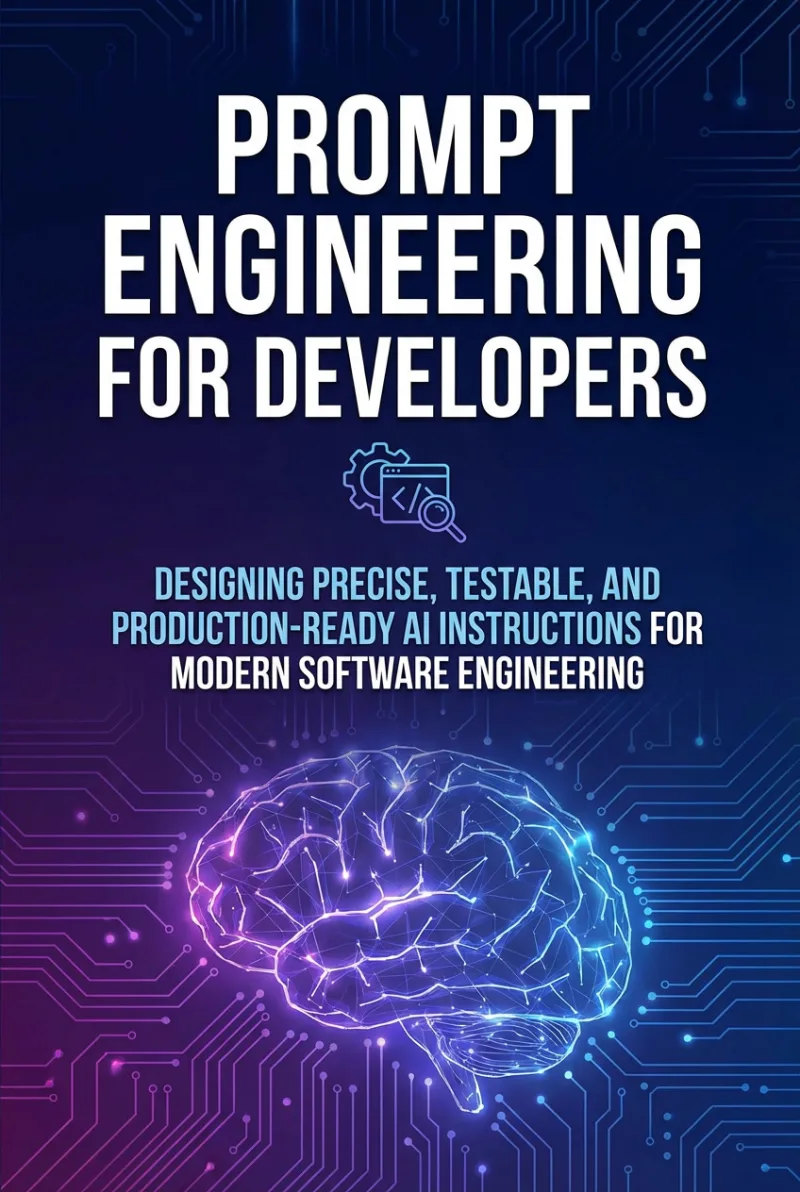
Prompt Engineering for Developers
Designing Precise, Testable, and Production-Ready AI Instructions for Modern Software Engineering
What's Included:
At a Glance
Prompt Engineering for Developers is a professional DATA & AI eBook by Lucas Winfield, 202 pages, available as an instant PDF and EPUB download for €8.90 with lifetime access and free updates. Designing Precise, Testable, and Production-Ready AI Instructions for Modern Software Engineering.
- Length: 202 pages
- Format: PDF and EPUB (instant download)
- Language: English
- Topic: DATA & AI
- Edition: 1st Edition
- Price: €8.90
Key Highlights
- Engineering-grade prompt structure
- Reliable code generation control patterns
- Structured JSON and schema enforcement
- Prompt debugging methodologies
- Testing and QA prompt workflows
- Multi-agent orchestration techniques
- Prompt security and injection prevention
- Token cost optimization strategies
- Reusable prompt library design
Overview
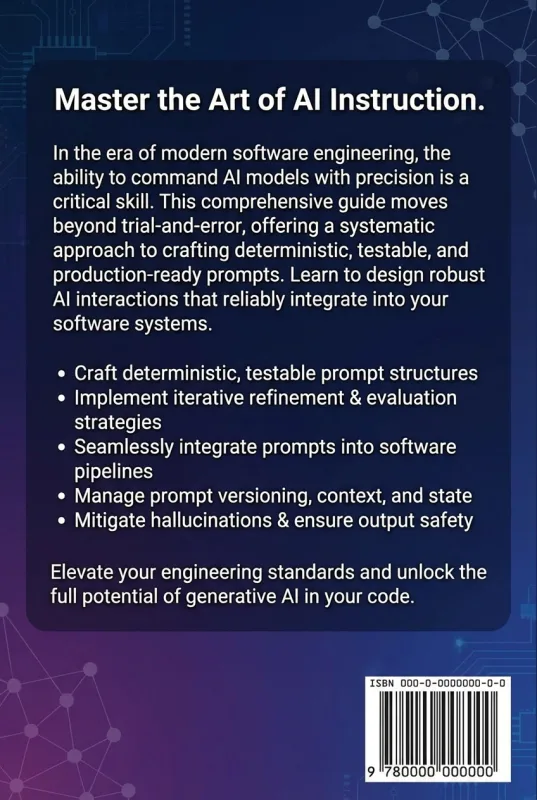
Master prompt engineering as a core developer skill. Learn structured prompt design, code generation control, debugging, testing, security, token optimization, and production-ready AI instruction patterns.
The Problem
Many developers treat prompting as experimentation rather than engineering.
- Vague instructions that produce inconsistent results
- Unstructured outputs that break downstream systems
- Lack of testing and version control for prompts
- Security risks such as prompt injection
- Escalating API costs due to inefficient token usage
Without structure, prompt engineering becomes unpredictable and fragile.
The Solution
Prompt Engineering for Developers introduces a systematic framework for building production-ready prompts.
- Prompt anatomy patterns that enforce clarity and control
- Schema-driven output strategies
- Testable prompt iteration cycles
- Security-first design principles
- Reusable prompt libraries and modular systems
- Token-aware optimization techniques
This book transforms prompting from trial-and-error into disciplined engineering.
About This Book
Prompt Engineering for Developers is a practical, engineering-focused guide to designing precise, testable, and production-ready AI instructions.
In modern software development, prompts are no longer casual inputs — they are programmable interfaces. A well-designed prompt can be versioned, tested, optimized, secured, and reused. A poorly designed one leads to inconsistency, hallucinations, security vulnerabilities, and wasted tokens.
This book treats prompts as first-class engineering artifacts.
What You'll Learn
- The mindset shift from traditional coding to instruction design
- The anatomy of high-performance prompts
- Prompting patterns for reliable code generation
- Structured output enforcement and schema control
- Iterative refinement cycles and systematic improvement
- Debugging prompts with engineering discipline
- Prompt patterns for testing and QA workflows
- Role-based and multi-agent prompt orchestration
- Using prompts for system design and architectural thinking
- Security and safe prompt engineering practices
- Automating prompt workflows
- Building reusable prompt libraries
- Performance and token cost optimization
- Positioning prompt expertise as a senior engineering skill
By the end of this book, you will not rely on guesswork. You will design prompts with the same rigor you apply to APIs, schemas, and production systems.
The prompt is the new interface. Learn to engineer it deliberately.
Who Is This Book For?
- Software developers integrating LLMs into applications
- Backend engineers building AI-powered workflows
- AI tool builders and automation engineers
- Senior developers formalizing AI instruction practices
- Engineering teams adopting AI in production systems
Who Is This Book NOT For?
- Readers seeking deep neural network theory
- Non-technical users looking for casual prompt tips
- Developers unwilling to test and validate AI outputs
Table of Contents
- The Developer’s Shift
- The Anatomy of a High-Performance Prompt
- Prompting for Code Generation
- Structured Output & Schema Control
- Iterative Prompt Refinement Cycles
- Debugging Prompts Like Code
- Prompt Patterns for Testing & QA
- Role-Based & Multi-Agent Prompting
- Prompting for System Design & Architecture
- Security & Safe Prompt Engineering
- Automating Prompt Workflows
- Prompt Libraries & Reusable Systems
- Performance, Cost & Token Optimization
- Becoming a Prompt-Savvy Senior Engineer
Requirements
- Basic programming experience
- Familiarity with APIs or software architecture concepts
- Access to a large language model (recommended)