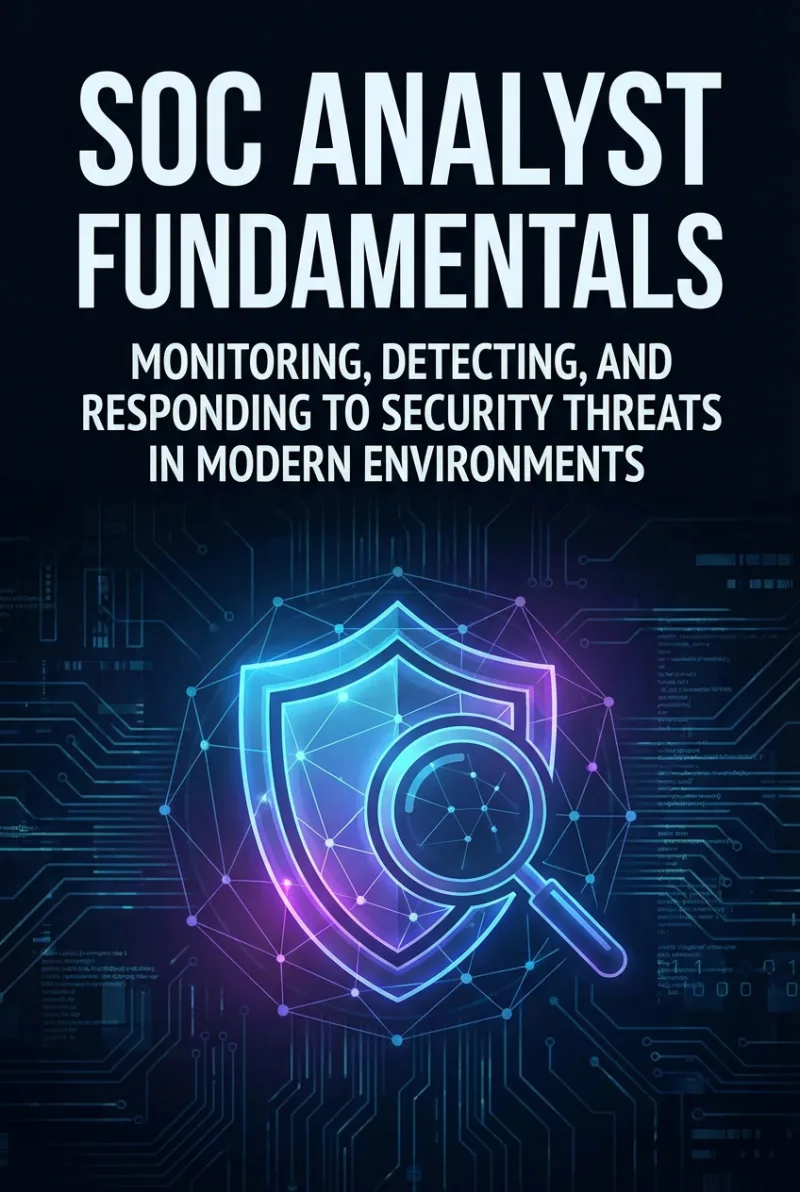
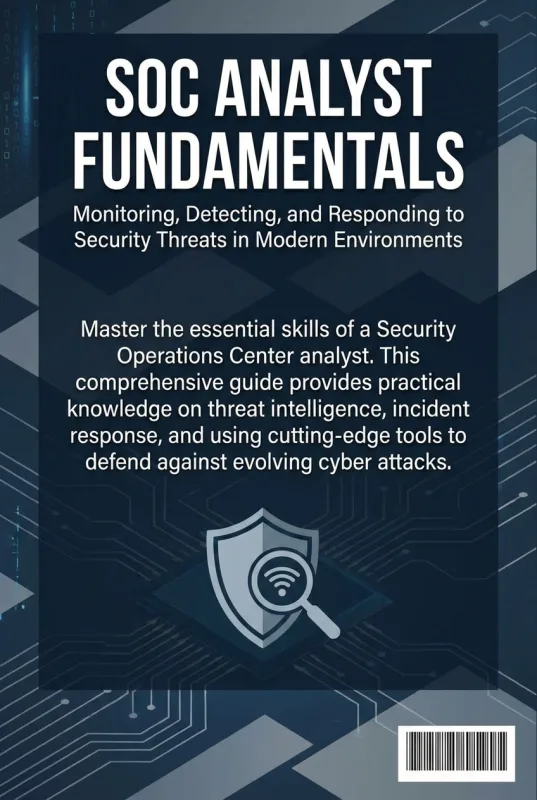
SOC Analyst Fundamentals
Monitoring, Detecting, and Responding to Security Threats in Modern Environments
What's Included:
At a Glance
SOC Analyst Fundamentals is a professional CyberSecurity eBook by Julien Moreau, 289 pages, available as an instant PDF and EPUB download for €11.90 with lifetime access and free updates. Monitoring, Detecting, and Responding to Security Threats in Modern Environments.
- Length: 289 pages
- Format: PDF and EPUB (instant download)
- Language: English
- Topic: CyberSecurity
- Edition: 1st Edition
- Price: €11.90
Key Highlights
- Real-world SOC alert investigation workflows
- SIEM query fundamentals and practical examples
- Networking and OS knowledge tailored for analysts
- Incident response methodology for beginners
- Professional reporting and documentation guidance
- Career roadmap for SOC Analysts
Overview
Learn how to monitor, detect, and respond to cyber threats as a professional SOC Analyst. Practical SIEM skills, alert triage, incident response, and real-world security workflows.
The Problem
Many aspiring SOC Analysts struggle with fragmented learning resources that do not reflect real-world workflows.
They understand cybersecurity theory but lack hands-on investigation skills required to analyze alerts and respond to incidents effectively.
The Solution
This book delivers a structured, practical roadmap to mastering the SOC Analyst role.
Through real-world scenarios, SIEM investigation techniques, and clear workflows, you gain the skills needed to perform confidently from day one.
About This Book
SOC Analyst Fundamentals is a practical, real-world guide to becoming a confident and capable Security Operations Center (SOC) Analyst. Designed for aspiring cybersecurity professionals and early-career analysts, this book focuses on the actual day-to-day responsibilities of working inside a modern SOC.
Cybersecurity headlines highlight massive breaches, ransomware campaigns, and sophisticated adversaries—but behind every successful defense stands a skilled analyst who detected the threat early enough to stop it. This book was written to prepare you to be that analyst.
Rather than overwhelming you with abstract theory, this book mirrors the real workflow of a SOC environment. It teaches you how to think like an analyst, investigate alerts methodically, understand log data, interpret SIEM results, and respond to incidents with clarity and confidence.
Build the Foundations That Matter
The early chapters establish a solid foundation in SOC structure, analyst roles, and core IT knowledge. You will understand how Tier 1, Tier 2, and Tier 3 analysts operate, how security teams collaborate, and what expectations employers have for junior analysts.
You will then develop critical technical skills tailored specifically for security operations:
- Networking fundamentals from an investigative perspective
- Operating system concepts relevant to security monitoring
- Understanding common log sources and event types
- SIEM architecture and alert lifecycle management
Understand the Adversary
Effective detection requires understanding how attacks manifest in logs and telemetry. This book introduces common attack techniques, indicators of compromise (IOCs), suspicious behaviors, and adversary tactics aligned with modern threat landscapes.
You will learn how phishing, lateral movement, privilege escalation, malware execution, and data exfiltration appear in real monitoring environments.
Master the SOC Workflow
The operational core of the book walks you through:
- Alert triage methodology
- Incident investigation processes
- Writing and optimizing SIEM queries
- Working with endpoint and network monitoring tools
- Containment and mitigation strategies
- Clear and professional incident documentation
This section transforms knowledge into action. By the end, you will understand not just what to look for—but how to make decisions under pressure.
Professional Growth and Career Path
The final chapters guide you beyond entry-level performance. You will learn SOC best practices, common analyst mistakes to avoid, and how to transition toward advanced cybersecurity roles such as Incident Responder, Threat Hunter, or Security Engineer.
Five appendices provide ongoing reference material, including common ports and protocols, SIEM query examples, an incident response checklist, realistic alert scenarios, and a structured SOC career roadmap.
If you want to break into cybersecurity or strengthen your SOC analyst skills with practical, job-ready knowledge, this book provides the blueprint.
Who Is This Book For?
- Aspiring SOC Analysts
- Entry-level cybersecurity professionals
- IT professionals transitioning into security
- Students preparing for cybersecurity certifications
- Blue Team beginners seeking practical skills
Who Is This Book NOT For?
- Advanced penetration testers
- Red Team specialists seeking exploit development techniques
- Readers with no basic IT understanding
Table of Contents
- What a SOC Analyst Really Does
- Security Operations Center Structure
- Networking Basics for SOC Analysts
- Operating System Fundamentals
- Understanding Log Sources
- SIEM Fundamentals
- Common Attack Techniques
- Indicators of Compromise (IOCs)
- Alert Triage Process
- Incident Investigation Basics
- Working with SIEM Queries
- Endpoint and Network Monitoring Tools
- Containment and Mitigation
- Reporting and Documentation
- SOC Best Practices and Common Mistakes
- From SOC Analyst to Cybersecurity Specialist
Requirements
- Basic IT knowledge (networking and operating systems)
- Interest in cybersecurity and threat detection
- Access to lab environment or virtual machines (recommended)