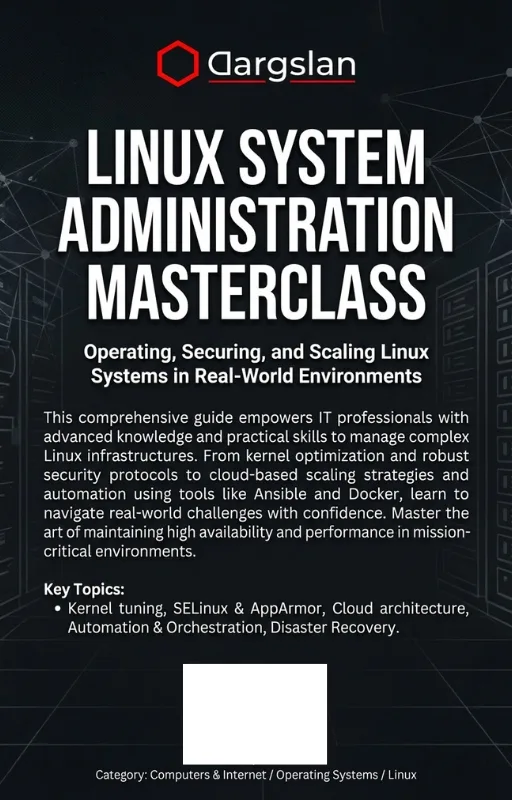
Linux System Administration Masterclass
Operating, Securing, and Scaling Linux Systems in Real-World Environments
What's Included:
At a Glance
Linux System Administration Masterclass is a professional Linux Administration eBook by Miles Everhart, 424 pages, available as an instant PDF and EPUB download for €16.90 with lifetime access and free updates. Operating, Securing, and Scaling Linux Systems in Real-World Environments.
- Length: 424 pages
- Format: PDF and EPUB (instant download)
- Language: English
- Topic: Linux Administration
- Edition: 1st Edition
- Price: €16.90
Key Highlights
- 16 comprehensive chapters covering Linux architecture, systemd mastery, security hardening, storage management, networking, performance optimization, and infrastructure design
- Production-focused content based on real-world enterprise Linux administration across diverse environments from financial services to high-growth startups
- Deep architectural understanding of Linux kernel concepts, boot processes, process management, memory systems, and filesystem structures that enable expert-level troubleshooting
- Comprehensive security hardening including defense-in-depth strategies, SELinux and AppArmor implementation, advanced firewall architectures, and security monitoring
- Advanced troubleshooting methodologies with systematic approaches for diagnosing complex production issues using strace, ltrace, and other advanced debugging tools
- Performance optimization expertise covering monitoring tools, bottleneck identification across CPU/memory/disk/network, and targeted optimization for production workloads
- Enterprise storage management including LVM mastery, RAID configurations, modern filesystem features, and comprehensive backup/disaster recovery strategies
- Production-grade automation with robust shell scripting, error handling, idempotent operations, and integration with configuration management tools
- Modern infrastructure integration showing how Linux fits into containers, orchestration platforms, cloud architectures, and DevOps practices
- Real-world scenarios throughout covering system failures, security incidents, performance degradation, and capacity planning that mirror actual enterprise challenges
- Strategic career guidance for progressing from Linux administrator to infrastructure architect with skill development roadmaps
- Five comprehensive appendices including advanced command reference, incident response playbooks, security checklists, backup templates, and learning roadmap
- Over 400 pages of detailed technical content designed for intermediate administrators advancing to senior-level expertise
- Practical, immediately applicable knowledge you can implement in production Linux environments starting immediately
- Distribution-agnostic approach teaching fundamental Linux concepts applicable across RHEL, Ubuntu, Debian, SUSE, and other major distributions
Overview
Master Linux system administration from operational fundamentals to architectural excellence. Learn production-grade security, performance optimization, and enterprise infrastructure management with real-world scenarios used by senior Linux professionals.
The Problem
Linux administrators often face scattered knowledge - a bit of networking here, some security there, but no comprehensive understanding. Most online tutorials are superficial and do not prepare you for the challenges of real production environments.
The result: stressful incidents, uncertain configurations, and constant firefighting instead of proactively managing systems.
The Solution
This book provides structured, comprehensive knowledge that connects all the important areas. You will learn not just the "how" but also the "why" behind every configuration.
By the end, you will confidently handle any Linux server and proactively plan instead of just reacting to problems. Also prepares you for RHCSA/LPIC certifications.
About This Book
The Linux System Administration Masterclass is the most comprehensive guide to professional Linux system management. This book provides all the knowledge and practical skills you need to confidently manage enterprise Linux infrastructure.
What You Will Learn
This book covers every essential area of Linux administration - from installation and basic configuration to advanced topics like performance tuning, security hardening, and automation.
- System Installation & Configuration: Setting up Ubuntu, RHEL, Rocky Linux, and Debian servers
- User Management: Accounts, groups, permissions, and sudo configuration
- File Systems & Storage: LVM, RAID, filesystem types, and quotas
- Networking: IP configuration, firewalls (firewalld, iptables), DNS, and routing
- Service Management: systemd, logging, scheduled tasks
- Security: SELinux, AppArmor, SSH hardening, audit logging
- Monitoring: System supervision, alerting, performance analysis
- Automation: Bash scripting, Ansible basics
- Backup & Recovery: Backup strategies, disaster recovery
- Troubleshooting: Methodology and tools for problem resolution
Practical Approach
Every chapter contains real-world examples and hands-on exercises. By the end of this book, you will be able to independently install, configure, and operate production Linux servers.
Who Is This For?
This book is ideal for beginner and intermediate system administrators who want to deepen their Linux knowledge. It is also valuable for DevOps engineers and developers who want to better understand infrastructure operations.
Who Is This Book For?
- Beginner Linux administrators seeking structured knowledge
- Windows admins transitioning to Linux
- DevOps engineers wanting to strengthen their foundations
- Developers who want to better understand servers
- Those preparing for RHCSA or LPIC certification
Who Is This Book NOT For?
- Advanced Linux experts who have been running production systems for years
- Those who only want to use desktop Linux
- Kernel developers or systems programmers
Table of Contents
- Thinking Like a Senior Linux Administrator
- Linux Architecture Revisited (Deep Dive)
- Boot Process and systemd Mastery
- Service Management in Production
- Identity, Permissions, and Privilege Control
- Linux Security Hardening
- Storage Management and Filesystems
- Backup, Recovery, and Snapshots
- Linux Networking for Administrators
- Secure Remote Administration
- Performance Monitoring and Optimization
- Advanced Troubleshooting Methodology
- Automation with Shell and Scripting
- Linux in Modern Infrastructure
- Production Operations and Governance
- From Linux Administrator to Infrastructure Architect
Requirements
- Intermediate Linux knowledge – comfort with basic command-line operations, file navigation, and fundamental Linux concepts
- Familiarity with Linux systems – previous experience working with Linux in development, testing, or production environments
- Understanding of basic system administration – concepts like users, groups, permissions, processes, and services
- Access to Linux environment for practice – virtual machine, cloud instance, or physical system for hands-on experimentation
- Basic networking knowledge – understanding of IP addresses, ports, protocols, and basic network concepts
- Commitment to hands-on practice – willingness to experiment with concepts in real Linux systems, not just read passively
- Technical reading comprehension – ability to follow detailed technical explanations and apply concepts to practical scenarios
- Career motivation – desire to advance from junior/intermediate to senior Linux administration positions
- Time for systematic learning – this is comprehensive material requiring focused study and practice over weeks or months
Not required: Programming expertise, specific Linux certifications, experience with particular distributions, or prior DevOps background. The masterclass builds advanced knowledge from intermediate foundations.