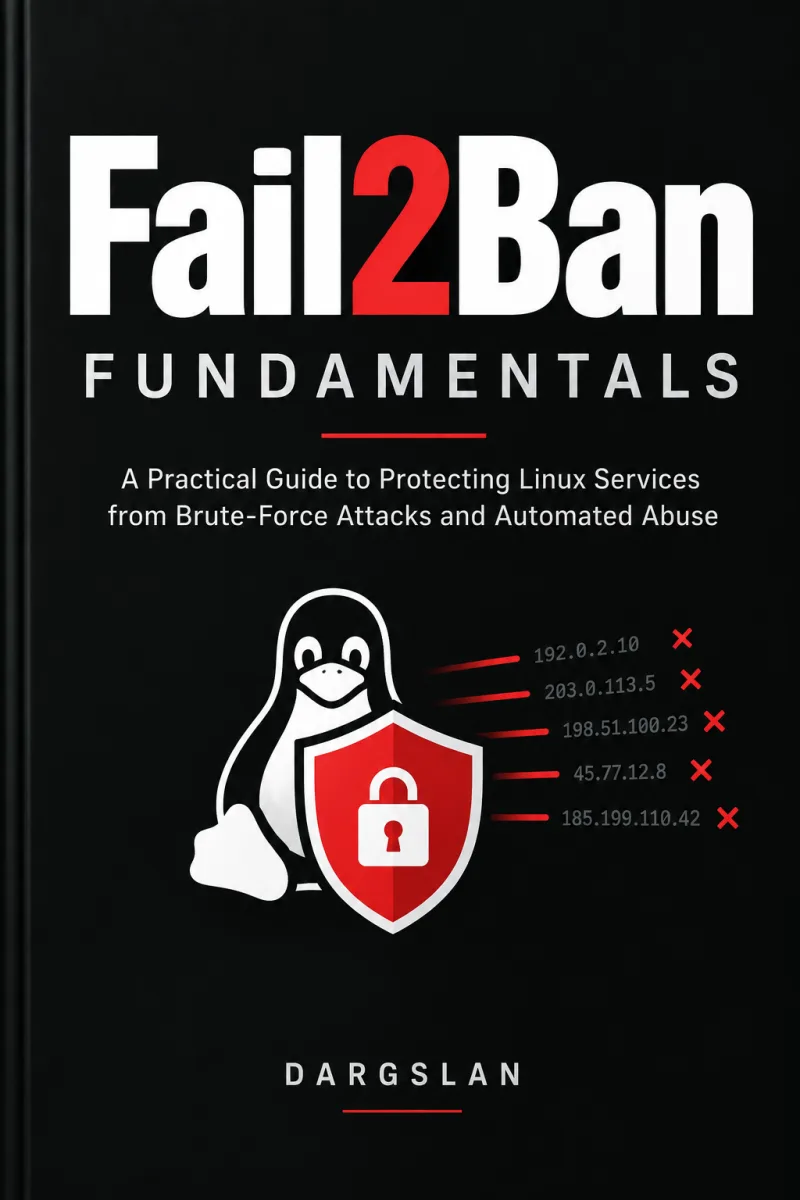
Fail2Ban Fundamentals
A Practical Guide to Protecting Linux Services from Brute-Force Attacks and Automated Abuse
What's Included:
At a Glance
Fail2Ban Fundamentals is a professional Linux Security eBook by Bas van den Berg, 311 pages, available as an instant PDF and EPUB download for €0.00 with lifetime access and free updates. A Practical Guide to Protecting Linux Services from Brute-Force Attacks and Automated Abuse.
- Length: 311 pages
- Format: PDF and EPUB (instant download)
- Language: English
- Topic: Linux Security
- Edition: 1
- Price: €0.00
Key Highlights
- Master Fail2Ban from first install to production-grade configuration
- Understand how Fail2Ban works and where it fits in your security posture
- Configuration architecture and building your first jail
- Design thoughtful ban policies that protect without locking out real users
- Write filters and regular expressions to catch the attacks that matter
- Integrate cleanly with Linux firewalls so bans are enforced
- Protect SSH, the number-one automated-attack target
- Protect NGINX and Apache web servers
- Defend web applications, including against credential stuffing
- Protect mail and other services
- Handle reverse proxies correctly—ban the real attacker, not the proxy
- Run Fail2Ban in Docker and Podman environments
- Monitor, troubleshoot, and apply best practices beyond the defaults
- Hands-on labs in realistic scenarios
- Reference appendices: command cheat sheet, jail and filter references, SSH and NGINX templates, and troubleshooting and production checklists
Overview
Master Fail2Ban to defend Linux services against brute-force attacks and automated abuse. This hands-on guide covers jails, filters and regex, ban policies, firewall integration, and protecting SSH, NGINX, Apache, web apps, mail, reverse proxies, and Docker/Podman—up to production-grade configs.
The Problem
The moment a server touches the internet, the attacks begin. Automated bots relentlessly scan for open SSH ports, brute-force login forms, stuff stolen credentials into web apps, and probe mail servers—24 hours a day, from thousands of addresses. This isn't a rare event you prepare for; it's the constant background noise of running any internet-facing service, and every one of those attempts is a chance for one weak password or one unpatched form to become a breach.
Fail2Ban is the obvious defense, but most people never get its real value. They install it, paste a jail config from a forum post, and assume they're protected—without understanding filters, regular expressions, ban policies, or firewall integration. As a result, their setup misses attacks it should catch, bans legitimate users it shouldn't, or fails silently behind a reverse proxy or inside a container. A tool this powerful, configured by copy-paste, leaves real gaps in the very defense it's supposed to provide.
The Solution
Fail2Ban Fundamentals closes the gap between installing Fail2Ban and actually mastering it. It's a practical, hands-on guide that takes you from your first installation to resilient, production-grade configurations that protect real infrastructure—turning the constant noise of automated attacks into actionable defense.
You'll build a genuine understanding of the mechanics that make Fail2Ban powerful: jails, filters and regular expressions, ban policies, and firewall integration. Dedicated chapters cover protecting SSH, NGINX and Apache, web applications, mail, reverse proxies, and Docker and Podman environments—including the tricky cases like banning the real attacker behind a proxy. You'll monitor it, troubleshoot it, and apply best practices well beyond the defaults, culminating in a production configuration and hands-on labs. With command cheat sheets, jail and filter templates, and checklists, this book helps you wield Fail2Ban with confidence and precision.
About This Book
Fail2Ban Fundamentals: A Practical Guide to Protecting Linux Services from Brute-Force Attacks and Automated Abuse is your complete, hands-on companion for mastering one of the most effective, lightweight, and accessible security tools available. Every day, across every corner of the internet, servers are quietly probed, prodded, and attacked—bots scan for open SSH ports, brute-force login forms, and hammer web applications hoping to find a weakness. For any service connected to the internet, this isn't hypothetical; it's the constant background noise of running infrastructure. Fail2Ban turns that noise into actionable defense, and this book helps you wield it fully.
Why This Book
Fail2Ban is widely used but only partially understood. Many administrators install it, copy a jail configuration from a forum post, and move on—never realizing the depth of customization and protection the tool truly offers. This book closes that gap. It's a practical guide that takes you from your very first installation to building resilient, production-grade configurations that protect real-world infrastructure.
Whether you're securing a single SSH server, protecting a fleet of NGINX and Apache instances, defending web applications from credential stuffing, or integrating Fail2Ban into containerized environments with Docker and Podman, this book meets you where you are and grows with your needs.
What You'll Learn
The chapters build your expertise progressively. You'll start with the foundations—what Fail2Ban is, how it works, and how it fits into your broader security posture—before moving into installation, configuration architecture, and constructing your first jail. From there, the book dives deep into the mechanics that make Fail2Ban powerful: filters, regular expressions, ban policies, and firewall integration.
Dedicated chapters then address real-world use cases:
- Protecting SSH — the number-one target of automated attacks
- Protecting NGINX and Apache — defending your web servers
- Protecting web applications — including defense against credential stuffing
- Protecting mail and other services — extending coverage across your stack
- Fail2Ban with reverse proxies — banning the real attacker, not the proxy
- Fail2Ban with Docker and Podman — making it work in modern containerized environments
Filters, Regex, and Ban Policies Done Right
Fail2Ban's real power lives in its filters and ban logic, and this book gives them the depth they deserve. You'll learn to write and adapt filters using regular expressions to catch the specific attack patterns that matter to you, design thoughtful ban policies that balance protection against locking out legitimate users, and integrate cleanly with Linux firewalls so bans are actually enforced. This is the difference between a default install and a defense tuned to your infrastructure.
Operate It in Production, Not Just Install It
A tool is only as good as how it's run. You'll learn to monitor Fail2Ban's behavior over time, troubleshoot common issues, and apply security best practices that go well beyond default configurations. The book culminates in guidance for building a robust production configuration, followed by hands-on labs that let you apply everything you've learned in realistic scenarios.
A Learning Path and a Reference Manual
The book is designed to work both ways. Newcomers should read sequentially, building knowledge chapter by chapter. Experienced administrators can jump straight to specific topics—reverse proxy integration, Docker deployments—and use the appendices as an ongoing resource during real deployments. Throughout, the emphasis is on practicality: every concept is grounded in real configuration examples, common pitfalls, and actionable guidance.
Reference Material You'll Keep Coming Back To
The appendices provide quick-reference resources you'll return to long after your first read: a Fail2Ban command cheat sheet, a jail configuration reference, filter examples, an SSH jail template, NGINX jail templates, a troubleshooting checklist, and a production security checklist.
Why This Book
Security is rarely about a single silver bullet—it's about layers, vigilance, and tools used well. Fail2Ban is one such tool, and Fail2Ban's true value is only realized when it's configured thoughtfully and maintained deliberately. This book helps you wield it with confidence and precision. Let's begin.
Who Is This Book For?
- System administrators securing internet-facing Linux servers
- Security-conscious developers protecting their own deployments
- DevOps and SRE engineers defending fleets of web and application servers
- Self-hosters and home lab enthusiasts hardening their services
- Anyone protecting SSH, NGINX, Apache, web apps, or mail from brute-force attacks
- Administrators running services in Docker or Podman who need intrusion prevention
- Anyone who installed Fail2Ban from a forum snippet and wants to truly understand it
Who Is This Book NOT For?
- Complete beginners with no Linux command-line experience
- Readers seeking a Windows or macOS security tool guide
- Those wanting an enterprise SIEM or a large-scale distributed IPS rather than Fail2Ban
- Users looking for a broad security-theory overview with no hands-on configuration
- Developers seeking application-level security code rather than service protection
Table of Contents
- Introduction to Fail2Ban
- Installing Fail2Ban
- Understanding the Configuration
- Building Your First Jail
- Designing Ban Policies
- Filters & Regular Expressions
- Fail2Ban & Linux Firewalls
- Protecting SSH
- Protecting NGINX & Apache
- Protecting Web Applications
- Protecting Mail & Other Services
- Fail2Ban with Reverse Proxies
- Fail2Ban with Docker & Podman
- Monitoring Fail2Ban
- Troubleshooting
- Fail2Ban Security Best Practices
- Building a Production Configuration
- Practical Labs
- Appendix: Fail2Ban Command Cheat Sheet
- Appendix: Jail Configuration Reference
- Appendix: Filter Examples
- Appendix: SSH Jail Template
- Appendix: NGINX Jail Templates
- Appendix: Troubleshooting Checklist
- Appendix: Production Security Checklist
Requirements
- Basic familiarity with the Linux command line and shell navigation
- A Linux server or VM (ideally internet-facing) to protect and experiment with
- Root or sudo access to install Fail2Ban and configure the firewall
- General understanding of log files and how services write them is helpful
- Basic familiarity with regular expressions is useful but built up in the book
- Familiarity with the services you want to protect (SSH, NGINX, Apache, mail) helps
- No prior Fail2Ban experience required—the book starts from installation