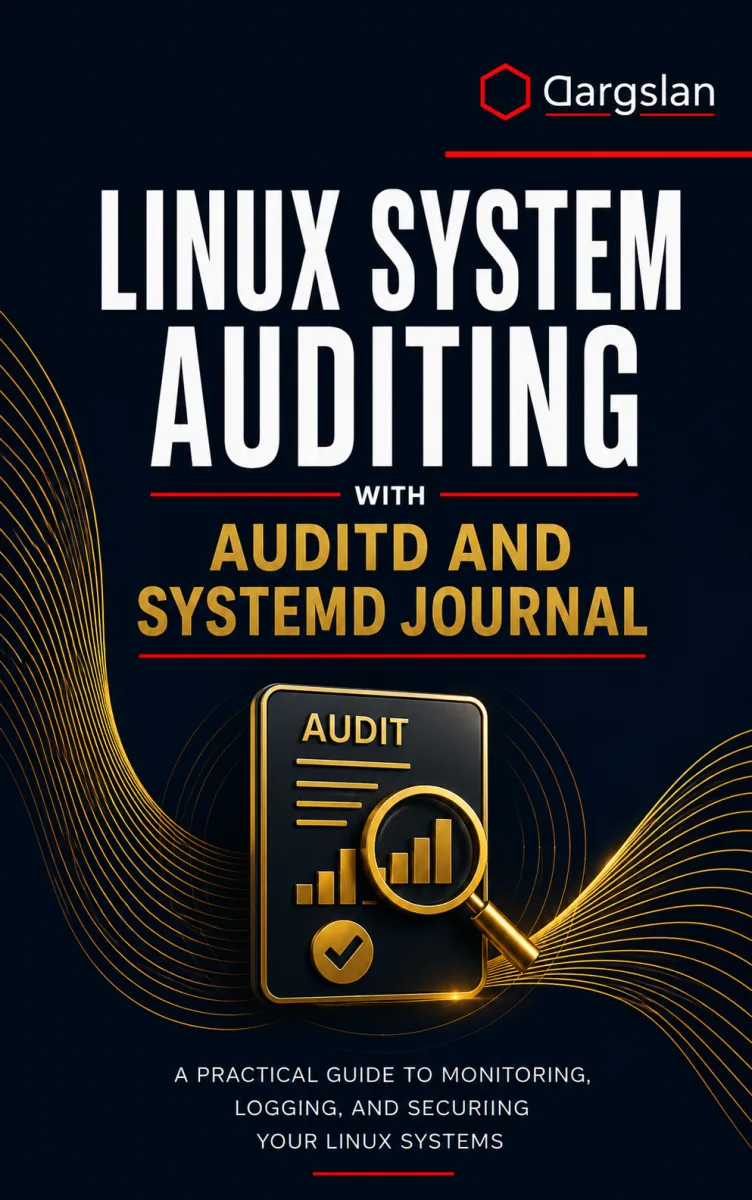
Linux System Auditing with Auditd and Systemd Journal
A Practical Guide to Monitoring, Logging, and Securing Your Linux Systems
What's Included:
At a Glance
Linux System Auditing with Auditd and Systemd Journal is a professional Linux Administration eBook by Dargslan, 364 pages, available as an instant PDF and EPUB download for €15.90 with lifetime access and free updates. A Practical Guide to Monitoring, Logging, and Securing Your Linux Systems.
- Length: 364 pages
- Format: PDF and EPUB (instant download)
- Language: English
- Topic: Linux Administration
- Edition: 1st Edition
- Price: €15.90
Key Highlights
- Master both auditd and the systemd journal as a unified auditing strategy
- Understand Linux auditing architecture from the ground up
- Write precise audit rules and filters that capture only what matters
- Monitor files and directories for unauthorized changes
- Track processes and command execution
- Audit network activity on your systems
- Master journalctl and advanced journal filtering
- Configure persistent and remote journals
- Combine auditd and journalctl for comprehensive coverage
- Build centralized logging architectures for many systems
- Automate audit rule deployment at scale
- Secure and protect audit and journal logs against tampering
- Real-world audit scenarios and complete hands-on final projects
- Tested across major Linux distributions
- Reference appendices: auditd and journalctl quick references, Bash one-liners for log analysis, and further resources
Overview
Master Linux system auditing with auditd and the systemd journal. This hands-on guide covers configuring audit rules, monitoring files, processes, and network activity, journalctl filtering, persistent and remote journals, centralized logging, automation, and securing your audit logs.
The Problem
Linux runs the infrastructure the modern world depends on—and that makes it a target. Security incidents, insider misuse, unauthorized file changes, and compliance audits all demand one thing: a clear, trustworthy record of exactly what happened on your systems, when, and by whom. Yet most administrators lack that record, or have one so noisy and poorly configured that it's useless when it matters most.
The tools to fix this—auditd and the systemd journal—are already on your systems, but they're powerful and unforgiving. Many professionals settle for default or basic configurations that capture too much noise, miss the events that actually matter, or leave audit logs exposed to tampering. Add the challenge of scaling across hundreds of instances, centralizing logs, and meeting compliance requirements, and effective auditing feels out of reach. Without deliberate configuration and a coherent strategy, you're flying blind precisely when visibility counts.
The Solution
Linux System Auditing with Auditd and Systemd Journal turns two powerful but underused tools into a complete, coherent auditing strategy. It bridges theory and practice with hands-on guidance tailored for real Linux environments, showing you how to capture exactly the events that matter while maintaining full system visibility.
You'll progress from fundamentals to advanced implementation: writing precise audit rules, monitoring files, processes, and network activity, mastering journalctl and advanced filtering, and configuring persistent and remote journals. Then you'll combine auditd and journalctl, build centralized logging, automate rule deployment, and secure your logs against tampering—reinforced by real-world scenarios and complete final projects. With quick-reference appendices and Bash one-liners for log analysis, this book gives you the trustworthy record and the confident control that secure, compliant Linux systems require.
About This Book
Linux System Auditing with Auditd and Systemd Journal: A Practical Guide to Monitoring, Logging, and Securing Your Linux Systems is your comprehensive, hands-on companion for mastering two of the most powerful—and most underused—tools in modern Linux administration. Linux powers the critical infrastructure that keeps our digital world running, from web servers and databases to cloud platforms and embedded devices. With that responsibility comes a non-negotiable requirement: keeping those systems secure, compliant, and transparent in their operations.
Effective monitoring and logging aren't just technical checkboxes—they're essential pillars of Linux administration and security. This book bridges the gap between theoretical knowledge and practical implementation, giving Linux administrators, security professionals, and DevOps engineers the tools and techniques to master system auditing on real Linux platforms.
Unlock the Full Power of auditd and the systemd Journal
Linux auditing has evolved significantly, and tools like auditd and the systemd journal have become indispensable components of the modern Linux ecosystem. Yet many professionals settle for basic configurations that barely scratch the surface of what's possible. This book changes that, providing comprehensive, hands-on guidance tailored specifically for Linux environments—so you capture precisely the events that matter and maintain complete system visibility.
Whether you manage a single Linux server or orchestrate hundreds of instances across a cloud environment, the principles and practices here will transform how you approach system monitoring, security auditing, and log management.
What You'll Learn
The book takes you on a comprehensive journey from fundamental concepts to advanced, real-world implementations. You'll master configuring auditd to capture exactly the right events, and learn to leverage the systemd journal's powerful logging capabilities for full-system insight. Key areas of focus include:
- Foundational understanding — a deep dive into Linux auditing concepts and the architecture of auditd and the systemd journal
- Practical implementation — step-by-step deployment and configuration across various Linux distributions
- Advanced techniques — sophisticated filtering, centralized logging, and automation strategies
- Security focus — protecting audit logs and ensuring compliance within Linux security frameworks
- Real-world applications — practical scenarios and case studies drawn from actual production environments
From Rules to Real-World Scenarios
You'll get hands-on with the full toolset: writing audit rules and filters, monitoring files and directories for unauthorized changes, tracking processes and commands, and auditing network activity. On the journal side, you'll master journalctl and advanced filtering, configure persistent and remote journals, and learn to combine auditd and journalctl into a unified auditing strategy. From there you'll build centralized logging setups, automate audit rule deployment, and harden your audit and journal logs against tampering—culminating in real-world audit scenarios and complete final projects that tie everything together.
Structured for Newcomers and Experts Alike
The book follows a carefully crafted progression that respects both those new to Linux auditing and experienced professionals seeking to deepen their expertise. Early chapters establish foundational principles, middle sections dive deep into practical implementation, and the final chapters explore advanced centralized logging architectures and automation strategies. Every chapter includes hands-on examples, configuration snippets, and troubleshooting guidance tested across major distributions.
Reference Material You'll Use Daily
The extensive appendices serve as quick-reference guides you'll find invaluable in day-to-day administration: an auditd quick reference, a systemd journalctl quick reference, useful Bash one-liners for log analysis, and a curated list of further resources and tools.
Why This Book
Mastery comes through practice. Every technique here is designed to be implemented, tested, and adapted to your own environment. Whether you're securing a single workstation or building enterprise-scale logging infrastructure, the foundation you build with this book will serve you throughout your Linux administration career. Welcome to the comprehensive world of Linux system auditing.
Who Is This Book For?
- Linux system administrators responsible for security and compliance
- Security professionals and analysts building audit and detection capabilities
- DevOps and SRE engineers implementing monitoring and centralized logging
- Compliance and audit teams needing reliable, tamper-resistant system records
- Cloud engineers managing many Linux instances at scale
- Incident responders who need clear forensic trails of system activity
- Anyone running Linux who wants deep visibility into what happens on their systems
Who Is This Book NOT For?
- Complete beginners with no Linux command-line experience
- Readers seeking a Windows or macOS auditing guide
- Those wanting only a specific commercial SIEM product's manual rather than native Linux tooling
- Developers looking purely for application-level logging rather than system auditing
- Anyone wanting pure theory with no hands-on rules, commands, or configuration
Table of Contents
- Understanding Linux System Auditing
- Getting Started with Auditd
- Introduction to Systemd Journal
- Audit Rules and Filters
- Monitoring Files and Directories
- Process and Command Tracking
- Network Activity Auditing
- Working with Journalctl
- Advanced Journalctl Filtering
- Persistent and Remote Journals
- Combining Auditd and Journalctl
- Building a Centralized Logging Setup
- Automating Audit Rule Deployment
- Securing Audit and Journal Logs
- Real-World Audit Scenarios
- Final Projects
- Appendix: Auditd Quick Reference
- Appendix: Systemd Journalctl Quick Reference
- Appendix: Useful Bash One-Liners for Log Analysis
- Appendix: Further Resources and Tools
Requirements
- Basic familiarity with the Linux command line and shell navigation
- Access to a Linux system (with systemd) for hands-on practice
- Root or sudo access to configure auditd, write rules, and read journals
- General understanding of Linux processes, files, and permissions
- Basic Bash knowledge is helpful for the log-analysis one-liners but built up as needed
- No prior auditing experience required—concepts progress from the ground up