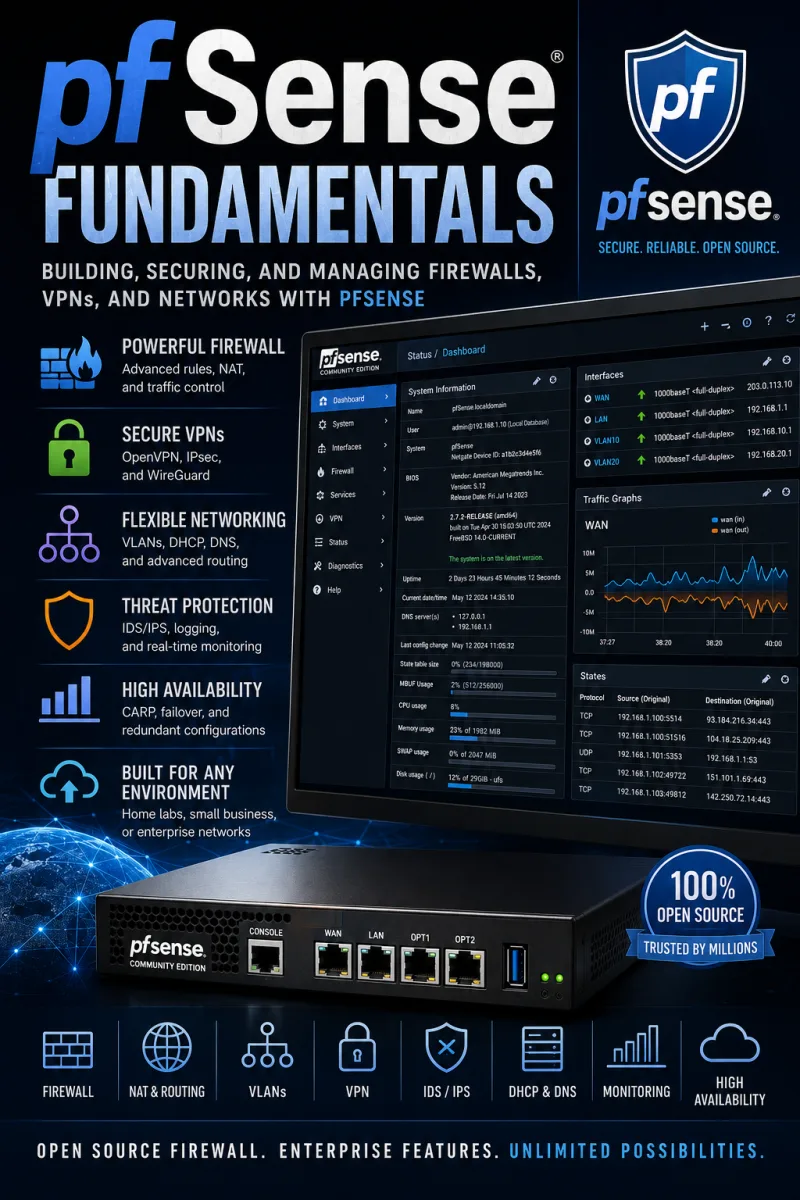
pfSense Fundamentals
Building, Securing, and Managing Firewalls, VPNs, and Networks with pfSense
What's Included:
At a Glance
pfSense Fundamentals is a professional NETWORKING & SECURITY eBook by Marcus Webb, 379 pages, available as an instant PDF and EPUB download for €16.90 with lifetime access and free updates. Building, Securing, and Managing Firewalls, VPNs, and Networks with pfSense.
- Length: 379 pages
- Format: PDF and EPUB (instant download)
- Language: English
- Topic: NETWORKING & SECURITY
- Price: €16.90
Key Highlights
- Hands-on, project-driven approach to mastering pfSense
- Install on physical hardware, virtual machines, and cloud environments
- Design segmented networks with VLANs, interfaces, and advanced routing
- Craft precise firewall rules and NAT policies
- Configure DHCP and DNS services
- Deploy secure remote access with OpenVPN, IPsec, and WireGuard
- Build resilient infrastructure with High Availability (CARP) and Multi-WAN
- Harden pfSense against modern threats
- Integrate IDS/IPS with Suricata or Snort
- Monitor performance, back up configurations, and recover from failures
- Automate pfSense with APIs and scripting for scalable operations
- Complete real-world builds, including an SMB firewall
- Understand not just how pfSense works, but why
- Ten reference appendices: CLI cheat sheet, rule and NAT guides, VPN and HA checklists, Multi-WAN guide, hardening checklist, troubleshooting flowcharts, ports reference, and design templates
Overview
Master pfSense, the powerful open-source firewall built on FreeBSD. This hands-on, project-driven guide covers installation, VLANs, firewall rules, NAT, DHCP/DNS, OpenVPN, IPsec, WireGuard, High Availability, IDS/IPS with Suricata and Snort, monitoring, backup, and automation.
The Problem
Enterprise-grade network security shouldn't require an enterprise-grade budget—but for years, robust firewalls, VPN concentrators, and intrusion prevention meant expensive proprietary appliances with recurring licensing fees and vendor lock-in. For home labs, small businesses, and even larger organizations, that cost is a real barrier to building networks they can actually trust.
pfSense solves the cost problem, but it introduces a knowledge problem. It's enormously powerful and flexible, which also means it's easy to misconfigure. A single loose firewall rule, a botched NAT policy, an insecure VPN setup, or a missed hardening step can quietly leave your network exposed. Documentation is scattered across forums and wikis, features interact in subtle ways, and without a structured, hands-on path, newcomers end up assembling critical security infrastructure by trial and error—an expensive way to learn when the thing you're protecting is your entire network.
The Solution
pfSense Fundamentals gives you a structured, hands-on path from your first install to production-ready deployments—turning a powerful but easy-to-misconfigure platform into a firewall you fully understand and trust. Instead of cataloging features, every chapter builds practical skills through real configuration walkthroughs and best practices drawn from actual deployments.
You'll install pfSense on hardware, VMs, or the cloud; design segmented networks with VLANs; craft precise firewall rules and NAT policies; and deploy secure remote access with OpenVPN, IPsec, and WireGuard. Then you'll build resilient infrastructure with High Availability and Multi-WAN, harden the platform, integrate IDS/IPS with Suricata or Snort, and set up monitoring, backup, and automation. Culminating in complete real-world projects and backed by ten reference appendices, this book helps you understand not just how pfSense works, but why—so you can build networks you can genuinely trust.
About This Book
pfSense Fundamentals: Building, Securing, and Managing Firewalls, VPNs, and Networks with pfSense is your complete, practical companion for mastering one of the most powerful, flexible, and cost-effective network security platforms available. In an era where network security is no longer optional and enterprise-grade firewalls often carry enterprise-grade price tags, pfSense stands out. Built on FreeBSD and refined over nearly two decades, it has become the go-to firewall for home labs, small businesses, service providers, and even large enterprises seeking a robust alternative to proprietary appliances.
Whether you're a networking student, a systems administrator, a security professional, or a curious enthusiast setting up your first home firewall, this book guides you from foundational concepts to advanced, production-ready deployments—entirely through the lens of pfSense.
A Hands-On, Project-Driven Approach
Rather than simply cataloging features, this book takes a hands-on, project-driven approach. Each chapter is designed to build practical skills you can immediately apply to real networks, with configuration walkthroughs and best-practice notes drawn from real deployments. By the end, you won't just understand how pfSense works—you'll understand why it works the way it does, and how to make it work for you.
What You'll Learn
Across a carefully sequenced set of chapters, you'll learn to:
- Install and configure pfSense on physical hardware, virtual machines, and cloud environments
- Design segmented networks using VLANs, interfaces, and advanced routing
- Craft precise firewall rules and NAT policies that protect without disrupting business
- Deploy secure remote access with OpenVPN, IPsec, and WireGuard
- Build resilient infrastructure with High Availability (CARP) and Multi-WAN
- Harden pfSense against modern threats and integrate IDS/IPS with Suricata or Snort
- Monitor performance, back up configurations, and recover quickly from failures
- Automate pfSense using APIs and scripting for scalable operations
From Fundamentals to Mastery
The book progresses naturally from the essentials to advanced deployment. It begins by establishing the fundamentals of firewalls, networking, and the pfSense ecosystem, then walks you through installation, initial configuration, interfaces, and VLAN design. From there you'll dive into the core of pfSense—firewall rules, NAT, DHCP, and DNS—before moving into high availability and the three major VPN technologies pfSense supports.
Later chapters focus on the operational and security concerns that separate a working firewall from a trustworthy one: hardening, intrusion detection and prevention, monitoring, performance, and backup strategies. The book culminates in real-world builds—an SMB firewall, advanced routing, automation, and complete deployment projects—that bring everything together into production-ready skills.
VPNs, High Availability, and Security Done Right
Secure remote access is central to modern networks, and this book gives all three major pfSense VPN technologies—OpenVPN, IPsec, and WireGuard—the dedicated attention they deserve. You'll also build resilient infrastructure with CARP-based High Availability and Multi-WAN, and layer on serious defenses by hardening the platform and integrating Suricata or Snort for intrusion detection and prevention.
Reference Material You'll Return To
The extensive appendices provide quick-reference material you'll rely on long after finishing: a pfSense CLI cheat sheet, a firewall rule design guide, a NAT configuration reference, a VPN deployment checklist, a Multi-WAN configuration guide, a High Availability checklist, a security hardening checklist, troubleshooting flowcharts, a network ports reference, and ready-to-use network design templates.
Why This Book
pfSense is more than a firewall—it's a gateway to understanding how modern networks are secured, segmented, and scaled. This book empowers you to build networks you can trust and gives you the confidence to tackle any pfSense challenge that comes your way. Welcome aboard—let's build something great.
Who Is This Book For?
- Systems administrators deploying and managing firewalls and VPNs
- Security professionals hardening and monitoring network perimeters
- Networking students learning firewalls, VLANs, NAT, and routing hands-on
- Home lab and self-hosting enthusiasts building their first serious firewall
- Small business owners and IT staff seeking a cost-effective security platform
- Service providers and consultants deploying pfSense for clients
- Anyone wanting an open-source alternative to expensive proprietary appliances
Who Is This Book NOT For?
- Readers seeking a guide to a specific proprietary firewall (Cisco ASA, Palo Alto, Fortinet) instead of pfSense
- Those with no interest in networking concepts like IP addressing, VLANs, or routing
- Users wanting only a basic consumer router setup rather than a full firewall platform
- Developers looking for application-level security code rather than network infrastructure
- Anyone wanting pure theory without hands-on configuration and real deployments
Table of Contents
- Introduction to pfSense
- Network Fundamentals
- Installing pfSense
- Initial Configuration
- Interface Configuration
- VLANs
- Firewall Rules
- NAT
- DHCP & DNS
- High Availability
- OpenVPN
- IPsec & WireGuard
- Hardening pfSense
- IDS / IPS
- Monitoring & Performance
- Backup & Recovery
- Building an SMB Firewall
- Advanced Routing
- Automation & APIs
- Real-World Projects
- Appendix: pfSense CLI Cheat Sheet
- Appendix: Firewall Rule Design Guide
- Appendix: NAT Configuration Reference
- Appendix: VPN Deployment Checklist
- Appendix: Multi-WAN Configuration Guide
- Appendix: High Availability Checklist
- Appendix: Security Hardening Checklist
- Appendix: Troubleshooting Flowcharts
- Appendix: Network Ports Reference
- Appendix: Network Design Templates
Requirements
- Basic understanding of networking fundamentals (IP addressing, subnets, routing)
- Hardware, a virtual machine, or a cloud environment to install pfSense on
- A spare network interface or two for firewall/LAN separation (physical or virtual)
- Comfort navigating a web-based admin interface, and willingness to use the CLI
- General familiarity with firewalls and VPNs is helpful but not required
- No prior pfSense experience needed—concepts build from the ground up