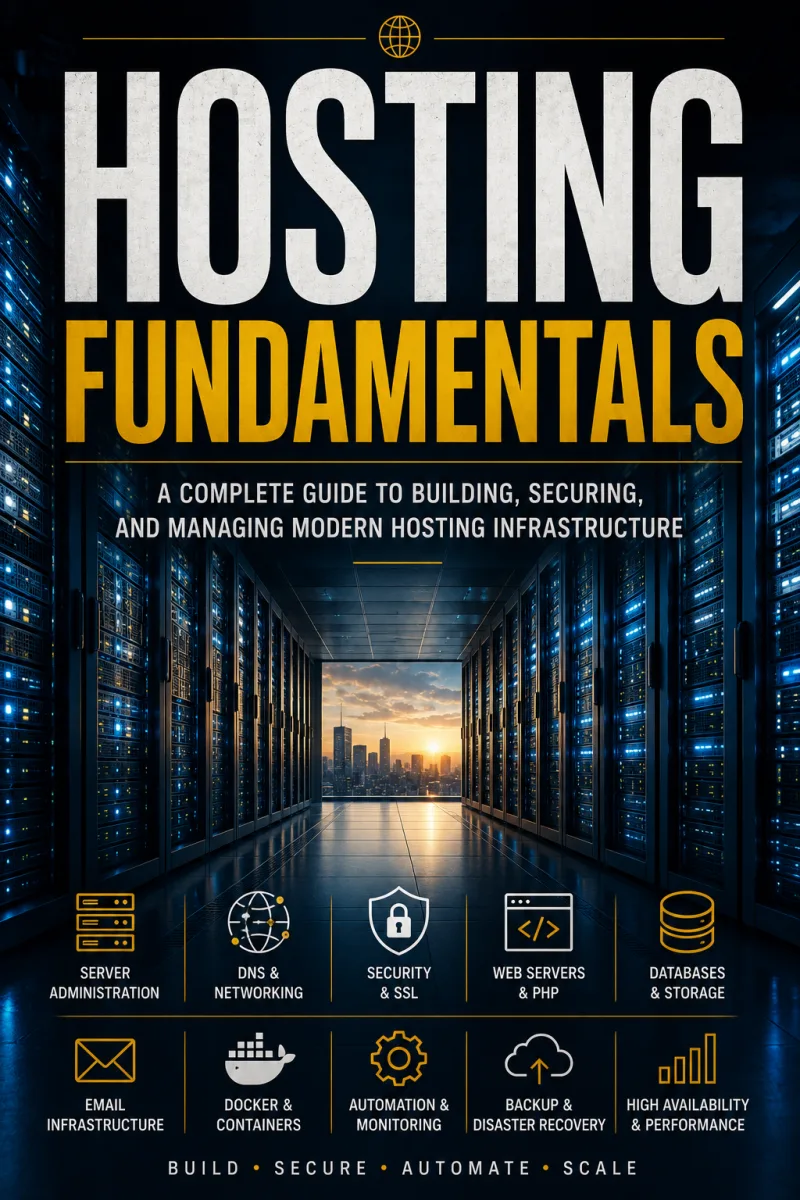
Hosting Fundamentals
A Complete Guide to Building, Securing, and Managing Modern Hosting Infrastructure
What's Included:
At a Glance
Hosting Fundamentals is a professional Linux eBook by Dargslan, 558 pages, available as an instant PDF and EPUB download for €25.90 with lifetime access and free updates. A Complete Guide to Building, Securing, and Managing Modern Hosting Infrastructure.
- Length: 558 pages
- Format: PDF and EPUB (instant download)
- Language: English
- Topic: Linux
- Edition: 1st Edition
- Price: €25.90
Key Highlights
- End-to-end coverage of the entire hosting stack in one coherent guide
- Plan hosting infrastructure, then install and administer Linux servers
- Master DNS, networking, and web servers
- PHP hosting, SQL databases, and NoSQL
- Build and secure mail infrastructure, with dedicated email security coverage
- Hosting security and SSL/PKI treated as first-class concerns
- Modern container hosting with Docker and Podman
- Infrastructure automation and monitoring
- Backup, disaster recovery, and storage strategies
- Performance optimization and high availability
- Hosting control panels, customer management, VPS providers, and CDN/edge delivery
- Four complete real-world builds: personal server, small business platform, enterprise architecture, and your own hosting company
- Ten reference appendices: Linux cheat sheet, security/backup/performance/monitoring checklists, DNS reference, SSL guide, provider comparison, design templates, and an admin roadmap
Overview
Build, secure, and manage modern hosting infrastructure end to end. This complete guide covers Linux servers, DNS, networking, web servers, PHP, SQL and NoSQL, mail, SSL/PKI, Docker and Podman, automation, monitoring, backup, HA, and even launching your own hosting company.
The Problem
Hosting looks simple from the outside—until you're the one responsible for it. Then you discover it isn't one skill but many, all at once: Linux administration, DNS, networking, web servers, databases, mail, certificates, containers, backups, monitoring, and security. Each of those has its own learning curve, and they all have to work together.
The available resources rarely help. Tutorials cover one slice in isolation—how to install a web server, how to add a DNS record—without ever showing how the pieces fit into a coherent, secure, resilient whole. So people assemble infrastructure by copying commands they don't fully understand, and the gaps surface at the worst possible moments: an expired certificate, a misconfigured mail server landing on a blocklist, a database with no tested backup, a site that collapses under load. When you're troubleshooting at 2 a.m., fragmented knowledge is exactly what you don't need.
The Solution
Hosting Fundamentals brings every thread of the discipline into one coherent, hands-on guide. Instead of scattered tutorials, you get an end-to-end path from foundational concepts and infrastructure planning through to production-grade, real-world builds—so you understand not just each component, but how they fit together.
You'll install and administer Linux servers, then master DNS, networking, web servers, PHP hosting, SQL and NoSQL databases, and mail infrastructure. Security runs throughout, with dedicated coverage of email security, hosting security, and SSL/PKI. Modern practices—Docker and Podman, automation, monitoring, backup and disaster recovery, storage, performance tuning, and high availability—give you resilience, while chapters on control panels, customer management, VPS providers, and CDN cover the business realities. It closes with complete builds: a personal server, a small business platform, an enterprise architecture, and even your own hosting company—backed by ten reference appendices you'll use for years.
About This Book
Hosting Fundamentals: A Complete Guide to Building, Securing, and Managing Modern Hosting Infrastructure demystifies the infrastructure that the entire internet depends on. Every website, application, email, and digital service rests on hosting that must be built, secured, and managed—often invisibly, but always critically. This book gives you the practical, comprehensive knowledge to master it.
Hosting is not a single skill—it's a discipline that touches Linux systems, networking, security, databases, automation, and business operations all at once. Most resources cover one slice; this book brings all those threads together into one coherent, hands-on guide. Whether you're a system administrator, a developer curious about the servers behind your applications, an entrepreneur dreaming of launching your own hosting company, or an IT professional responsible for enterprise infrastructure, it was designed with you in mind.
An End-to-End, Hands-On Approach
The book begins with foundational concepts—what hosting actually is, how infrastructure is planned, and how Linux servers are installed and administered. From there it builds outward into the core services every hosting environment depends on: DNS, networking, web servers, PHP hosting, SQL and NoSQL databases, and mail infrastructure. Each layer is explained clearly, then reinforced with actionable guidance you can apply immediately.
Security Woven Throughout
Security is not an afterthought here. Dedicated chapters on email security, hosting security, and SSL/PKI ensure that protecting infrastructure receives the seriousness it deserves in today's threat landscape—covering certificate deployment, hardening practices, and the defenses that keep production systems and customer data safe.
Modern, Production-Grade Practices
As hosting has evolved, so has this book's scope. You'll find thorough coverage of the tools and practices that define resilient hosting today: Docker and Podman container hosting, infrastructure automation, monitoring, backup and disaster recovery, storage, performance optimization, and high availability. These are the capabilities that separate a server that happens to work from infrastructure you can genuinely rely on.
The Business Side of Hosting
Running hosting environments involves more than technology. The book addresses the practical realities too: hosting control panels, customer management, VPS providers, and CDN and edge delivery. Understanding these dimensions is essential whether you're serving internal users, clients, or paying customers.
Real-World Scenarios You Can Build
The book closes with complete, real-world builds so you can apply everything to your specific goals: a personal hosting server, a small business hosting platform, an enterprise hosting architecture, and even launching your own hosting company. These aren't abstract case studies—they're end-to-end scenarios that tie together every skill you've developed.
A Reference That Lives on Your Desk
By the end, you won't just understand hosting conceptually—you'll be equipped to build it, secure it, and manage it. The rich appendices are designed for long-term use: a Linux commands cheat sheet, hosting security checklist, DNS record reference, SSL deployment guide, backup checklist, performance tuning checklist, monitoring checklist, hosting provider comparison, infrastructure design templates, and a hosting administrator roadmap.
This is a book meant to sit on your desk, get marked up, and be returned to again and again—whether you're troubleshooting DNS records at 2 a.m. or architecting a high-availability platform for a growing business.
Why This Book
Written with clarity over jargon and practicality over theory-for-theory's-sake, this guide reflects the reality that hosting is learned by doing. It's your companion for the full journey—from your first Linux install to enterprise-grade infrastructure, or even a hosting business of your own. Welcome to Hosting Fundamentals. Let's build something reliable.
Who Is This Book For?
- System administrators building and managing hosting infrastructure
- Developers who want to understand the servers behind their applications
- Entrepreneurs planning to launch their own hosting or web services company
- IT professionals responsible for enterprise infrastructure
- Freelancers and agencies hosting client websites and applications
- Self-hosting enthusiasts building a personal server or home lab
- DevOps engineers who want a complete, end-to-end view of the hosting stack
Who Is This Book NOT For?
- Users who only want to buy shared hosting and click through a control panel
- Complete beginners with no exposure to servers or the command line
- Readers seeking a website-building or web design tutorial rather than infrastructure
- Those wanting a single vendor's cloud certification guide (AWS, Azure, GCP) instead of hosting fundamentals
- Anyone looking for pure theory without hands-on configuration and real builds
Table of Contents
- Understanding Web Hosting
- Planning a Hosting Infrastructure
- Installing Linux Servers
- Linux Administration
- DNS
- Networking
- Web Servers
- PHP Hosting
- SQL Databases
- NoSQL
- Mail Infrastructure
- Email Security
- Hosting Security
- SSL & PKI
- Docker Hosting
- Podman Hosting
- Infrastructure Automation
- Monitoring
- Backup & Disaster Recovery
- Storage
- Performance Optimization
- High Availability
- Hosting Control Panels
- Customer Management
- VPS Providers
- CDN & Edge
- Building a Personal Hosting Server
- Small Business Hosting Platform
- Enterprise Hosting Architecture
- Building Your Own Hosting Company
- Appendix: Linux Commands Cheat Sheet
- Appendix: Hosting Security Checklist
- Appendix: DNS Record Reference
- Appendix: SSL Deployment Guide
- Appendix: Backup Checklist
- Appendix: Performance Tuning Checklist
- Appendix: Monitoring Checklist
- Appendix: Hosting Provider Comparison
- Appendix: Infrastructure Design Templates
- Appendix: Hosting Administrator Roadmap
Requirements
- Basic familiarity with the command line and general computer literacy
- A server, VPS, or virtual machine where you can install Linux and experiment
- Root or sudo access to install and configure services
- A domain name is helpful for practicing DNS, SSL, and mail configuration
- General understanding of how websites and the internet work
- Willingness to build hands-on rather than only read—hosting is learned by doing
- No prior hosting or sysadmin experience required; concepts start from foundations