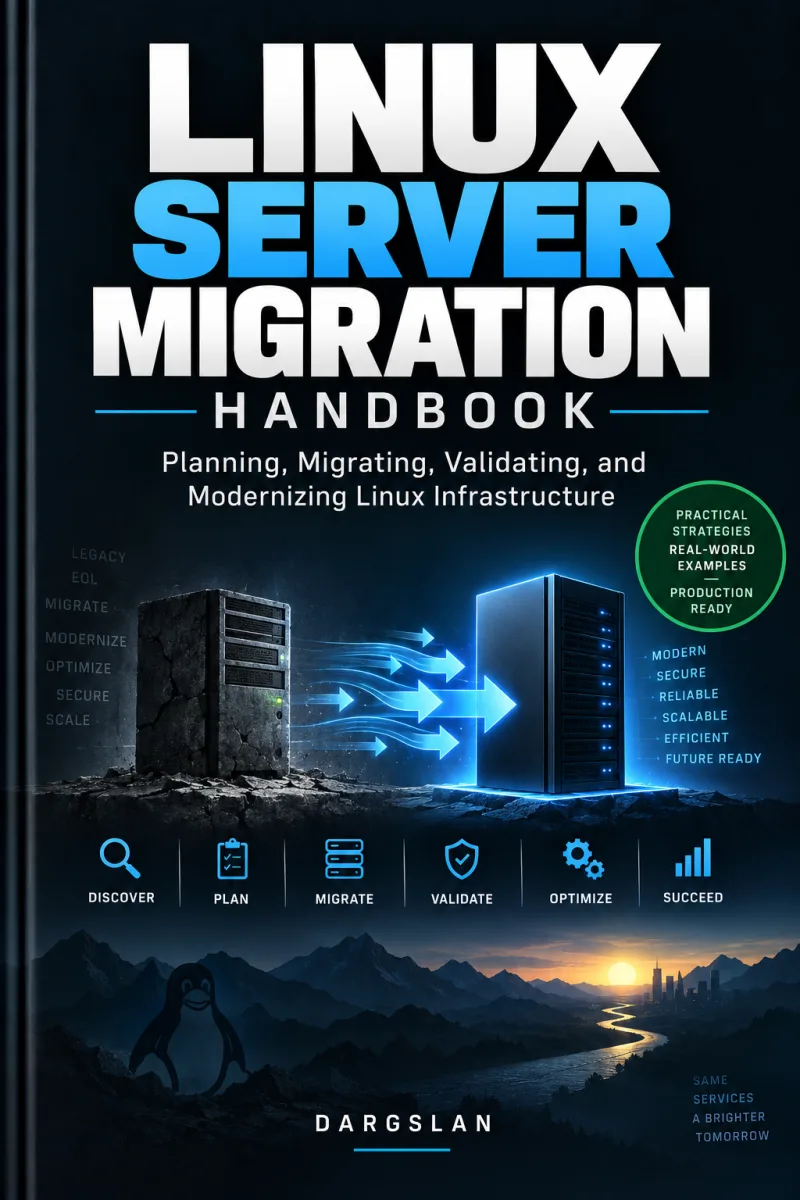
Linux Server Migration Handbook
Planning, Migrating, Validating, and Modernizing Linux Infrastructure
What's Included:
At a Glance
Linux Server Migration Handbook is a professional Linux Servers eBook by Marcus Webb, 606 pages, available as an instant PDF and EPUB download for €0.00 with lifetime access and free updates. Planning, Migrating, Validating, and Modernizing Linux Infrastructure.
- Length: 606 pages
- Format: PDF and EPUB (instant download)
- Language: English
- Topic: Linux Servers
- Edition: 1st Edition
- Price: €0.00
Key Highlights
- Covers the complete Linux migration lifecycle, from discovery to stabilization
- Honest and practical—no clean-slate assumptions, no glossing over production realities
- Assessment and planning: discovery, service inventory, dependency mapping, and risk evaluation
- Compatibility and readiness assessment specific to Linux environments
- Strategy: in-place vs. side-by-side, and structuring migration waves for complex estates
- Designing the target server and a standard Linux baseline
- Configuration migration, users and permissions, and systemd services
- Networking, DNS and hostname, firewall, filesystem, and storage migration
- Database, web and application server migration
- Container workloads and their unique considerations
- Security controls, certificates, keys, and secrets that survive the transition
- Rollback planning, migration validation, and a detailed migration-day runbook
- Stabilization and decommissioning practices
- Thirteen ready-to-use appendices: master checklist, worksheets, templates, risk matrix, cutover and rollback plans, command cheat sheet, and a sample runbook
Overview
Migrate Linux servers without the guesswork. This practical handbook covers the full lifecycle—discovery, dependency mapping, risk assessment, and strategy through configuration, services, storage, databases, containers, security, validation, cutover runbooks, and rollback planning.
The Problem
Sooner or later, every Linux server has to move. The OS reaches end of life, the legacy platform gets too expensive, or the organization pivots to cloud-native infrastructure—and suddenly you're responsible for relocating a production system that everything depends on. The trouble is that Linux migration is never as clean as the plan on the whiteboard. It touches applications, dependencies, security, networking, storage, and the people who use these systems every day.
Most guidance makes it worse by assuming a clean slate—a tidy, well-documented server with no surprises. Real servers aren't like that. They've accumulated undocumented dependencies, hand-edited config files, forgotten cron jobs, and services nobody remembers installing. Miss one dependency, break one certificate, or skip a rollback plan, and migration day turns into an outage with stakeholders watching. Without a complete, honest, lifecycle-wide approach, you're migrating on hope—and hope is a terrible cutover strategy.
The Solution
The Linux Server Migration Handbook fills that gap with a comprehensive, practical, and honest guide to the full migration lifecycle—no guesswork, no clean-slate assumptions, no glossing over the messy realities of production. It's organized to mirror a real project: planning, execution, validation, and stabilization.
You'll work through discovery, application and dependency mapping, compatibility and risk assessment, and strategy (in-place vs. side-by-side, migration waves). Then you'll execute the technical migration—configuration, users and permissions, systemd, networking, DNS, firewalls, storage, databases, web servers, and containers—while ensuring security controls, certificates, and secrets survive intact. Rollback planning, migration validation, a cutover-day runbook, and stabilization close the loop. With thirteen ready-to-use appendices—checklists, worksheets, templates, and a sample runbook built to print and carry into a 2 a.m. cutover—this handbook turns a daunting task into a controlled, repeatable discipline.
About This Book
The Linux Server Migration Handbook: Planning, Migrating, Validating, and Modernizing Linux Infrastructure is a comprehensive, practical, and honest guide to moving Linux servers from one environment to another—without the guesswork, without assuming a "clean slate," and without glossing over the messy realities of production. Linux has quietly become the backbone of modern computing, and eventually every administrator, DevOps engineer, and architect faces the same daunting task: an aging server that must be moved, upgraded, or replaced.
Whatever the trigger—an end-of-life operating system, a costly legacy platform, or a shift toward cloud-native infrastructure—Linux migration is rarely simple. It touches everything: applications, dependencies, security postures, network configurations, storage, and the people who rely on these systems daily. This handbook was written to fill exactly that gap.
The Complete Migration Lifecycle
The book follows the full lifecycle of a Linux migration project, from initial discovery through post-migration stabilization. The chapters are organized to mirror a real project—planning, execution, validation, and stabilization—so you're always working the way an actual migration unfolds.
What You'll Master
- Assessment and planning — discovery, application and service inventory, dependency mapping, compatibility analysis, readiness and risk evaluation specific to Linux
- Migration strategy — comparing in-place versus side-by-side approaches, structuring migration waves for complex estates, and designing the target server and a standard Linux baseline
- Technical execution — configuration migration, users, groups and permissions, systemd services, networking, DNS and hostname changes, firewalls, filesystems, storage, and databases
- Modern workloads — web and application servers, and containerized applications with their unique migration considerations
- Security and validation — ensuring security controls, certificates, keys, and secrets survive the transition intact, plus thorough migration validation
- Operational readiness — rollback planning, a migration-day runbook, and stabilization and decommissioning practices
Grounded in Production Reality
Throughout, the focus stays squarely on Linux systems—their configuration files, service architectures, command-line tools, and the operational patterns that make Linux administration both powerful and occasionally unforgiving. This book assumes you're working with real systems, real constraints, and real consequences for failure. The guidance is deliberately practical, grounded in the decisions Linux professionals make under deadline pressure—not theoretical ideals divorced from production.
Risk Reduction Built In
Migration day is where planning meets reality, and this handbook is built to reduce risk when it matters most. Dedicated coverage of risk assessment, rollback plan design, migration validation, and a detailed cutover runbook means you go into your cutover window with a plan, a safety net, and a clear way to prove success—rather than hoping for the best.
Both a Learning Resource and a Working Reference
Whether you're planning your first Linux migration or your fiftieth, this book serves as both a learning resource and a working reference. System administrators will find practical checklists and command references. Architects will find frameworks for assessment and planning. Team leads will find runbooks and validation strategies that reduce risk on migration day.
Thirteen Appendices Built for Real Use
The appendices are designed to be printed, adapted, and carried into your next project: a Linux migration master checklist, a server discovery checklist, a migration assessment worksheet, a dependency mapping template, a migration risk matrix, a source/target comparison template, a data migration checklist, a security validation checklist, a production cutover checklist, a rollback plan template, a post-migration checklist, a command cheat sheet, and a sample migration runbook.
Why This Book
Read it cover to cover to build a complete migration discipline, or jump directly to the checklist you need at 2 a.m. during a cutover window. Either way, this handbook is built to support you—so you can migrate Linux infrastructure thoughtfully, safely, and successfully.
Who Is This Book For?
- System administrators planning and executing Linux server migrations
- DevOps and SRE engineers modernizing or relocating infrastructure
- Infrastructure architects designing migration strategy and target environments
- Team leads responsible for cutover planning and risk reduction
- Engineers moving off end-of-life OS versions or legacy platforms
- Teams migrating to cloud, cloud-native, or containerized infrastructure
- Anyone facing a Linux migration who wants a complete, honest playbook
Who Is This Book NOT For?
- Complete beginners with no Linux server administration experience
- Readers seeking a Windows Server or macOS migration guide
- Those wanting a single-vendor cloud migration certification guide rather than Linux fundamentals
- Users looking for desktop or workstation migration rather than servers
- Anyone wanting pure theory without checklists, runbooks, and hands-on execution
Table of Contents
- Understanding Linux Server Migration
- The Linux Migration Lifecycle
- Discovering the Existing Server
- Application & Service Inventory
- Dependency Discovery
- Migration Readiness Assessment
- Compatibility Assessment
- Risk Assessment
- Choosing a Migration Method
- In-Place vs Side-by-Side Migration
- Migration Waves
- Designing the Target Server
- Building a Standard Linux Baseline
- Configuration Migration
- Users, Groups & Permissions
- Services & systemd
- Network Configuration
- DNS & Hostname Migration
- Firewall Migration
- Filesystem & File Migration
- Storage Migration
- Database Migration
- Web & Application Servers
- Container Workloads
- Security Controls
- Certificates, Keys & Secrets
- Designing the Rollback Plan
- Migration Validation
- Migration Day Runbook
- Stabilization & Decommissioning
- Appendix: Linux Migration Master Checklist
- Appendix: Server Discovery Checklist
- Appendix: Migration Assessment Worksheet
- Appendix: Dependency Mapping Template
- Appendix: Migration Risk Matrix
- Appendix: Source/Target Comparison Template
- Appendix: Data Migration Checklist
- Appendix: Security Validation Checklist
- Appendix: Production Cutover Checklist
- Appendix: Rollback Plan Template
- Appendix: Post-Migration Checklist
- Appendix: Linux Migration Command Cheat Sheet
- Appendix: Sample Migration Runbook
Requirements
- Working knowledge of Linux server administration
- Comfort with the Linux command line, configuration files, and systemd
- Access to source and target Linux systems (or VMs) to plan and practice migrations
- Root or sudo access to inventory, configure, and migrate services
- General understanding of networking, storage, and security concepts
- Familiarity with the workloads you're migrating (web, database, containers) is helpful
- Not aimed at absolute beginners—Linux administration experience is assumed