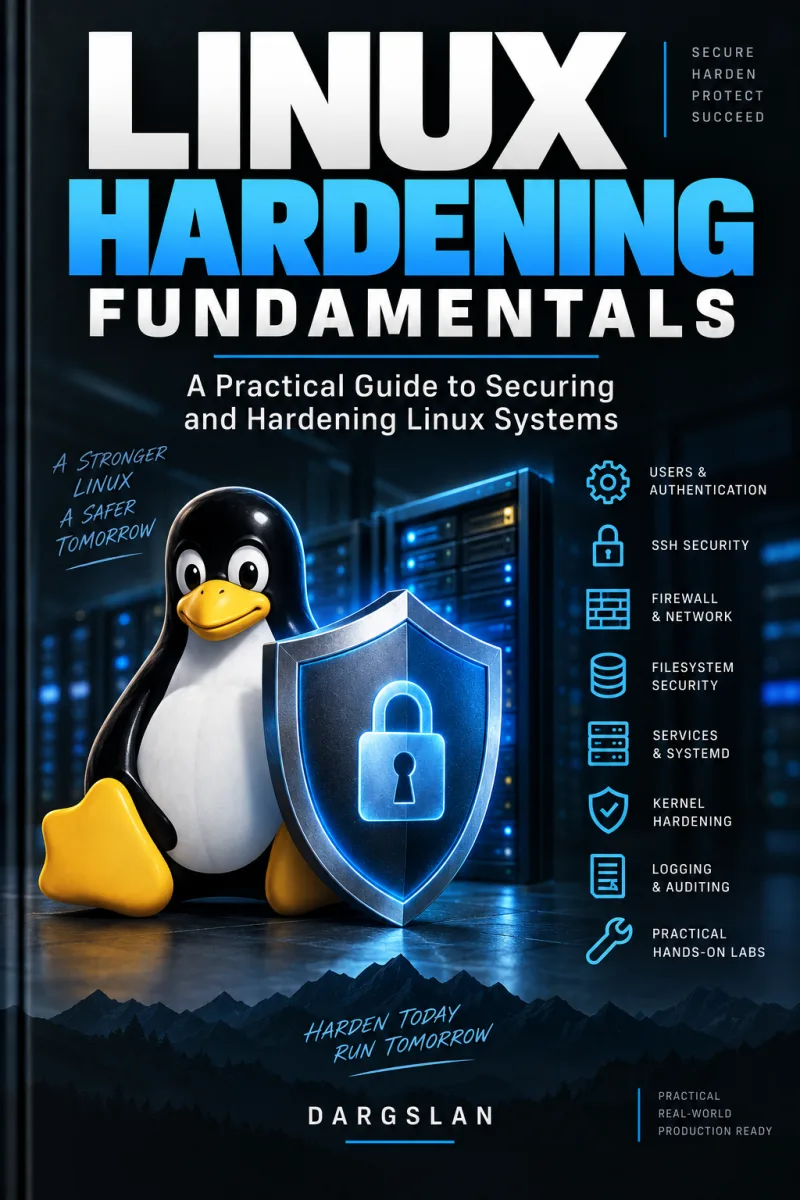
Linux Hardening Fundamentals
A Practical Guide to Securing and Hardening Linux Systems
What's Included:
At a Glance
Linux Hardening Fundamentals is a professional Linux Security eBook by Marcus Webb, 378 pages, available as an instant PDF and EPUB download for €19.90, DRM-free and yours to keep, with free updates. A Practical Guide to Securing and Hardening Linux Systems.
- Length: 378 pages
- Format: PDF and EPUB (instant download)
- Language: English
- Topic: Linux Security
- Edition: 1st Edition
- Price: €19.90
Key Highlights
- Dedicated entirely to hardening Linux—filling the gap between using and defending it
- Grounded in how Linux is actually attacked and defended in production
- Covers the full hardening lifecycle, from assessment to a hardened production server
- Assess a system and build a minimal, attack-resistant installation
- Update and patch management to close a major share of real-world risk
- User and group hardening, password and authentication security, and sudo
- Dedicated SSH hardening plus defending SSH from attacks
- File permissions, ownership, and filesystem hardening
- systemd service security, network hardening, and firewall configuration
- Kernel hardening and sysctl protections
- Mandatory access control with SELinux and AppArmor
- Security logging, auditing, and monitoring
- Protecting data, keys, and secrets
- Practical labs plus reusable checklists for SSH, auth, filesystems, firewalls, sysctl, and production
- Teaches the why behind each measure, instilling hardening as an ongoing discipline
Overview
Learn to defend Linux, not just run it. This hands-on guide walks the full hardening lifecycle—system assessment, minimal installs, user and SSH hardening, filesystem and network protection, firewalls, kernel security, SELinux and AppArmor, logging and auditing, and data protection.
The Problem
Linux runs the infrastructure the modern world depends on, which makes it a permanent target. The moment a system is online, it's being probed—SSH brute-forced, services scanned, weaknesses hunted around the clock. Yet most administrators know how to run Linux far better than they know how to defend it. Getting a service working and getting it working securely are very different skills, and the gap between them is where breaches happen.
The available material rarely closes that gap. General administration books teach you to operate Linux but treat security as a footnote. Abstract security texts explain principles without ever showing you the commands and configs. And scattered blog posts hand you a hardening tweak with no explanation of why it matters or what it might break. So systems ship with default configurations, unnecessary services running, weak SSH settings, and no auditing—an inviting attack surface that could have been dramatically reduced with the right, systematic approach.
The Solution
Linux Hardening Fundamentals lives exactly in that gap—between using Linux and defending it. It's a practical, hands-on guide dedicated entirely to hardening, grounded in how systems are actually attacked and defended in production today, not hypothetical scenarios.
You'll work the full hardening lifecycle: assess an existing system, build a minimal attack-resistant install, and manage patches, then harden every pillar—users and authentication, sudo, SSH (and defending it from attacks), file permissions and filesystems, systemd services, networking, firewalls, and the kernel. Mandatory access control with SELinux and AppArmor, security logging and auditing, and protecting keys and secrets complete the picture, culminating in a fully hardened production server. Crucially, it teaches you why each measure matters, so hardening becomes a discipline you can adapt—not a checklist you run once. Practical labs and reusable checklists make it a working reference for every audit and deployment.
About This Book
Linux Hardening Fundamentals: A Practical Guide to Securing and Hardening Linux Systems fills a critical gap—the space between knowing how to use Linux and knowing how to defend it. Linux powers the modern world: the servers hosting our websites, the containers orchestrating our applications, the cloud infrastructure businesses depend on, and the embedded devices woven into everyday life. With that ubiquity comes responsibility, and this book is dedicated entirely to hardening Linux systems against real-world threats.
This is not a general-purpose Linux administration book, nor an abstract treatise on security principles. It's a practical, hands-on guide grounded in how Linux systems are actually attacked and defended today—the real techniques used by attackers and defenders in production environments, not hypothetical scenarios.
A Systematic Approach to the Whole Hardening Lifecycle
The book walks the entire hardening lifecycle: from initial system assessment, to building a minimal, attack-resistant installation, all the way through to deploying a fully hardened production server. It's structured progressively—building from foundational concepts to advanced, production-grade hardening—while each chapter also stands on its own as a reference you can jump straight to when you need it.
The Core Pillars of Linux Security
Along the way, you'll master every major pillar of Linux security:
- Identity and access control — user and group hardening, password and authentication policies, and privileged access management through
sudo - Remote access security — dedicated chapters on securing SSH and defending it from attacks, since it's one of the most frequently targeted services on any host
- System and filesystem integrity — file permissions, ownership, and filesystem-level protections
- Service and network hardening —
systemdsecurity, network hardening, firewall configuration, and kernel-level protections - Mandatory access control — SELinux and AppArmor fundamentals
- Visibility and accountability — security logging, auditing, and monitoring practices
- Data protection — keeping secrets, keys, and sensitive information secure
Updates, Patching, and Minimal Attack Surface
Good hardening starts before you touch a single config file. The book covers assessing an existing system, building a minimal installation that removes attack surface from the start, and managing updates and patches—the unglamorous foundation that prevents a huge share of real-world compromises.
Understand Why, Not Just How
Linux hardening isn't a one-time task; it's a discipline. Systems change, threats evolve, and hardening must be treated as an ongoing process rather than a checklist completed once and forgotten. This book instills that mindset, encouraging you to think critically about why each measure matters, not just how to implement it—so you can adapt as your systems and the threat landscape change.
Labs and Reference Material You'll Reuse
The book concludes with an extensive set of practical labs and appendices built to be used again and again during real hardening projects, security audits, and production deployments: a Linux hardening checklist, an SSH hardening checklist, a user and authentication checklist, a filesystem security checklist, a firewall checklist, a basic sysctl hardening reference, a security audit command cheat sheet, and a production server hardening checklist.
Who This Book Is For
Whether you're a system administrator responsible for a fleet of Linux servers, a DevOps engineer building secure infrastructure, a security professional auditing Linux environments, or a student preparing for a cybersecurity career, this book is designed for you. Basic familiarity with the Linux command line is assumed, but no prior security expertise is required.
Why This Book
Making Linux systems safer is quiet, essential work—often done without recognition. This book gives you the practical skills and the security mindset to do it well, from your first assessment to a fully hardened production server. To every reader who picks it up with the goal of making Linux systems safer: welcome.
Who Is This Book For?
- System administrators responsible for securing Linux servers
- DevOps and SRE engineers building secure infrastructure
- Security professionals auditing and hardening Linux environments
- Self-hosters and home lab enthusiasts protecting their own systems
- Students preparing for a career in cybersecurity or systems administration
- IT professionals responsible for compliance and secure baselines
- Anyone who knows how to run Linux and now needs to defend it
Who Is This Book NOT For?
- Complete beginners with no Linux command-line experience
- Readers wanting a general Linux administration tutorial rather than a security focus
- Those seeking a Windows or macOS hardening guide
- Users looking for an abstract security-principles textbook without hands-on configuration
- Anyone wanting a single "set and forget" checklist rather than an ongoing discipline
Table of Contents
- Introduction to Linux Hardening
- Assessing a Linux System
- Building a Minimal Linux System
- Updates & Patch Management
- User and Group Hardening
- Password & Authentication Security
- sudo & Privileged Access
- Securing SSH
- Protecting SSH from Attacks
- File Permissions & Ownership
- Filesystem Hardening
- Services & systemd Security
- Network Hardening
- Linux Firewall Hardening
- Basic Kernel Hardening
- SELinux & AppArmor Fundamentals
- Security Logging
- Auditing Linux Systems
- Protecting Data, Keys & Secrets
- Building a Hardened Linux Server
- Practical Labs
- Appendix: Linux Hardening Checklist
- Appendix: SSH Hardening Checklist
- Appendix: User & Authentication Checklist
- Appendix: Filesystem Security Checklist
- Appendix: Firewall Checklist
- Appendix: Basic sysctl Hardening Reference
- Appendix: Security Audit Command Cheat Sheet
- Appendix: Production Server Hardening Checklist
Requirements
- Basic familiarity with the Linux command line and shell navigation
- Access to a Linux system or VM you can harden and experiment with
- Root or sudo access to change configuration, services, and security settings
- General understanding of how Linux services, users, and permissions work
- A test environment is recommended so you can harden safely before production
- No prior security expertise required—concepts build from the ground up