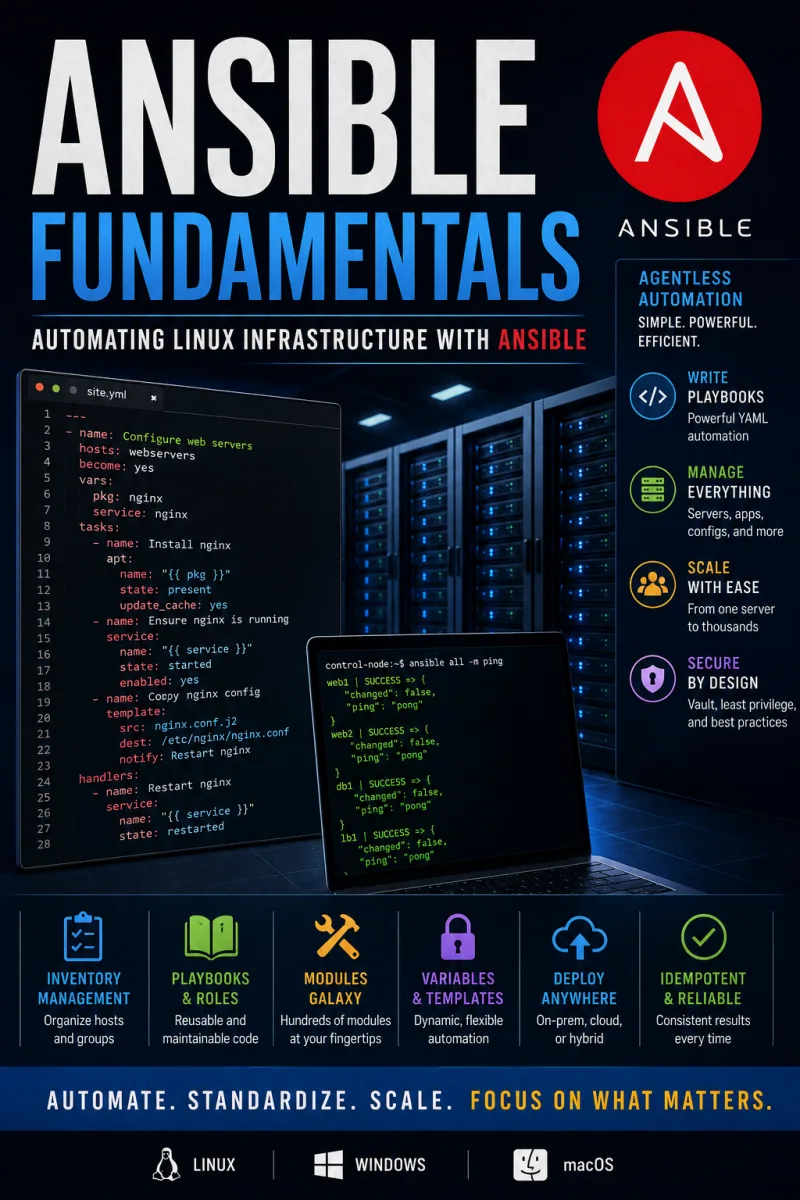
Ansible Fundamentals
Automating Linux Infrastructure with Ansible
What's Included:
At a Glance
Ansible Fundamentals is a professional DEVOPS & INFRASTRUCTURE eBook by Marco Rinaldi, 383 pages, available as an instant PDF and EPUB download for €14.90 with lifetime access and free updates. Automating Linux Infrastructure with Ansible.
- Length: 383 pages
- Format: PDF and EPUB (instant download)
- Language: English
- Topic: DEVOPS & INFRASTRUCTURE
- Edition: 1st Edition
- Price: €14.90
Key Highlights
- Complete path from your first playbook to a production automation platform
- Agentless, YAML-based automation you can start using within minutes
- Build and manage inventories for your infrastructure
- Write playbooks and use essential Ansible modules effectively
- Work with variables, templates, loops, conditions, and handlers
- Organize complex automation with roles and reusable project structures
- Automate real Linux servers and multi-server deployments
- Integrate Ansible into CI/CD pipelines
- Secure secrets with Ansible Vault and best practices
- Build a full-fledged automation platform for production
- Grounded in real-world scenarios throughout
- Eight reference appendices: command cheat sheet, YAML and Jinja2 references, common modules, inventory examples, playbook best practices, Vault guide, and an automation roadmap
Overview
Automate your Linux infrastructure with Ansible, from your very first playbook to a production automation platform. This hands-on guide covers inventories, playbooks, modules, variables, templates, roles, multi-server deployments, CI/CD, and securing secrets with Ansible Vault.
The Problem
Managing Linux infrastructure by hand doesn't scale. Configuring servers one at a time, running the same commands across dozens of machines, and trying to keep every system consistent is slow, error-prone, and impossible to reproduce reliably. One forgotten step or one machine configured slightly differently, and you've introduced the kind of drift that causes outages weeks later—the kind that's maddening to track down.
Automation is the obvious answer, but many tools make it painful: agents to install on every host, complex domain-specific languages to learn, and heavy infrastructure to maintain before you can automate anything at all. That overhead stops many administrators before they start, leaving them stuck with manual, repetitive work that consumes time they don't have and introduces risk they can't afford.
The Solution
Ansible Fundamentals gives you a complete, structured, and practical path to automating Linux infrastructure with the industry's most approachable automation tool. Ansible's agentless architecture and human-readable YAML mean you can automate meaningful tasks within minutes—no agents, no complex DSL, no heavy infrastructure required.
Starting from your very first playbook, the book takes you step by step through inventories, modules, variables, templates, loops, conditions, handlers, and reusable roles. Then it applies Ansible to real work: automating Linux servers, orchestrating multi-server deployments, integrating with CI/CD, and securing secrets with Ansible Vault—culminating in a full production-grade automation platform. Every chapter is grounded in real-world scenarios, and eight reference appendices keep you productive long after you finish. By the end, Ansible will feel like a natural extension of how you think about infrastructure.
About This Book
Ansible Fundamentals: Automating Linux Infrastructure with Ansible is your practical, hands-on guide to mastering one of the most powerful and widely adopted automation tools in the industry. In today's fast-paced technology landscape, managing infrastructure efficiently, consistently, and at scale is no longer a luxury—it's a necessity. Whether you're managing a handful of Linux servers or orchestrating deployments across hundreds of cloud nodes, manual configuration simply can't keep pace with modern demands. This is where Ansible shines, and this book helps you harness its full power.
Ansible's agentless architecture, human-readable YAML syntax, and vast ecosystem of modules have made it the go-to choice for system administrators, DevOps engineers, and cloud architects worldwide. Starting from your very first playbook and progressing to enterprise-grade automation, this book gives you a complete, structured, and genuinely practical foundation.
Why Ansible, and Why This Book
Countless tools exist for infrastructure automation, but Ansible stands apart for its simplicity, flexibility, and low barrier to entry. You don't need to install agents on remote systems, learn a complex domain-specific language, or maintain heavy infrastructure just to start. With Ansible, you can automate meaningful tasks within minutes of installation.
This book was written with a clear mission: to give you a complete, structured, and practical foundation in Ansible—not just as a scripting tool, but as a strategic capability that transforms how you manage Linux infrastructure. Every chapter is grounded in real-world scenarios you're likely to encounter, from configuring web servers and managing users to orchestrating multi-tier deployments and integrating automation into CI/CD pipelines.
What You'll Learn
Throughout these pages, you'll build a deep, working knowledge of Ansible, including:
- The fundamentals of infrastructure automation and why it matters in modern IT
- How Ansible works under the hood, and how to install, configure, and structure your first projects
- Writing playbooks and using modules, variables, templates, loops, conditions, and handlers
- Organizing complex automation with roles and reusable project structures
- Applying Ansible to real Linux server automation, multi-server deployments, and CI/CD workflows
- Securing your automation with Ansible Vault and secrets management best practices
- Building a full-fledged automation platform capable of supporting production environments
A Logical Learning Journey
The book is organized as a deliberate progression. It begins by introducing the concepts of automation and getting you set up with Ansible, then walks you through inventories, playbooks, and essential modules. From there you'll dive into variables, templates, control flow, and project organization before applying Ansible to real Linux systems, multi-server deployments, and CI/CD. The final chapters cover security, real-world projects, and building a complete automation platform. Whether you read cover to cover or jump to the topics most relevant to your work, each chapter stands on its own while contributing to a cohesive whole.
From First Playbook to Production Platform
What distinguishes this book is its arc from absolute basics to genuine production capability. You won't just learn syntax—you'll learn to think in terms of reusable roles, maintainable project structures, secure secrets management, and platform-level automation. By the end, Ansible will feel like a natural extension of how you think about infrastructure, and you'll have the confidence to build automation that supports real production environments.
Reference Material You'll Keep Using
The extensive appendices are built for daily use long after your first read: an Ansible command cheat sheet, a YAML quick reference, a guide to common modules, a Jinja2 template reference, inventory examples, playbook best practices, an Ansible Vault quick guide, and an infrastructure automation roadmap to guide your continued growth.
Why This Book
Automation is a journey, not a destination—and Ansible is a remarkably powerful ally on that journey, one that rewards curiosity, experimentation, and consistent practice. This book aims not only to teach you Ansible, but to inspire you to rethink how infrastructure can be built, managed, and evolved. Let's get started. Happy automating!
Who Is This Book For?
- System administrators looking to automate repetitive Linux configuration tasks
- DevOps engineers building repeatable, reliable deployment workflows
- Cloud architects orchestrating infrastructure across many nodes
- SREs and platform engineers standardizing configuration at scale
- IT professionals adopting infrastructure-as-code practices
- Developers who need to provision and manage their own environments
- Anyone new to Ansible who wants a complete path from first playbook to production
Who Is This Book NOT For?
- Complete beginners with no exposure to Linux or the command line
- Those seeking coverage of a different automation tool (Puppet, Chef, SaltStack, Terraform) instead of Ansible
- Advanced Ansible experts looking only for deep internals, module development, or edge-case tuning
- Readers wanting a Windows-only automation guide rather than a Linux-focused one
- Anyone wanting pure theory without hands-on playbooks and configuration
Table of Contents
- Why Infrastructure Automation Matters
- Understanding Ansible
- Installing and Configuring Ansible
- Building Your First Inventory
- Writing Your First Playbook
- Essential Ansible Modules
- Working with Variables
- Templates and Configuration Files
- Loops, Conditions, and Handlers
- Roles and Project Organization
- Automating Linux Servers
- Multi-Server Deployments
- Ansible in CI/CD
- Security and Secrets Management
- Real-World Infrastructure Projects
- Building an Automation Platform
- Appendix: Ansible Command Cheat Sheet
- Appendix: YAML Quick Reference
- Appendix: Common Ansible Modules
- Appendix: Jinja2 Template Reference
- Appendix: Inventory Examples
- Appendix: Playbook Best Practices
- Appendix: Ansible Vault Quick Guide
- Appendix: Infrastructure Automation Roadmap
Requirements
- Basic familiarity with the Linux command line and shell navigation
- Access to one or more Linux systems (or VMs/containers) to automate
- A control machine with SSH access to the systems you want to manage
- General understanding of Linux server administration (users, services, files)
- Basic familiarity with YAML is helpful but taught as you go
- No prior Ansible or automation experience required—concepts build from the ground up