Linux Log Management and Analysis
What's Included:
At a Glance
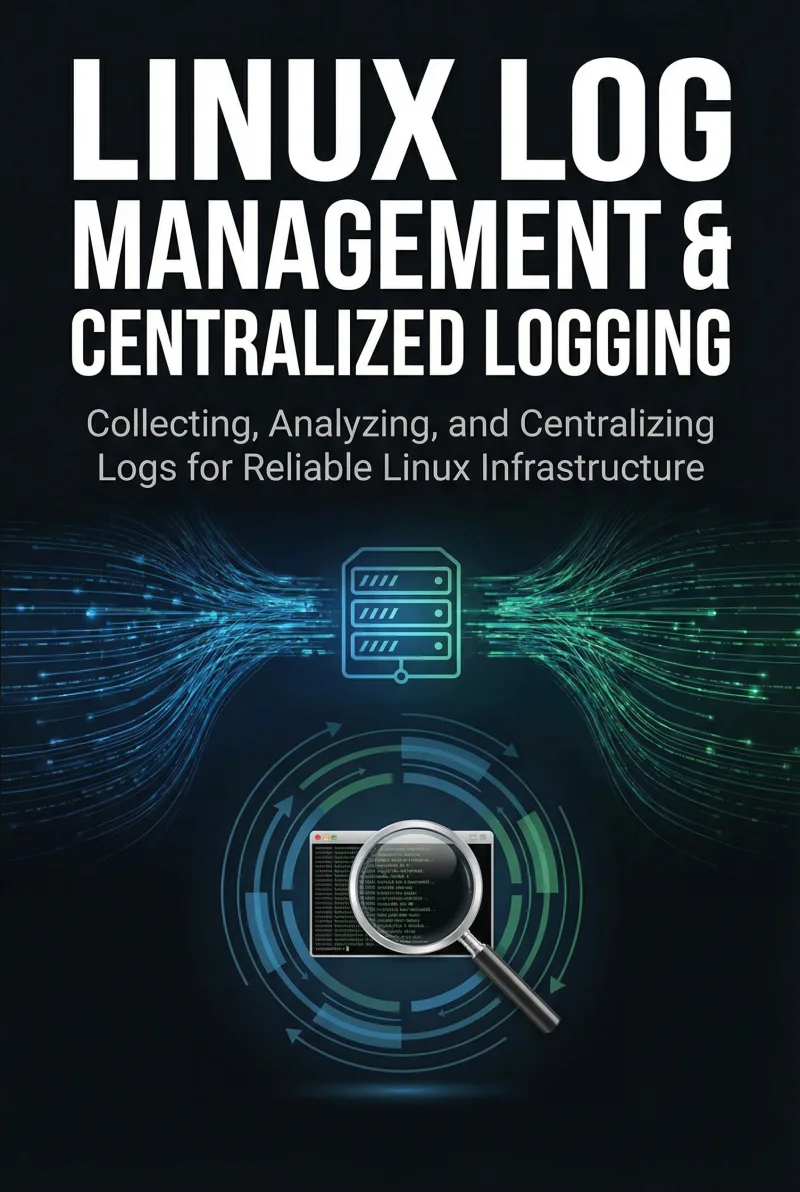
Linux Log Management and Analysis is a professional Linux Administration eBook by Dargslan, 383 pages, available as an instant PDF and EPUB download for €15.90 with lifetime access and free updates. Turn raw Linux logs into actionable insight. This practical guide covers syslog, rsyslog, and systemd's journald; reading, filtering, and analyzing logs; centra...
- Length: 383 pages
- Format: PDF and EPUB (instant download)
- Language: English
- Topic: Linux Administration
- Edition: 1st Edition
- Price: €15.90
Key Highlights
- Master traditional syslog, rsyslog, and modern systemd journald
- Read, filter, and analyze logs to turn raw data into actionable insight
- Explore common log files and understand what each one tells you
- Log application events effectively
- Build centralized log management for distributed infrastructure
- Master journalctl and systemd logging
- Configure log rotation and archiving to control data volume
- Set up real-time monitoring and alerts
- Apply log analysis tools to work efficiently at scale
- Meet security and compliance requirements with proper audit trails
- Diagnose and resolve issues fast with structured troubleshooting
- Cross-distribution guidance for diverse Linux environments
- Five Linux-specific appendices: directory map by distribution, facility/severity cheat sheet, sample logrotate configs, parsing exercises, and a glossary
Overview
Turn raw Linux logs into actionable insight. This practical guide covers syslog, rsyslog, and systemd's journald; reading, filtering, and analyzing logs; centralized logging; real-time monitoring and alerts; log rotation; security and compliance; and fast troubleshooting with logs.
The Problem
On Linux, logs record everything—but most administrators only think about them after something has already broken. When a server goes down, a service misbehaves, or a security incident unfolds, you suddenly need answers that are buried somewhere in gigabytes of log data across syslog, journald, and application files. Finding them fast, under pressure, is a skill few people build until they desperately need it.
The landscape doesn't make it easy. Modern Linux logging spans traditional syslog and rsyslog, systemd's journald, rotated archives, and centralized pipelines—each with its own tools, formats, and quirks that differ across distributions. Add enormous data volumes, security threats that demand rapid detection, and compliance requirements for complete audit trails, and log management becomes overwhelming. Without a structured approach, you're left grepping blindly, missing critical events, and troubleshooting far slower than you should.
The Solution
Linux Log Management and Analysis replaces reactive, last-minute log-hunting with real mastery. It bridges the complexity gap across syslog, rsyslog, and systemd's journald with practical, hands-on guidance that works across distributions—turning raw log data into actionable insight and fast, confident troubleshooting.
Following a progressive path from fundamentals to advanced implementation, you'll learn to read, filter, and analyze logs; log application events; build centralized logging; master journalctl and systemd logging; configure rotation and archiving; and set up real-time monitoring and alerts. Dedicated coverage of log analysis tools, security and compliance, and troubleshooting with logs equips you for the challenges real environments throw at you. With Linux-specific appendices—directory maps by distribution, facility/severity cheat sheets, sample logrotate configs, and hands-on parsing exercises—you'll be ready long before something goes wrong.
About This Book
Linux Log Management and Analysis: A Practical Guide to System Logging, Monitoring, and Troubleshooting in Linux Environments is your comprehensive, hands-on companion for mastering one of the most overlooked—yet most critical—skills in Linux administration. Logs are the silent witnesses to everything that happens on your systems: they capture the heartbeat of your servers, record critical events, and leave the breadcrumbs you need to solve complex problems. This book teaches you to harness that power.
Effective log management is what separates proficient Linux administrators from exceptional ones. Whether you're managing a single Ubuntu server or orchestrating a complex multi-distribution infrastructure, understanding how to work with Linux logging systems is essential for keeping environments reliable, secure, and performant. Yet too often, log management is ignored until something goes wrong—and by then it's a scramble. This book ensures you're ready before that moment arrives.
Navigate a Complex, Evolving Landscape
Linux logging has evolved dramatically—from traditional syslog implementations to modern systemd journaling, from simple text files to sophisticated centralized logging architectures. That evolution has made logging more powerful but also more complex. This book bridges the complexity gap with practical, hands-on guidance that works across different distributions and use cases, so you're never lost between competing tools and approaches.
Solve the Real Challenges
Today's Linux administrators face multifaceted challenges: systems generate enormous volumes of log data, security threats demand rapid detection and response, compliance requirements call for comprehensive audit trails, and distributed architectures require centralized monitoring. This book addresses each of these head-on with Linux-specific solutions, tools, and best practices you can apply immediately.
What You'll Gain
Through this guide, you'll develop the expertise to transform raw log data into actionable insight. You'll learn to navigate the intricacies of rsyslog and systemd's journald, master the art of log filtering and analysis, and implement robust monitoring solutions that keep your systems running smoothly. Just as importantly, you'll gain the troubleshooting skills to quickly diagnose and resolve issues through log analysis—a capability that's invaluable in fast-paced IT environments.
Practical exercises and real-world scenarios throughout ensure you're not just learning theory but building skills you can apply to your own infrastructure right away. From basic log reading to advanced centralized architectures, each chapter builds on the last toward a complete, working understanding of Linux log management.
A Journey from Fundamentals to Advanced Implementation
The book is organized as a progressive journey. It begins with the fundamentals of Linux logging systems, exploring how syslog and rsyslog work across distributions. It then moves into the practical work of reading, filtering, and analyzing logs and logging application events, before advancing to sophisticated topics: centralized log management, journalctl and systemd logging, log rotation and archiving, real-time monitoring and alerts, log analysis tools, security and compliance, and finally troubleshooting with logs. By the end, you'll have both the foundational knowledge and the advanced techniques real environments demand.
Reference Material Tailored for Linux
The appendices provide valuable, Linux-specific reference materials you'll return to again and again: a log file directory map organized by distribution, a syslog facility and severity cheat sheet, sample logrotate configurations, real-world exercises for log parsing, and a glossary of log-related terms. Together they make this book as useful on the job as it is during study.
Who Should Read This Book
Whether you're a system administrator looking to sharpen your troubleshooting skills, a DevOps engineer implementing monitoring solutions, or a security professional enhancing your log analysis capabilities, this book will serve as your comprehensive guide. Welcome to the world of Linux logging—let's begin the journey together.
Who Is This Book For?
- Linux system administrators managing one server or a large fleet
- DevOps engineers implementing monitoring, alerting, and centralized logging
- Security professionals enhancing log analysis and threat detection
- Site reliability engineers who troubleshoot production issues with logs
- IT professionals responsible for audit trails and compliance
- Support and operations staff who need faster, log-driven diagnosis
- Anyone running Ubuntu, RHEL/CentOS, Debian, or other distributions who wants logging fluency
Who Is This Book NOT For?
- Complete beginners with no exposure to the Linux command line
- Readers seeking a Windows- or macOS-focused logging guide
- Those wanting only a specific commercial platform's manual (e.g., a single SIEM product) rather than Linux logging foundations
- Developers looking purely for application-level logging libraries rather than system logging
- Anyone wanting pure theory with no hands-on commands or configuration
Table of Contents
- Introduction to Log Management
- The Role of syslog and rsyslog
- Exploring Common Log Files
- Reading and Filtering Logs
- Logging Application Events
- Centralized Log Management
- journalctl and systemd Logging
- Log Rotation and Archiving
- Real-Time Monitoring and Alerts
- Log Analysis Tools
- Security and Compliance
- Troubleshooting with Logs
- Appendix: Log File Directory Map per Distribution
- Appendix: Syslog Facility/Severity Cheat Sheet
- Appendix: Sample logrotate Configurations
- Appendix: Real-World Exercises for Log Parsing
- Appendix: Glossary of Log-Related Terms
Requirements
- Basic familiarity with the Linux command line and shell navigation
- Access to a Linux system (Ubuntu, RHEL/CentOS, Debian, or similar) for hands-on practice
- Root or sudo access to read system logs and edit logging configuration
- General understanding of how Linux services and processes work is helpful
- Familiarity with basic text tools (grep, less, tail) is useful but built up as needed
- No prior logging expertise required—concepts progress from the ground up