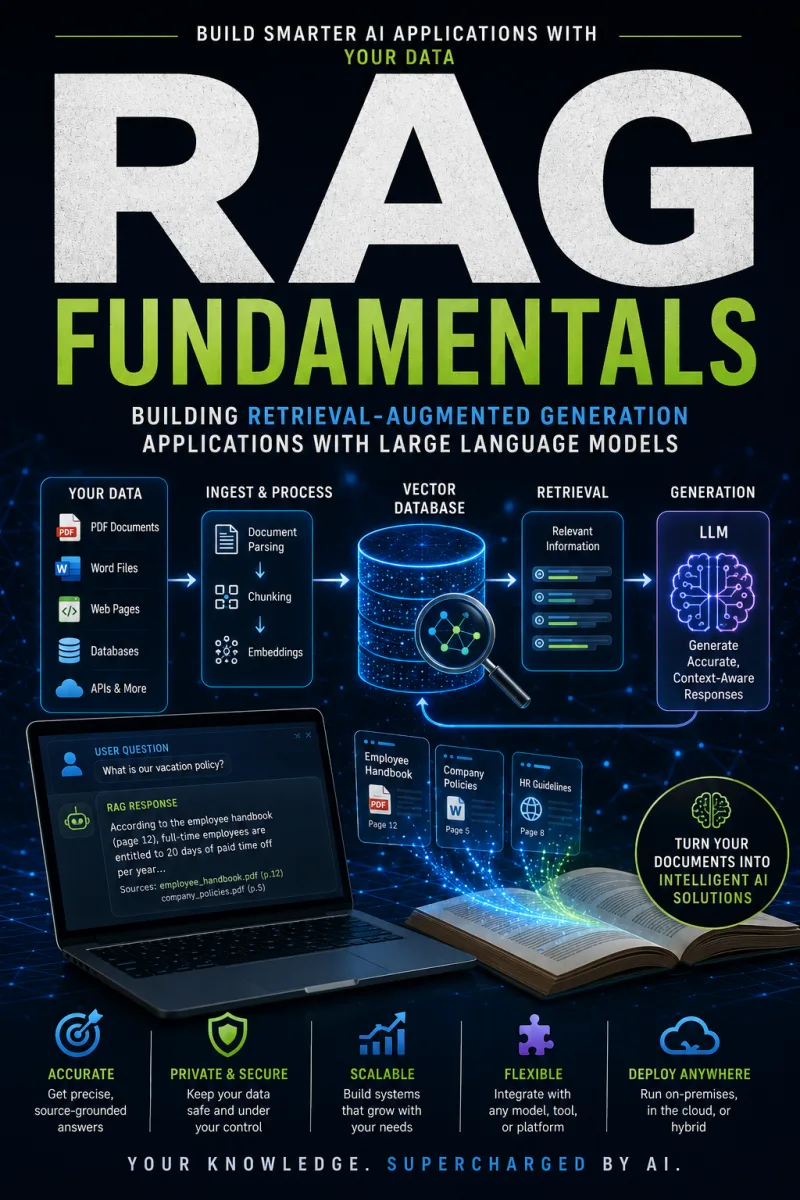
RAG Fundamentals
Building Retrieval-Augmented Generation Applications with Large Language Models
What's Included:
At a Glance
RAG Fundamentals is a professional DATA & AI eBook by Dargslan AI Team, 450 pages, available as an instant PDF and EPUB download for €18.90 with lifetime access and free updates. Building Retrieval-Augmented Generation Applications with Large Language Models.
- Length: 450 pages
- Format: PDF and EPUB (instant download)
- Language: English
- Topic: DATA & AI
- Edition: 1st Edition
- Price: €18.90
Key Highlights
- Fundamentals-first approach that transfers across tools, frameworks, and providers
- RAG broken into its core components and explained, not treated as a black box
- Understand the full RAG pipeline, from raw data to grounded generation
- Data sources, data processing, and chunking strategies
- Embeddings and vector database fundamentals
- Retrieval strategies for getting the right context to the model
- Designing a RAG system and integrating large language models
- Securing RAG applications and protecting enterprise data
- Deploying, monitoring, and optimizing RAG in production
- Advanced retrieval techniques and rigorous evaluation
- Practical RAG projects, enterprise platforms, and emerging patterns
- Learn to diagnose problems from first principles rather than guesswork
- Ten reference appendices: architecture cheat sheet, chunking and embedding guides, vector DB selection, security/performance/deployment checklists, troubleshooting, tools, and an engineer roadmap
Overview
Master Retrieval-Augmented Generation from the fundamentals up. This guide breaks RAG into its core components—data sources, chunking, embeddings, vector databases, retrieval strategies, and LLM integration—then covers security, deployment, evaluation, and enterprise-grade systems.
The Problem
Retrieval-Augmented Generation has become one of the most important patterns in applied AI—and one of the most misunderstood. Most of the discourse jumps straight to advanced techniques, clever tricks, and the framework of the week, without ever establishing a solid conceptual foundation. So developers wire up a RAG pipeline from tutorials, get something that works in a demo, and then hit a wall.
That wall is unforgiving. RAG systems fail in subtle ways: retrieval returns irrelevant context, the model hallucinates despite the retrieval, answers degrade as data grows, and enterprise data leaks through poorly secured pipelines. When you built the system by copying tricks rather than understanding fundamentals—chunking, embeddings, retrieval strategies, evaluation—you can't diagnose why it's failing, because you never understood why it worked. And because the tools change constantly, skills tied to a specific framework go stale fast, leaving you starting over with each new release.
The Solution
RAG Fundamentals corrects that imbalance by running directly through the fundamentals—the fastest, most durable path to production-ready RAG. Instead of treating RAG as a black box or a bag of tricks, it breaks the system into its core components and explains why each matters before showing how to implement it.
You'll build a fundamentals-first mental model that transfers across any vector database, embedding model, or LLM provider you choose. Progressing from data sources, processing, chunking, embeddings, vector databases, and retrieval strategies through system design and LLM integration, you'll then tackle security, enterprise data protection, deployment, monitoring, advanced retrieval, and rigorous evaluation—culminating in real projects and enterprise platforms. Because it anchors everything in stable principles rather than fleeting trends, you'll learn to diagnose problems from first principles and design systems with intention. Ten reference appendices keep the fundamentals close long after your first read.
About This Book
RAG Fundamentals: Building Retrieval-Augmented Generation Applications with Large Language Models gives you the rigorous, fundamentals-first grounding that every successful RAG system depends on. Retrieval-Augmented Generation has rapidly become one of the most transformative patterns in applied AI—yet much of the discourse jumps straight into advanced techniques without establishing a solid conceptual foundation. This book corrects that imbalance, because the fastest, most durable path to production-ready RAG runs directly through mastering the fundamentals, not around them.
Whether you're a software engineer encountering RAG for the first time, a data scientist looking to systematize your understanding, or an architect responsible for enterprise-grade deployments, this book gives you a rigorous grounding in the fundamentals that underpin every successful RAG application—regardless of scale or industry.
RAG, Broken Down and Explained
Rather than treating RAG as a black box or a collection of disconnected tricks, this book breaks it into its core components—data sources, data processing, chunking, embeddings, vector databases, retrieval strategies, and LLM integration—and explains why each piece matters before showing how to implement it. By returning again and again to fundamentals, you'll develop an intuition that transfers across tools, frameworks, and use cases. Technologies will change; the fundamentals of retrieval, representation, and generation will not.
What You'll Learn
The book progresses deliberately from foundations to production and beyond:
- The RAG pipeline as a system — how data flows from raw sources to grounded generation
- Data sources and processing — preparing real-world content for retrieval
- Chunking strategies — the design decisions that quietly make or break retrieval quality
- Embeddings and vector databases — representing and storing knowledge for fast, relevant search
- Retrieval strategies — getting the right context to the model at the right time
- Designing a RAG system and integrating LLMs — assembling the pieces intentionally
- Securing RAG applications and protecting enterprise data — production demands more than proof-of-concept thinking
- Deploying, monitoring, and optimizing RAG in production
- Advanced retrieval techniques and rigorous evaluation — measuring what matters, not just what's easy
Fundamentals That Compound
Several themes run throughout: the RAG pipeline as a system of fundamentals; design fundamentals, where architectural decisions at each stage compound into system-level performance; security and enterprise fundamentals, because production systems demand real rigor; and evaluation fundamentals, learning to measure what matters. Each chapter builds on the ones before it, culminating in advanced topics, real-world projects, and enterprise platform considerations that only make sense once the fundamentals are internalized.
A Mental Model That Outlasts the Tools
By working through this book, you'll gain a fundamentals-first mental model that serves you regardless of which vector database, embedding model, or LLM provider you ultimately choose. You'll learn to diagnose problems by returning to first principles, design systems with intentionality rather than guesswork, and communicate confidently with both engineers and stakeholders about how and why RAG systems behave the way they do.
From Fundamentals to Enterprise Platforms
The later chapters carry you into practical RAG projects, enterprise RAG platforms, and emerging patterns—showing that "advanced" work is simply the fundamentals applied at greater scale and consequence. A closing chapter on becoming a RAG engineer maps your continued growth in the field.
Reference Material You'll Return To
The extensive appendices are designed as fundamentals-based reference tools for ongoing use: a RAG architecture cheat sheet, a chunking strategy guide, an embedding model comparison, a vector database selection guide, a RAG security checklist, a performance optimization checklist, an enterprise deployment checklist, a troubleshooting guide, an overview of open-source RAG tools, and a RAG engineer roadmap.
Why This Book
Written to be rigorous without being dense and practical without sacrificing depth, this book favors clarity over jargon and fundamentals over fads. Where the RAG ecosystem shifts quickly, it anchors explanations in principles that remain stable. Mastery of RAG is mastery of its fundamentals—and this book is your guide to that mastery. Let's begin.
Who Is This Book For?
- Software engineers building RAG and LLM-powered applications
- Data scientists systematizing their understanding of retrieval systems
- AI and ML engineers designing production RAG pipelines
- Architects responsible for enterprise-grade RAG deployments
- Backend developers integrating vector databases and embeddings
- Technical leads who need to reason about and communicate RAG behavior
- Anyone who wants durable RAG understanding that outlasts specific tools
Who Is This Book NOT For?
- Complete non-developers looking for a high-level, non-technical AI overview
- Readers seeking AI research theory or the math behind training models
- Those wanting only quick copy-paste snippets for one specific framework
- Users seeking a no-code tutorial rather than genuine engineering understanding
- Anyone wanting to train foundation models rather than build retrieval systems on them
Table of Contents
- What is Retrieval-Augmented Generation?
- Understanding the RAG Pipeline
- Data Sources
- Data Processing
- Chunking Strategies
- Embeddings
- Vector Database Fundamentals
- Retrieval Strategies
- Designing a RAG System
- Integrating Large Language Models
- Securing RAG Applications
- Protecting Enterprise Data
- Deploying RAG Applications
- Monitoring & Optimization
- Advanced Retrieval Techniques
- Evaluating RAG Systems
- Practical RAG Projects
- Enterprise RAG Platforms
- Emerging RAG Patterns
- Becoming a RAG Engineer
- Appendix: RAG Architecture Cheat Sheet
- Appendix: Chunking Strategy Guide
- Appendix: Embedding Model Comparison
- Appendix: Vector Database Selection Guide
- Appendix: RAG Security Checklist
- Appendix: Performance Optimization Checklist
- Appendix: Enterprise Deployment Checklist
- Appendix: RAG Troubleshooting Guide
- Appendix: Open-Source RAG Tools
- Appendix: RAG Engineer Roadmap
Requirements
- Working software development experience in at least one mainstream language
- Comfort with APIs, the command line, and general development workflows
- Basic familiarity with how LLMs work is helpful but built up as needed
- Access to an LLM provider or local model, and a vector database, to follow the examples
- General understanding of data handling and text processing concepts
- No prior RAG experience required—the book starts from first principles