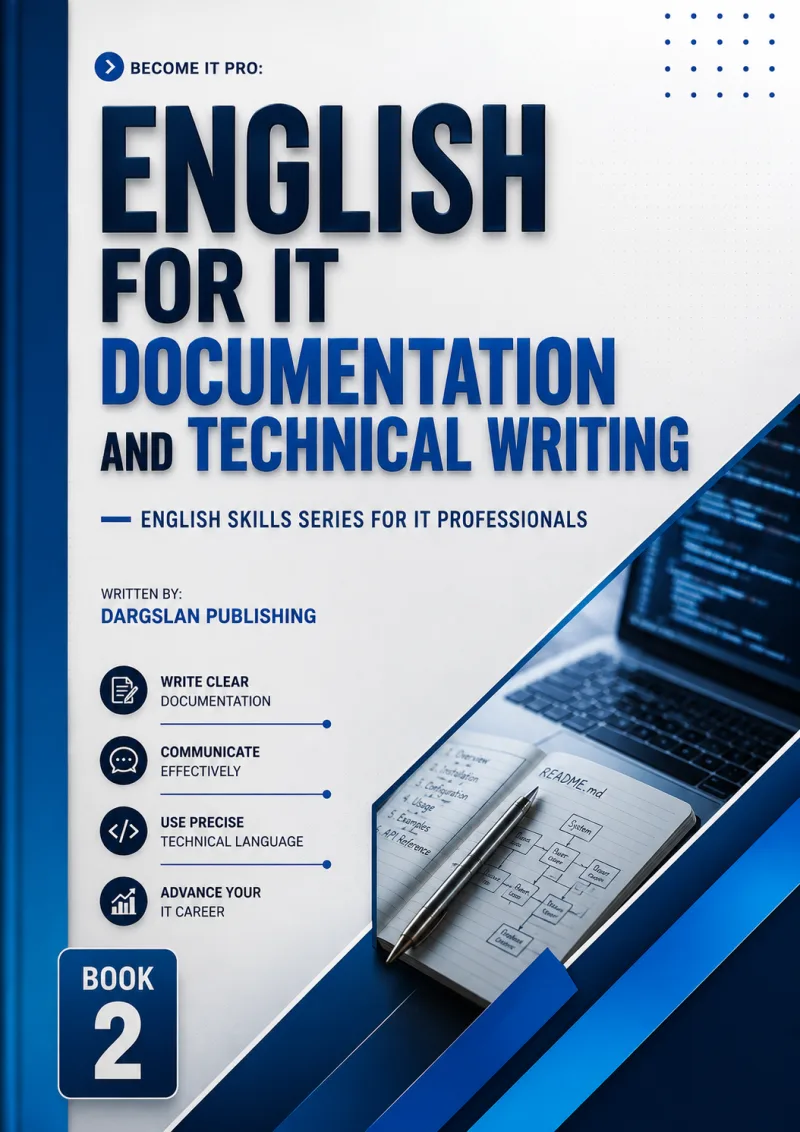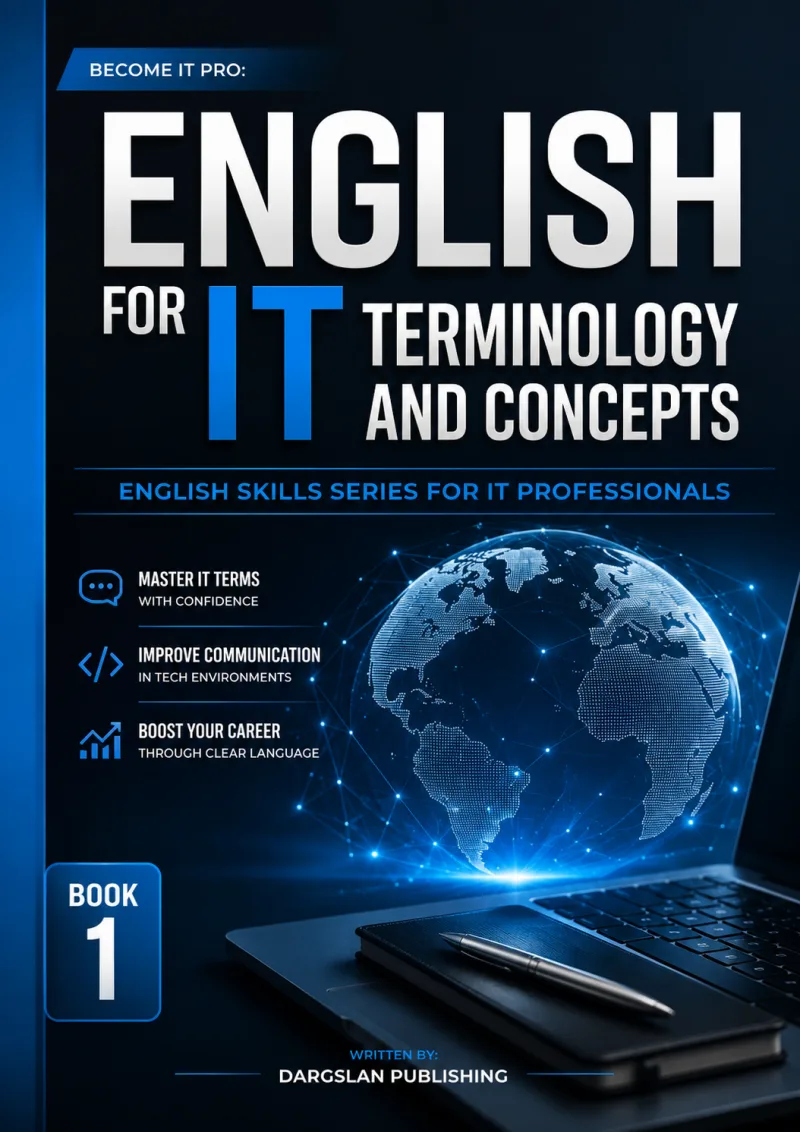
Book 1 : English for IT Terminology and Concepts
What's Included:
At a Glance
Book 1 : English for IT Terminology and Concepts is a professional English for IT eBook by Dargslan, 168 pages, available as an instant PDF and EPUB download for €12.90 with lifetime access and free updates. Master the English language of technology. This practical guide helps IT professionals—especially non-native speakers—build confident vocabulary across software...
- Length: 168 pages
- Format: PDF and EPUB (instant download)
- Language: English
- Topic: English for IT
- Edition: 1st Edition
- Price: €12.90
Key Highlights
- Master the English vocabulary that spans every major IT domain
- Designed with non-native English speakers in mind, useful for native speakers too
- Core IT terminology and the common acronyms used everywhere (API, TCP/IP, DNS, HTTP)
- Software development terms, from data structures to Agile, Scrum, and DevOps
- Networking and internet vocabulary, including web and security terms
- Cloud computing and virtualization: IaaS/PaaS/SaaS, VMs, Docker, Kubernetes
- Database concepts and core SQL command vocabulary
- Cybersecurity terminology, technologies, and compliance terms
- System administration and DevOps: CI/CD, IaC, and common tools
- Emerging tech: AI/ML, blockchain, cryptocurrency, and IoT
- Contextual usage for meetings, reports, presentations, and documentation
- Exercises and final reviews in every chapter to reinforce learning
- Read sequentially or use as a quick-reference vocabulary guide
Overview
Master the English language of technology. This practical guide helps IT professionals—especially non-native speakers—build confident vocabulary across software development, networking, cybersecurity, cloud, databases, DevOps, and AI, with real-world usage and exercises in every chapter.
The Problem
You can be a skilled developer, a sharp network administrator, or a capable support specialist—and still be held back by language. English has become the universal language of technology, and the IT world is dense with technical terms, acronyms, and jargon. When you're unsure of the vocabulary, understanding documentation is slower, explaining your ideas is harder, and speaking up in a technical meeting feels risky.
For non-native English speakers especially, this gap has real career consequences. You might know a concept perfectly well in your own language but struggle to explain it clearly to an international team, write a confident technical report, or field a global client's question on the spot. Even native speakers can stumble over the specialized vocabulary that spans networking, security, cloud, databases, and AI. When communication falters, your genuine technical ability gets undersold—and that quietly limits how far you advance.
The Solution
English for IT Terminology and Concepts closes that gap. It's built specifically to help IT professionals—especially non-native English speakers—master the vocabulary that runs through every corner of technology, and to use it confidently in real professional situations.
Across ten focused chapters, you'll build fluency in the essential terms of software development, networking, cybersecurity, cloud computing, databases, system administration and DevOps, and emerging technologies like AI and blockchain. Every concept is explained in plain English, then reinforced with contextual usage, hands-on exercises, and end-of-chapter reviews. Rather than just memorizing definitions, you'll practice applying terms in reports, presentations, technical discussions, and documentation—so when you speak or write, your real expertise finally comes through clearly and confidently.
About This Book
English for IT Terminology and Concepts is a practical guide designed to help IT professionals improve their understanding and use of English in the fast-paced world of technology. Whether you're a software developer, network administrator, system architect, or IT support specialist, mastering technical English terminology is essential for your success. In today's interconnected world, English has become the universal language of technology—and a strong command of it lets you communicate effectively with colleagues, clients, and global teams.
Why This Book
The IT industry is filled with highly technical terms, abbreviations, and jargon that can feel overwhelming, even to experienced professionals. Mastering these terms improves your ability to understand technical documentation, explain complex ideas, collaborate on projects, and navigate everyday workplace conversations. Whether you're just starting your career or advancing to a senior role, improving your IT English vocabulary is a smart investment in your professional growth. The ability to confidently explain technical concepts, troubleshoot problems, and write clear documentation genuinely sets you apart in the industry.
What You'll Learn
This book takes you through the essential terminology used across the major IT domains:
- Core IT terminology — the foundational terms and common acronyms (API, TCP/IP, RAM, CPU, DNS, HTTP) used across every department
- Software development — algorithms, data structures, functions, classes, version control, and development lifecycles like Agile, Scrum, Waterfall, and DevOps
- Networking and the internet — LAN, WAN, VPN, IP addresses, ports, web technologies, protocols, and networking security terms
- Cloud computing and virtualization — cloud models (IaaS, PaaS, SaaS), major providers, hypervisors, VMs, Docker, and Kubernetes
- Databases — tables, queries, indexes, relational vs. NoSQL, and core SQL commands
- Cybersecurity — malware, phishing, vulnerabilities, threats, security technologies, and compliance terms
- System administration and DevOps — servers, shell scripting, CI/CD, pipelines, infrastructure as code, and common tools
- Emerging technologies — AI and machine learning, blockchain and cryptocurrency, and the Internet of Things
Terminology in Real-World Context
The goal isn't just to familiarize you with individual terms—it's to help you understand how to use them in real-world contexts: writing reports, giving presentations, and collaborating with international teams. Each chapter explains key concepts in plain English, then shows contextual usage so you can apply the vocabulary in meetings, documentation, and everyday professional conversations. Later chapters focus specifically on practical usage: how to speak confidently in technical discussions and how to decode dense technical documentation using your growing command of the language.
Learn by Practicing
This is a book to be practiced, not just read. Every chapter includes clear definitions and examples, contextual usage scenarios, hands-on exercises, and a final review of key terms to consolidate your learning. Exercises range from matching definitions and filling in blanks to writing SQL queries, analyzing sample technical documents, and simulating real-world IT scenarios—so the vocabulary sticks.
Who This Book Is For
This book is intended for IT professionals of all levels. It's especially valuable for non-native English speakers who want to strengthen their technical language skills, but even native speakers benefit from a focused review of the specialized vocabulary that forms the backbone of IT communication. Whether you're a developer on an international team, a support specialist handling global client inquiries, or a systems administrator writing technical reports, this guide helps you use IT terms more confidently in any situation.
How to Use It
The chapters are organized to cover key areas of IT, so you can read sequentially or jump to the topics most relevant to you. Read it cover to cover to build comprehensive fluency, or keep it as a reference to reach for whenever you encounter unfamiliar terms. Either way, it's designed to help you navigate the complex and exciting world of IT with greater confidence.
Why This Book
In a rapidly evolving field, the ability to communicate effectively in English is more important than ever. This book gives you the tools and knowledge to excel—expanding your vocabulary and, just as importantly, helping you apply it in practical, real-world situations. Let's get started on the journey to mastering the language of technology.
Who Is This Book For?
- Non-native English speakers working in or entering the IT industry
- Software developers collaborating on international teams
- IT support specialists handling global client communication
- System and network administrators writing technical reports and documentation
- Students and career-changers entering the technology field
- IT professionals preparing for interviews, presentations, or senior roles
- Native English speakers wanting a focused review of specialized IT vocabulary
Who Is This Book NOT For?
- Readers seeking a deep technical how-to guide for a specific technology rather than its vocabulary
- Advanced English speakers who already have full command of IT terminology across all domains
- Those wanting a general English-language course unrelated to technology
- People looking to learn to code or configure systems rather than communicate about them
- Readers seeking certification-exam preparation rather than language and communication skills
Table of Contents
- Core IT Terminology
- Software Development Terminology
- Networking and Internet Terminology
- Cloud Computing and Virtualization Terms
- Database Terminology
- Cybersecurity Terminology
- System Administration and DevOps Terminology
- Emerging Technologies and Terminology
- Practical Usage of IT Terminology
- Putting It All Together
Requirements
- Basic to intermediate English reading ability
- General interest in or exposure to the IT/technology field
- No advanced technical expertise required—concepts are explained in plain English
- A willingness to complete the exercises and practice using the terms
- No special software or equipment needed
- Ideal for non-native English speakers, but open to all levels