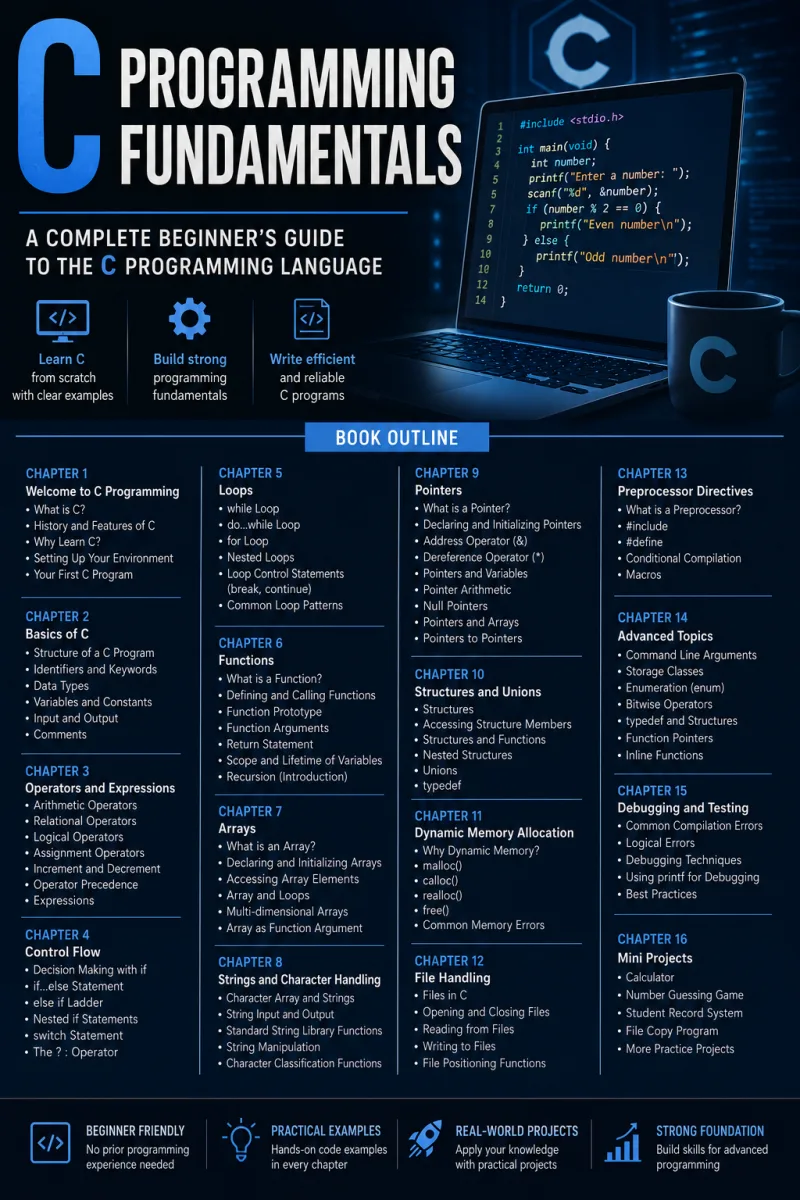
C Programming Fundamentals
A Complete Beginner's Guide to the C Programming Language
What's Included:
At a Glance
C Programming Fundamentals is a professional PROGRAMMING & DEVELOPMENT eBook by Marcus Webb, 401 pages, available as an instant PDF and EPUB download for €17.90 with lifetime access and free updates. A Complete Beginner's Guide to the C Programming Language.
- Length: 401 pages
- Format: PDF and EPUB (instant download)
- Language: English
- Topic: PROGRAMMING & DEVELOPMENT
- Edition: 1st Edition
- Price: €17.90
Key Highlights
- True beginner-friendly: no prior programming background required
- Teaches programming as a way of thinking, not just syntax memorization
- Complete coverage from your first program to real working projects
- Variables, data types, operators, and expressions explained clearly
- Decision making, loops, and functions to build programming logic
- Scope and storage classes, arrays, and strings
- Pointers and dynamic memory allocation demystified for beginners
- Structures, unions, enumerations, and file handling
- A dedicated chapter on debugging and error handling
- Practical Projects chapter that synthesizes everything into working code
- Each chapter builds on the last, following the natural learning curve
- Ten reference appendices: cheat sheet, standard library reference, operator precedence, ASCII table, compiler options, build guide, debugging checklist, best practices, common beginner mistakes, and next steps
Overview
Learn C from your very first program to real working projects. This complete beginner's guide covers variables, operators, control flow, functions, arrays, strings, pointers, dynamic memory, structures, file handling, and debugging—with clear explanations and hands-on practice throughout.
The Problem
C has a reputation that scares people away. It's the language behind operating systems, embedded devices, and the runtimes of nearly every modern language—which makes it enormously valuable to learn, and enormously intimidating to start. Beginners hear "pointers" and "manual memory management" and assume the door is closed to them.
The available learning material doesn't help. Some resources are terse reference manuals written for people who already know how to program. Others rush through syntax without ever explaining the logic underneath, leaving you able to copy examples but unable to write anything yourself—or to understand why your program crashed. The genuinely hard parts, pointers, dynamic memory, and debugging, are exactly where most tutorials go thin. So learners stall out, convinced the problem is them rather than the teaching.
The Solution
C Programming Fundamentals is built for exactly that beginner. It assumes no prior technical background and treats programming as a way of thinking rather than a set of commands to memorize—so you build genuine understanding, not just copied syntax.
You'll progress naturally from your first program through variables, operators, decision making, loops, functions, arrays, and strings. Then the intimidating topics—pointers, dynamic memory allocation, structures, and file handling—are demystified through clear explanations and hands-on examples, giving you the deep grasp of memory management that separates proficient developers from beginners. A dedicated debugging chapter builds real troubleshooting skill, and a Practical Projects chapter ties everything into working, tested code. Ten reference appendices, from a cheat sheet and standard library reference to common beginner mistakes, keep supporting you long after your first read.
About This Book
C Programming Fundamentals: A Complete Beginner's Guide to the C Programming Language was created with a singular mission: to make the art and discipline of programming accessible to everyone, regardless of prior technical background. Among the many languages that have shaped our digital world, C stands as the foundation upon which countless others are built—and learning it well changes how you understand software forever.
Whether you're a student taking your first steps into computer science, a self-taught enthusiast eager to understand how software truly works, or a professional looking to strengthen your programming foundations, this book guides you through the essential concepts of C with clarity, patience, and practical relevance.
Why C, and Why This Approach
C is often called the "mother of all languages"—and for good reason. Learning to program in C teaches you not just syntax, but the fundamental logic of how computers think, process data, and execute instructions. This book embraces that philosophy by treating programming not as a mechanical skill, but as a way of thinking. The habits and understanding you build here transfer to every language you learn afterward.
The Complete Spectrum of C Fundamentals
The book covers C programming from the ground up. You'll start by writing your very first program and understanding the structure of a C program, then master variables and data types, operators and expressions, decision making, and loops. From there you'll move into functions, scope and storage classes, arrays, and strings—building a solid command of programming logic step by step.
Then comes the territory that intimidates most beginners: pointers, dynamic memory allocation, structures, unions and enumerations, and file handling. These topics are demystified here through clear explanations and hands-on examples, so you develop the deep understanding of memory management that distinguishes proficient developers from beginners. A dedicated chapter on debugging and error handling ensures you can find and fix problems confidently rather than guessing.
Learning by Doing
Each chapter builds upon the previous one, reflecting the natural learning curve of programming. This is not a book to be passively read—it's a book to be practiced. Programming is learned by doing, and every chapter encourages active engagement with code. The journey culminates in a Practical Projects chapter, where you synthesize everything into functional, tested programs of your own.
What You'll Gain
- A strong command of programming logic — understanding how decision-making, loops, and functions drive software behavior
- Practical coding skills — the ability to read, write, and debug C programs confidently
- A deep understanding of memory management — a critical skill that sets proficient developers apart
- Problem-solving abilities — the true essence of programming, cultivated through hands-on exercises and projects
A Reference That Outlives Your First Read
The extensive appendices serve as ongoing reference tools: a C language cheat sheet, a standard library reference, an operator precedence table, an ASCII table, common compiler options, a build and compilation guide, a debugging checklist, programming best practices, and a guide to common beginner mistakes. A final "Next Steps" appendix bridges this book with advanced C programming and your continued journey beyond these pages.
Why This Book
Programming is not just a technical skill—it's a mindset. Every expert programmer once began exactly where you are now. This guide meets you there and walks with you, patiently and practically, until writing C feels natural. Welcome to the world of programming. Let's begin.
Who Is This Book For?
- Complete beginners writing their first lines of code
- Computer science students learning C for coursework
- Self-taught programmers who want strong fundamentals
- Developers from higher-level languages who want to understand what's underneath
- Aspiring embedded, systems, or low-level programmers
- Professionals strengthening their programming foundations
- Anyone who wants to understand how computers actually think and manage memory
Who Is This Book NOT For?
- Experienced C developers looking for advanced or expert-level techniques
- Readers seeking a C++, C#, or other language guide rather than C
- Those wanting a deep dive into a specific domain (kernel development, embedded RTOS) rather than fundamentals
- People looking for a quick syntax reference rather than a learning course
- Anyone unwilling to write and run code—this book is meant to be practiced, not just read
Table of Contents
- Introduction to C Programming
- The Structure of a C Program
- Variables and Data Types
- Operators and Expressions
- Decision Making
- Loops
- Functions
- Scope and Storage Classes
- Arrays
- Strings
- Pointers
- Dynamic Memory Allocation
- Structures, Unions and Enumerations
- File Handling
- Debugging and Error Handling
- Practical Projects
- Appendix: C Language Cheat Sheet
- Appendix: Standard Library Reference
- Appendix: Operator Precedence Table
- Appendix: ASCII Table
- Appendix: Common Compiler Options
- Appendix: Build & Compilation Guide
- Appendix: Debugging Checklist
- Appendix: Programming Best Practices
- Appendix: Common Beginner Mistakes
- Appendix: Next Steps — Advanced C Programming
Requirements
- No prior programming experience required—this is a complete beginner's guide
- A computer running Windows, macOS, or Linux
- A C compiler (such as GCC or Clang) — installation and compiler options are covered
- A text editor or IDE of your choice
- Basic computer literacy (creating files, using a terminal is taught as you go)
- A willingness to write and run code regularly—programming is learned by doing