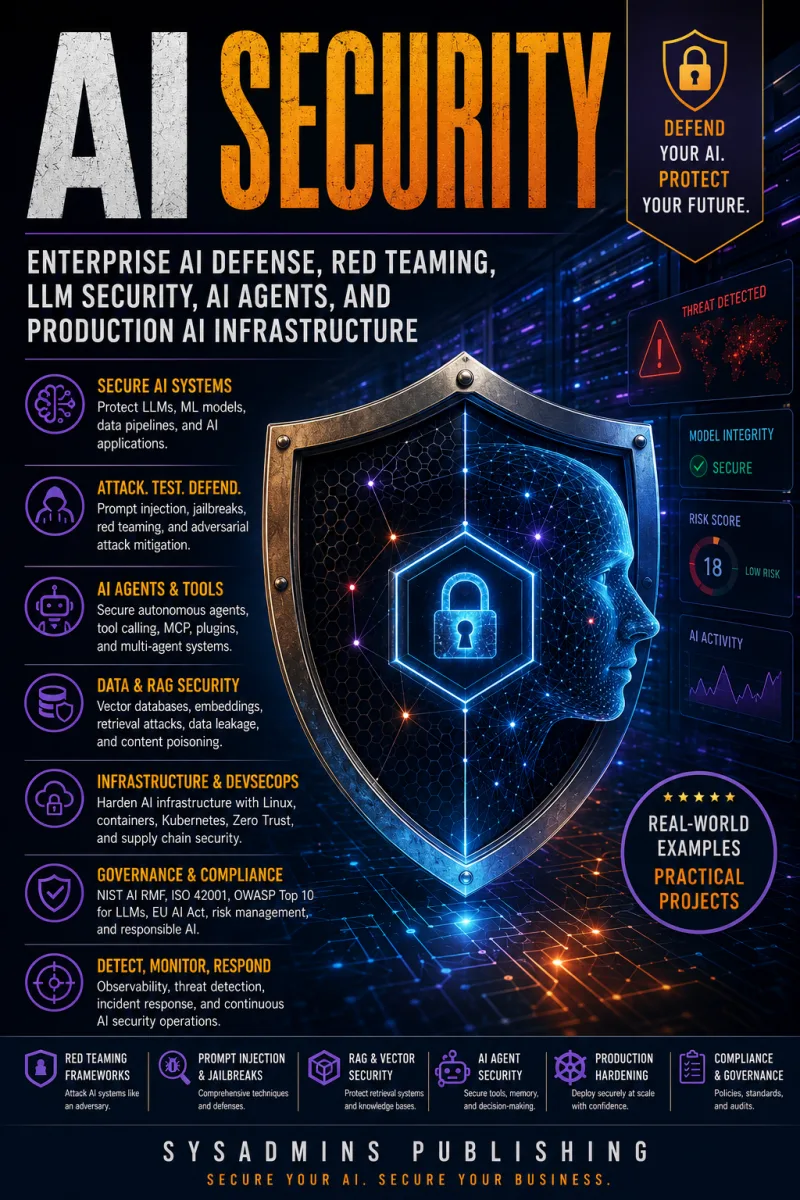
AI Security
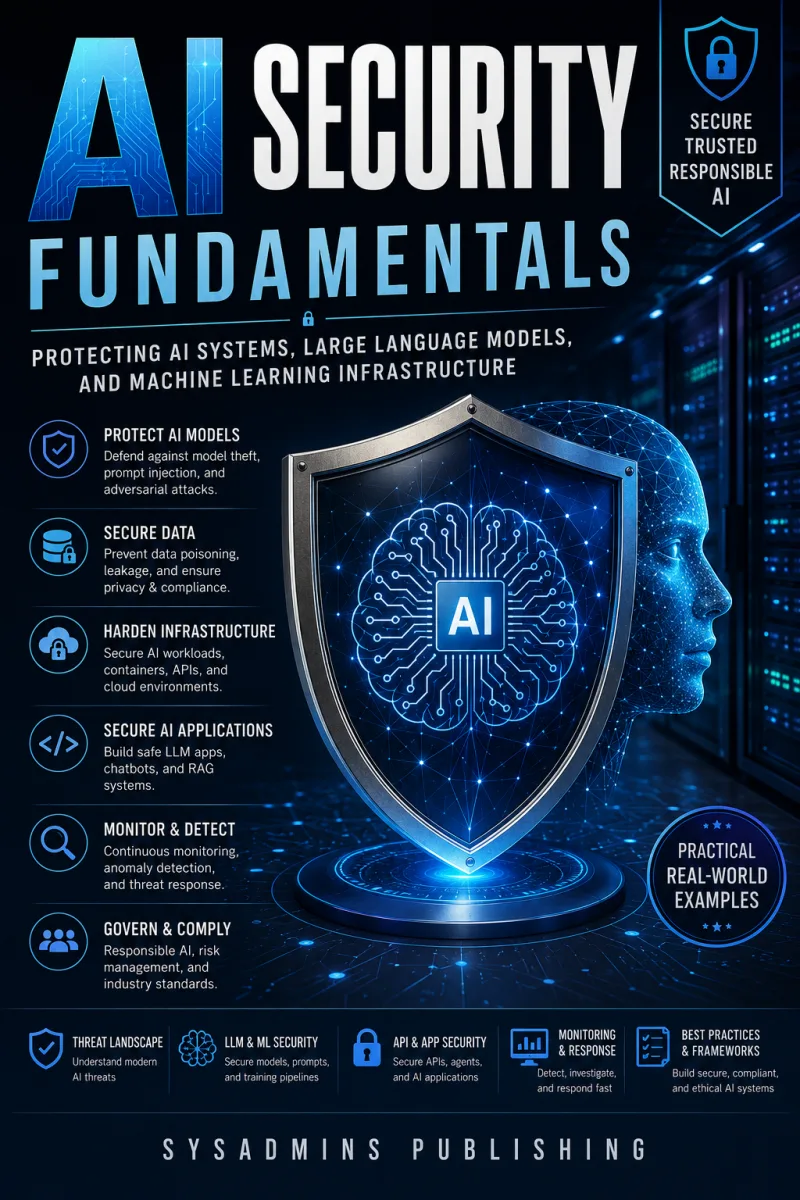
Securing Large Language Models, Machine Learning Systems, AI Agents, and Enterprise AI Infrastructure
What's Included:
At a Glance
AI Security is a professional DATA & AI eBook by Dargslan, 536 pages, available as an instant PDF and EPUB download for €26.90 with lifetime access and free updates. Securing Large Language Models, Machine Learning Systems, AI Agents, and Enterprise AI Infrastructure.
- Length: 536 pages
- Format: PDF and EPUB (instant download)
- Language: English
- Topic: DATA & AI
- Edition: 1st Edition
- Price: €26.90
Key Highlights
- Comprehensive, practitioner-focused defense of enterprise AI systems
- A security-first mental model for every layer of the AI stack
- Security across the full AI lifecycle, from dataset to production
- Dataset security, training pipeline hardening, and model integrity
- Deep coverage of LLM security: prompt injection, jailbreaks, and context window exploitation
- Hallucinations, trust failures, and how to defend against them
- AI agent security and agent authorization boundaries
- RAG architecture security and embedding security
- AI infrastructure, container, API, and secrets management hardening
- Privacy and data leakage prevention
- AI monitoring, incident response, governance, standards, and frameworks
- Building secure AI platforms and applying AI red teaming
- Extensive appendices: security, prompt injection, RAG, agent, and deployment checklists; risk assessment template; incident response playbook; tool catalog; and glossary
Overview
A comprehensive, practitioner's guide to defending enterprise AI—LLMs, ML systems, and autonomous agents. Covers prompt injection, jailbreaks, training pipeline and dataset security, RAG and embedding defense, agent authorization, infrastructure hardening, governance, and AI red teaming.
The Problem
AI has become critical enterprise infrastructure—running customer service, financial decisions, healthcare diagnostics, and autonomous agents that act on the business's behalf. But it arrived faster than security did. In the race to deploy LLMs, ML pipelines, and agents, security has too often been bolted on as an afterthought, if it was considered at all.
The deeper problem is that traditional cybersecurity frameworks simply weren't built for these systems. Nothing in classic security models accounts for software that generates its own outputs, reasons over untrusted context, or acts autonomously across your environment. AI opens entirely new attack surfaces—prompt injection, jailbreaking, training data poisoning, model extraction, embedding manipulation, agent authorization abuse—that didn't exist a decade ago. Defending against them with yesterday's playbook leaves high-stakes, decision-making systems dangerously exposed.
The Solution
AI Security gives practitioners the new security thinking these systems demand. It's a book about AI risk and the disciplined engineering required to manage it—delivering actionable frameworks, not just theory, for defending LLMs, ML systems, autonomous agents, and enterprise AI infrastructure.
You'll build a security-first mental model for every layer of the stack, working across the full AI lifecycle: dataset integrity and training pipeline hardening; LLM vulnerabilities like prompt injection, jailbreaks, and context window exploitation; RAG, embedding, and agent authorization security; and infrastructure, container, API, and secrets hardening in production. Governance, monitoring, incident response, and red teaming round out a complete program. Backed by checklists, a risk assessment template, an incident response playbook, and a tool catalog, this book helps you build AI systems that are not just powerful, but genuinely secure.
About This Book
AI Security: Securing Large Language Models, Machine Learning Systems, AI Agents, and Enterprise AI Infrastructure is a comprehensive, practitioner-focused guide to defending the systems that increasingly define how businesses operate and compete. AI now powers customer service, financial decisions, healthcare diagnostics, and autonomous agents that act on our behalf—yet in the race to deploy, security has too often been an afterthought rather than a foundation. This book exists to close that gap.
This is not a book about AI capabilities—it's a book about AI risk, and the disciplined engineering practices required to manage it. If you're responsible for building, deploying, or defending AI in production, it gives you actionable frameworks rather than theory.
Security Built for a New Kind of System
Traditional cybersecurity frameworks were never designed for systems that generate their own outputs, reason over untrusted context, or act autonomously across enterprise environments. AI introduces novel attack surfaces: prompt injection, jailbreaking, training data poisoning, model extraction, embedding manipulation, and agent authorization abuse—threats that didn't exist a decade ago and that demand new security thinking. This book addresses that reality head-on.
The Full AI Lifecycle
You'll examine security across the entire AI lifecycle: from dataset integrity and training pipeline hardening, through LLM-specific vulnerabilities like prompt injection and context window exploitation, to the operational challenges of securing agents, APIs, containers, and secrets in production. The book also addresses the governance layer—privacy, compliance, incident response, and the emerging standards that will shape how AI security is regulated and audited.
What You'll Gain
Readers develop a security-first mental model for every layer of the AI stack. You'll learn to:
- Assess and mitigate threats unique to LLMs, ML systems, and autonomous agents
- Harden training pipelines and datasets against poisoning and integrity attacks
- Defend against prompt injection, jailbreaks, and hallucination-driven trust failures
- Secure RAG architectures, embeddings, and agent authorization boundaries
- Build resilient AI infrastructure, from container security to secrets management
- Establish governance, monitoring, and incident response programs tailored to AI systems
- Apply red teaming methodologies to proactively test your AI security posture
Deep Technical Coverage Where It Counts
The book progresses deliberately: foundational concepts and threat landscapes first, followed by deep technical treatment of ML and LLM security, then agent and infrastructure security, and finally governance, standards, and future-facing challenges. Along the way it tackles the topics defining modern AI security—prompt injection and jailbreak techniques, hallucinations and trust, context window security, AI agent security and authorization, RAG security, embedding security, and model integrity—giving each the rigorous attention it deserves.
From Threats to Secure Platforms
Understanding threats is only half the discipline; this book carries you through to building resilient systems. You'll secure AI infrastructure, containers, APIs, and secrets; establish privacy and data leakage prevention; stand up AI monitoring and incident response; and align with governance, standards, and frameworks. The later chapters bring it all together—building secure AI platforms, applying AI red teaming, and delivering secure AI projects—while looking ahead to the future of AI security.
Reference Material for Immediate Use
Extensive appendices are designed for immediate application in your own organization: an AI security checklist, a prompt injection checklist, a secure RAG checklist, a secure agent checklist, an LLM deployment checklist, an AI risk assessment template, an AI incident response playbook, an AI security tool catalog, and a glossary.
Who This Book Is For
Whether you're a security engineer, ML practitioner, platform architect, or CISO, this book equips you with actionable frameworks for securing AI systems that are already shaping critical decisions. The tone throughout is practitioner-focused and unflinching—rigorous where rigor is warranted, but always oriented toward actionable defense. For every reader who intends to build AI systems that are not just powerful, but secure, this work is for you.
Who Is This Book For?
- Security engineers and architects defending enterprise AI systems
- ML practitioners and AI engineers who need to secure what they build
- Platform and infrastructure architects deploying AI in production
- CISOs and security leaders responsible for AI risk and governance
- AI red teamers and offensive security professionals testing AI systems
- DevSecOps engineers securing AI pipelines, agents, and APIs
- Teams building LLM applications, RAG systems, or autonomous agents at scale
Who Is This Book NOT For?
- Readers seeking a general machine learning or model-building tutorial rather than security
- Those wanting only a high-level, non-technical AI ethics discussion
- Complete beginners with no technical or security background
- Hobbyists looking for casual, small-scale AI tips rather than enterprise-grade defense
- Anyone expecting pure theory without checklists, frameworks, or actionable controls
Table of Contents
- Introduction to AI Security
- AI Threat Landscape
- AI System Architecture
- ML Security Fundamentals
- Dataset Security
- Training Pipeline Security
- Model Integrity
- LLM Architecture Security
- Prompt Injection Attacks
- Jailbreak Techniques
- Hallucinations & Trust
- Context Window Security
- AI Agent Security
- Agent Authorization
- RAG Security
- Embedding Security
- AI Infrastructure
- Container Security
- API Security
- Secrets Management
- Privacy
- Data Leakage Prevention
- AI Monitoring
- AI Incident Response
- AI Governance
- Standards & Frameworks
- Building Secure AI Platforms
- AI Red Teaming
- Secure AI Projects
- Future of AI Security
- Appendix: AI Security Checklist
- Appendix: Prompt Injection Checklist
- Appendix: Secure RAG Checklist
- Appendix: Secure Agent Checklist
- Appendix: LLM Deployment Checklist
- Appendix: AI Risk Assessment Template
- Appendix: AI Incident Response Playbook
- Appendix: AI Security Tool Catalog
- Appendix: AI Security Glossary
Requirements
- A technical background in security, software engineering, or machine learning
- Familiarity with core cybersecurity concepts (threats, controls, defense in depth)
- Understanding of how LLMs, ML systems, or AI agents work is strongly helpful
- Comfort with APIs, containers, and cloud infrastructure for the hands-on chapters
- Access to a test environment to apply the frameworks, checklists, and projects
- This is a practitioner-level book; enterprise or production AI context is assumed