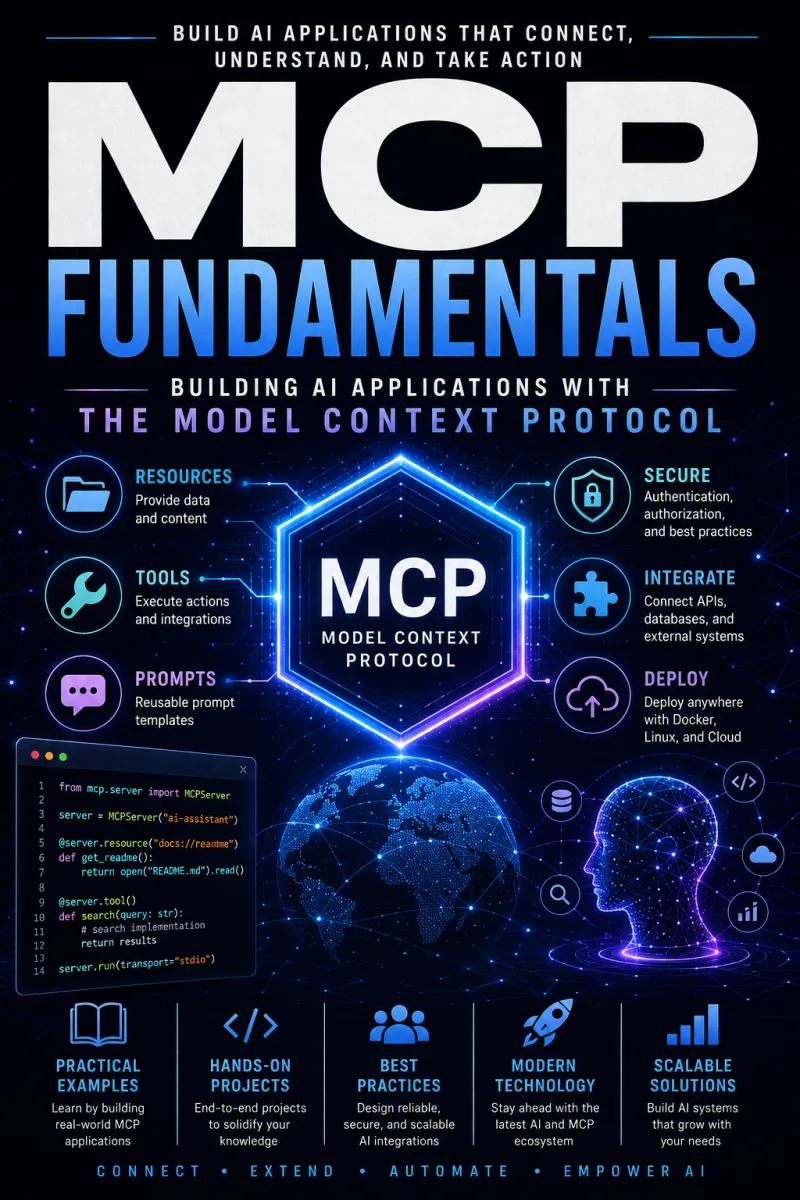
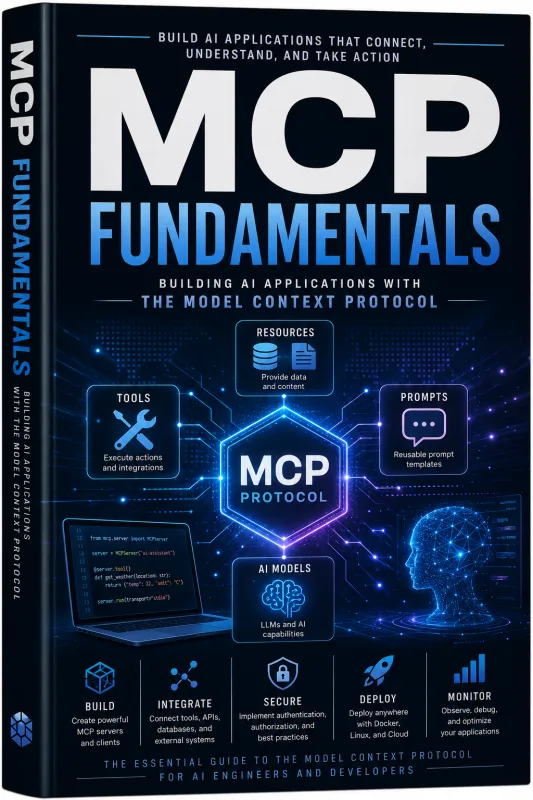
MCP Fundamentals
Building AI Applications with the Model Context Protocol
What's Included:
At a Glance
MCP Fundamentals is a professional DATA & AI eBook by Dargslan AI Team, 440 pages, available as an instant PDF and EPUB download for €18.90 with lifetime access and free updates. Building AI Applications with the Model Context Protocol.
- Length: 440 pages
- Format: PDF and EPUB (instant download)
- Language: English
- Topic: DATA & AI
- Edition: 1st Edition
- Price: €18.90
Key Highlights
- Structured path through MCP fundamentals, from first principles to production
- Build a clear, accurate mental model of how and why MCP works
- Set up your development environment and build your first MCP server
- Master the core building blocks: servers, resources, context, tools, and prompts
- Advanced tool design and prompt engineering for MCP
- Secure MCP applications and manage secrets properly
- Connect external services and integrate with AI platforms
- Deploy MCP servers with confidence
- Monitor and troubleshoot MCP applications in production
- Practical MCP projects and enterprise-scale solutions
- Explore emerging MCP patterns and a path to becoming an MCP engineer
- Understand why MCP works, not just how—so you can adapt as it evolves
- Ten reference appendices: terminology, message reference, resource/tool/prompt design guides, security and deployment checklists, debugging cheat sheet, ecosystem overview, and an engineer roadmap
Overview
Master the Model Context Protocol from first principles to production. This hands-on guide teaches you to build MCP servers, resources, tools, and prompt templates, then secure, deploy, and monitor them—connecting AI applications to external tools and services reliably and at scale.
The Problem
The Model Context Protocol is quickly becoming the standard way AI applications reach beyond the model—into external tools, data sources, and services. But its power has outpaced the shared understanding of how to use it well. Developers are wiring up MCP servers and tools from scattered snippets and half-understood examples, without a clear mental model of how the pieces actually fit together.
That shortcut-driven approach breaks down fast. An MCP integration that "works" in a quick test can be insecure, fragile, or impossible to maintain once real data, real users, and real services are involved. Without understanding resources, context management, tool design, secrets, and deployment as a coherent whole, you end up guessing—and guessing produces integrations that leak secrets, behave unpredictably, and fall apart in production. As AI applications grow more capable and more connected, that shaky foundation becomes a real liability.
The Solution
MCP Fundamentals replaces scattered snippets and guesswork with a deliberate, structured path through the core fundamentals of the Model Context Protocol—from first principles to production-grade competence. It's built on a simple belief: mastery begins with fundamentals, not shortcuts.
You'll first understand what MCP is and why it was designed the way it was, then build the fundamental building blocks hands-on—servers, resources, context management, tools, and prompt templates. From there you'll layer on real capability: securing applications, managing secrets, connecting external services, integrating AI platforms, and deploying and monitoring servers with confidence. The book culminates in practical projects and enterprise solutions, revealing that "advanced" work is simply the fundamentals applied at scale. With ten reference appendices—message reference, design checklists, security and deployment guides, and a debugging cheat sheet—you'll build MCP applications that are reliable, secure, and maintainable.
About This Book
MCP Fundamentals: Building AI Applications with the Model Context Protocol gives developers the solid grounding they need as AI applications grow more sophisticated—reaching into external tools, resources, and services. Every transformative technology reaches a moment when its power outpaces the shared understanding of how to use it well. The Model Context Protocol has reached that moment, and this book was written to provide exactly the fundamentals that make MCP integrations reliable, secure, and maintainable.
This is not a book of scattered tips or advanced edge cases reserved for specialists. It's a deliberate, structured journey through the core fundamentals of MCP—starting from first principles and building steadily toward real-world competence. Whether you're an engineer encountering MCP for the first time or a practitioner solidifying your understanding, this book meets you where you are and walks you forward with intention.
Fundamentals First
The book is organized around a simple belief: mastery begins with fundamentals, not shortcuts. The early chapters establish what MCP is and why it matters, demystifying the ecosystem before you write a single line of code. From there, you'll move into the fundamental building blocks—servers, resources, context management, tools, and prompts—each explored with enough depth to be practical, but never so much that it obscures the core concepts.
From Building Blocks to Real Capability
As the book progresses, those fundamentals are layered with real capability: securing applications, managing secrets, connecting external services, integrating with AI platforms, and deploying servers with confidence. By the time you reach the chapters on enterprise solutions and emerging patterns, you'll discover that the "advanced" material is simply the fundamentals applied at greater scale and consequence—proof that a strong foundation is what makes advanced work possible in the first place.
What You'll Learn
Readers will come away with:
- A clear, accurate mental model of how MCP works and why it was designed the way it was
- Hands-on experience building servers, tools, and prompt templates from scratch
- Deep understanding of resources, context management, and advanced tool design
- Practical fluency in securing, deploying, and monitoring MCP applications
- The ability to connect external services and integrate with AI platforms
- Confidence to tackle real projects, informed by fundamentals rather than guesswork
- A roadmap for continued growth as an MCP engineer
Understand Why, Not Just How
Written for practitioners by practitioners, the book favors clarity over jargon and practical understanding over theoretical abstraction. Where complexity is unavoidable, it slows down and explains the fundamentals underlying it. Where shortcuts are tempting, it resists them in favor of genuine understanding. You'll finish not merely knowing how to use MCP, but why it works the way it does—the kind of understanding that lets you adapt as the protocol and ecosystem evolve.
Hands-On and Practical
This is a build-it-yourself book. You'll set up a development environment, create your first MCP server, work with resources, manage context, build and refine tools, and design prompt templates. Then you'll secure applications, manage secrets, connect external services, deploy servers, and monitor and troubleshoot them in production—culminating in practical MCP projects and enterprise solutions that bring everything together.
Reference Material for the Long Haul
The extensive appendices reinforce these fundamentals long after your first read: MCP terminology, an MCP message reference, resource and tool design checklists, a prompt design guide, security and deployment checklists, a debugging cheat sheet, an overview of the open-source MCP ecosystem, and an MCP engineer roadmap. Together they form a companion you'll return to throughout your career.
Why This Book
MCP is quickly becoming the standard way AI applications connect to the tools, data, and services around them. Building on it well requires more than copied snippets—it requires genuine understanding of the fundamentals. This book delivers exactly that, in a structured path from first principles to production-grade capability. Welcome to the fundamentals of MCP. Let's begin.
Who Is This Book For?
- Software engineers building AI applications that connect to external tools and services
- AI and LLM developers integrating models with data sources and APIs
- Backend developers creating MCP servers and tools
- Practitioners who've experimented with MCP and want solid, structured fundamentals
- Engineers deploying and operating MCP applications in production
- Technical teams standardizing how their AI systems access tools and context
- Anyone who wants to understand not just how to use MCP, but why it works
Who Is This Book NOT For?
- Complete non-developers looking for a high-level, non-technical AI overview
- Readers seeking AI model training or research rather than application integration
- Those wanting only a quick copy-paste snippet rather than genuine understanding
- Users looking for a specific vendor product manual rather than the open protocol itself
- Anyone expecting pure theory without hands-on building, deployment, and operations
Table of Contents
- What is the Model Context Protocol?
- Understanding the MCP Ecosystem
- Installing Your Development Environment
- Your First MCP Server
- Working with Resources
- Managing Context
- Building MCP Tools
- Advanced Tool Design
- Prompt Templates
- Prompt Engineering for MCP
- Securing MCP Applications
- Secrets Management
- Connecting External Services
- AI Platform Integration
- Deploying MCP Servers
- Monitoring & Troubleshooting
- Practical MCP Projects
- Enterprise MCP Solutions
- Emerging MCP Patterns
- Becoming an MCP Engineer
- Appendix: MCP Terminology
- Appendix: MCP Message Reference
- Appendix: Resource Design Checklist
- Appendix: Tool Design Checklist
- Appendix: Prompt Design Guide
- Appendix: MCP Security Checklist
- Appendix: Deployment Checklist
- Appendix: Debugging Cheat Sheet
- Appendix: Open-Source MCP Ecosystem
- Appendix: MCP Engineer Roadmap
Requirements
- Working software development experience in at least one mainstream language
- Comfort with the command line, APIs, and general development workflows
- A development environment you can set up (guidance is provided)
- Basic familiarity with how LLMs and AI applications work is helpful
- General understanding of client-server and API concepts
- No prior MCP experience required—the book starts from first principles