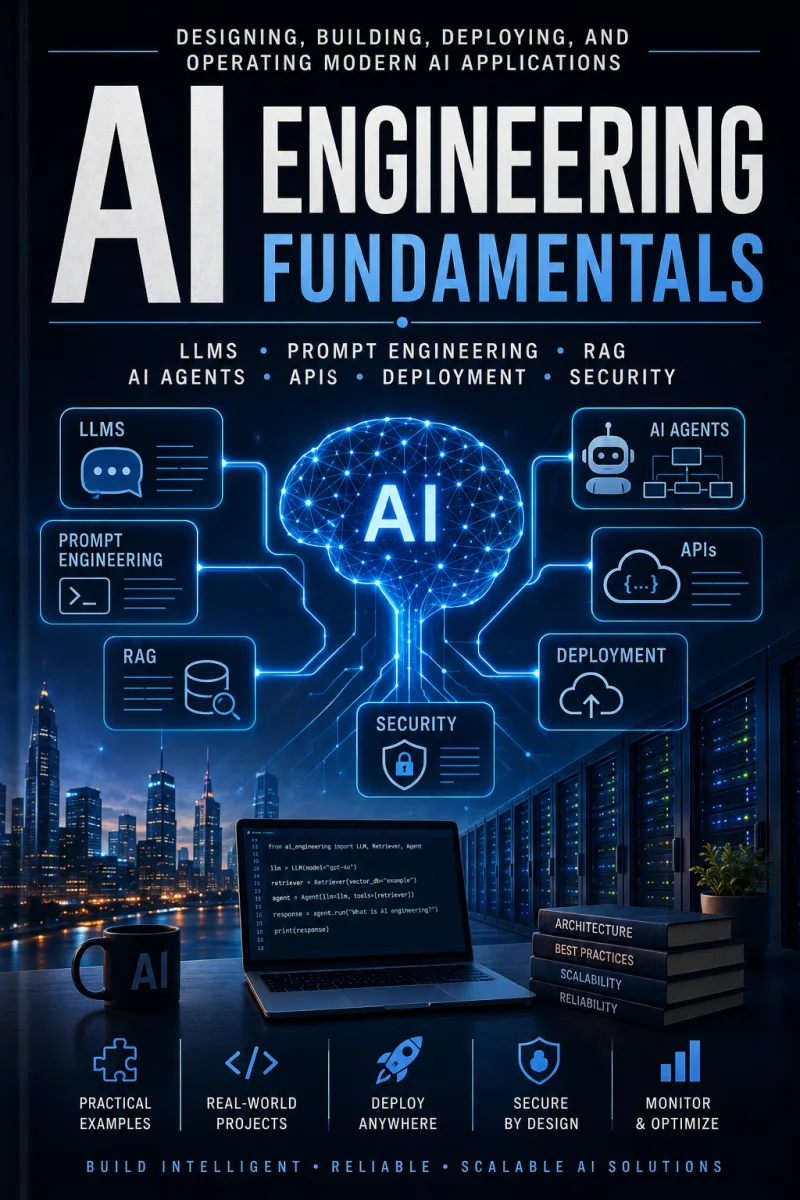
AI Engineering Fundamentals
Designing, Building, Deploying, and Operating Modern AI Applications
What's Included:
At a Glance
AI Engineering Fundamentals is a professional DATA & AI eBook by Dargslan AI Team, 456 pages, available as an instant PDF and EPUB download for €18.90 with lifetime access and free updates. Designing, Building, Deploying, and Operating Modern AI Applications.
- Length: 456 pages
- Format: PDF and EPUB (instant download)
- Language: English
- Topic: DATA & AI
- Edition: 1st Edition
- Price: €18.90
Key Highlights
- An engineering-first approach: treat prompts, RAG, and agents as testable engineered components
- Full AI application lifecycle, from design and prototyping to deployment and monitoring
- Understand modern AI and LLMs well enough to make sound engineering decisions
- Choose the right model for your requirements, constraints, and budget
- Prompt engineering from fundamentals through advanced techniques
- AI application design and working with AI APIs
- RAG fundamentals and vector databases for grounded retrieval
- AI agents and tool integration for agentic systems
- Local and cloud AI infrastructure literacy for sound tradeoffs
- Security, privacy, and compliance treated as first-class concerns
- Deploying and monitoring AI systems reliably in production
- Practical AI projects that tie everything together
- Ten reference appendices: glossary, prompt and LLM guides, RAG reference, deployment and security checklists, cost optimization guide, best practices, open-source tools, and a learning roadmap
Overview
Ship AI systems that survive production, not just demos. This engineering-first guide covers LLMs, model selection, prompt engineering, RAG and vector databases, agents and tool integration, local and cloud infrastructure, security, deployment, and monitoring—the full AI application lifecycle.
The Problem
AI demos are easy. AI systems are hard. A clever prompt and a weekend of tinkering can produce something that dazzles in a controlled demo—but the moment thousands of real users depend on it, everything changes. It hallucinates on inputs you didn't anticipate, leaks data through an unsecured API, buckles under load, drifts in quality, and quietly runs up a staggering bill. The gap between "impressive demo" and "production system" is enormous, and it's exactly where most AI projects fail.
That gap is an engineering gap. Working with LLMs is too often treated as prompt magic or research, when it actually demands the same rigor, architecture, and operational maturity as any other critical system. Yet that discipline is rarely taught. Practitioners are left to choose models without a framework, build retrieval pipelines that hallucinate, deploy without monitoring, and bolt on security at the last minute—if at all. The result is fragile systems that don't survive contact with the real world.
The Solution
AI Engineering Fundamentals closes that gap by treating AI as what it has become: a core engineering domain deserving the same architectural discipline, security scrutiny, and operational maturity as any critical system. It takes you from foundational concepts to production-grade practice, with the emphasis always on engineering, never abstract theory disconnected from implementation.
You'll work through the full AI application lifecycle—understanding LLMs, choosing the right model for your budget, engineering prompts as testable behavior, designing architectures, building RAG pipelines with vector databases, integrating tools and agents, and running on local and cloud infrastructure. Security, privacy, and compliance are treated as first-class concerns, and dedicated chapters cover deploying and monitoring systems in production. Every concept is grounded in the real decisions engineers face daily. Backed by ten hands-on appendices, this book gives you the engineering-first mental model to build AI that's resilient, secure, and maintainable—not just impressive in a demo.
About This Book
AI Engineering Fundamentals: Designing, Building, Deploying, and Operating Modern AI Applications is written for practitioners who understand that working with large language models isn't merely about clever prompts or novel research—it's fundamentally an engineering problem. Artificial intelligence has captured the world's imagination, but imagination alone doesn't ship products. Somewhere between a compelling demo and a production system that thousands of users depend on lies a discipline too often overlooked: engineering. This book exists to close that gap.
Building modern AI systems demands the same rigor, discipline, and systems thinking engineers have long applied to software, infrastructure, and complex systems design. This book treats AI as what it has become: a core engineering domain, deserving the same architectural discipline, security scrutiny, and operational maturity as any other critical system.
From Foundations to Production-Grade Practice
The book takes you from foundational concepts to production-grade practice. It begins with the essential question—what is AI Engineering, and how does it differ from data science or AI research?—and builds outward into the full lifecycle of AI application development: understanding models, engineering prompts, designing architectures, integrating tools and agents, deploying infrastructure, and operating systems safely and reliably at scale.
Engineering Practice, Not Abstract Theory
Throughout, the emphasis stays on engineering practice. You won't find abstract theory disconnected from implementation. Instead, each chapter grounds AI concepts in the practical realities engineers face daily: choosing the right model for a constrained budget, designing retrieval pipelines that don't hallucinate, securing APIs against prompt injection, monitoring systems in production, and making defensible architectural tradeoffs.
What You'll Learn
You'll build genuine, practical fluency across the building blocks of modern AI engineering:
- Understanding modern AI and LLMs deeply enough to make sound engineering decisions
- Choosing the right model for your requirements, constraints, and budget
- Prompt engineering, from fundamentals to advanced techniques, treated as engineered, testable behavior
- AI application design and working with AI APIs
- RAG fundamentals and vector databases for retrieval pipelines that stay grounded
- AI agents and tool integration—the foundation of agentic systems
- Local and cloud AI infrastructure, with the literacy to make sound tradeoffs
- AI security, privacy, and compliance as first-class concerns, not afterthoughts
- Deploying and monitoring AI applications reliably in production
Guided by Engineering Themes
Several threads run throughout: applying engineering rigor to AI by treating prompts, retrieval systems, and agents as engineered components with testable behavior rather than magic; full-lifecycle thinking from design and prototyping through deployment, monitoring, and iteration; infrastructure literacy across local and cloud environments; security and compliance built in from the start; and practical fluency with the vector databases, RAG architectures, tool integration, and agentic systems that define the field.
Think Like a Seasoned Engineer
By the end, you'll approach AI systems the way experienced engineers approach any complex system: with architectural clarity, operational awareness, and a healthy respect for edge cases and failure modes. Whether you're a software engineer expanding into AI, a data scientist moving toward production, or an engineering leader shaping technical strategy, you'll gain a structured, engineering-first mental model for building AI applications that are not just impressive in a demo, but resilient, secure, and maintainable in the real world.
References You'll Return To
The extensive appendices are designed as ongoing engineering references: an AI engineering glossary, a prompt engineering cheat sheet, an LLM selection guide, a RAG architecture reference, an AI deployment checklist, an AI security checklist, a cost optimization guide, best practices, recommended open-source tools, and a full learning roadmap. The chapters build progressively, but each stands on its own—so engineers under deadline pressure can jump straight to the chapter or appendix they need.
Why This Book
The distance between a demo and a dependable production system is engineering, and that's exactly what this book delivers. If you want to build AI applications that hold up under real users, real load, and real adversaries, this is your foundation. Welcome to AI Engineering. Let's build something solid.
Who Is This Book For?
- Software engineers expanding into AI and LLM application development
- Data scientists moving from experimentation toward production systems
- ML and AI engineers building real, deployable AI products
- Backend and full-stack developers integrating LLMs, RAG, and agents
- Engineering leaders shaping AI technical strategy and architecture
- Platform and infrastructure engineers supporting AI workloads
- Anyone who wants to build AI systems that survive production, not just demos
Who Is This Book NOT For?
- Readers seeking AI research theory or the math behind model training
- Complete non-technical readers looking for a high-level AI overview
- Those wanting to train foundation models from scratch rather than build applications on them
- Users seeking a no-code tutorial rather than an engineering discipline
- Anyone wanting pure prompt tips without architecture, deployment, or operations
Table of Contents
- What is AI Engineering?
- Understanding Modern AI
- Understanding LLMs
- Choosing the Right Model
- Prompt Engineering Fundamentals
- Advanced Prompting
- AI Application Design
- AI APIs
- RAG Fundamentals
- Vector Databases
- AI Agents
- Tool Integration
- Local AI Infrastructure
- Cloud AI Infrastructure
- AI Security
- Privacy & Compliance
- Deploying AI Applications
- Monitoring AI Systems
- Practical AI Projects
- The Future of AI Engineering
- Appendix: AI Engineering Glossary
- Appendix: Prompt Engineering Cheat Sheet
- Appendix: LLM Selection Guide
- Appendix: RAG Architecture Reference
- Appendix: AI Deployment Checklist
- Appendix: AI Security Checklist
- Appendix: AI Cost Optimization Guide
- Appendix: AI Engineering Best Practices
- Appendix: Recommended Open-Source AI Tools
- Appendix: AI Engineer Learning Roadmap
Requirements
- Working software engineering experience (any mainstream language)
- Comfort with APIs, the command line, and general development workflows
- Basic familiarity with how LLMs and AI systems work is helpful but built up as needed
- Access to AI model APIs or a local model setup to follow the practical examples
- General understanding of cloud or infrastructure concepts helps for the deployment chapters
- No AI research or advanced math background required—the focus is engineering practice