Build and Manage Professional Linux Networks
Networking is the foundation of every IT infrastructure. From a small office with a dozen workstations to a global data center serving millions of users, Linux networking skills are essential for building reliable, secure, and high-performance network architectures. Linux's networking stack is arguably the most powerful and flexible available, powering the routers, firewalls, load balancers, and servers that form the backbone of the internet.
This comprehensive guide brings together Dargslan's best networking resources — books, tutorials, cheat sheets, and learning paths — to help you master every aspect of Linux networking, from TCP/IP fundamentals to advanced software-defined networking (SDN).
Why Linux Networking Skills Are in High Demand
As organizations migrate to cloud-native architectures, the line between system administration and networking continues to blur. Modern infrastructure engineers need to understand virtual networks, container networking, overlay networks, service meshes, and programmable network policies. Linux is at the center of all these technologies, making Linux networking knowledge indispensable for any IT career.
Whether you are configuring a simple web server, building a multi-tier application architecture, or designing a software-defined data center, our resources provide the knowledge you need to succeed.
Core Networking Topics
TCP/IP Fundamentals
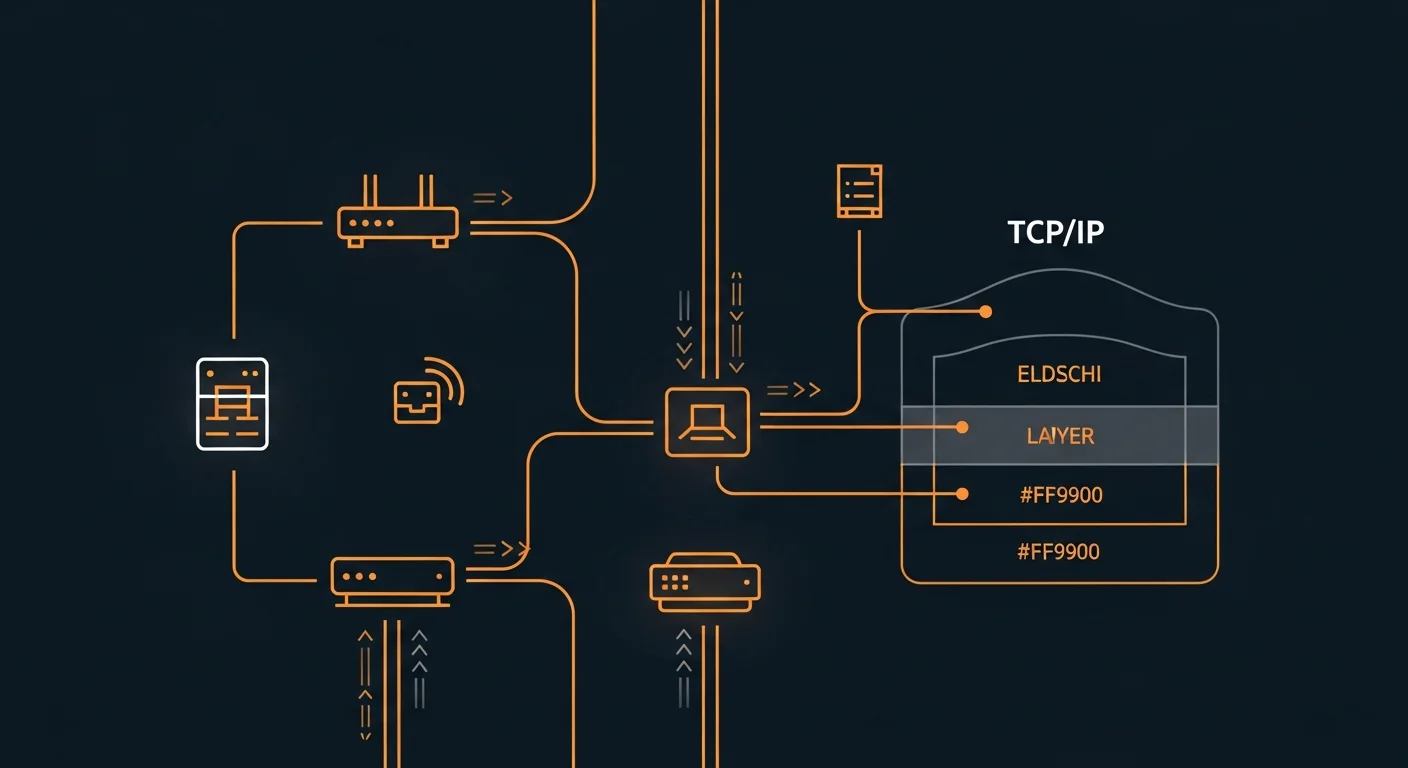
A deep understanding of TCP/IP is the foundation of all networking knowledge. Our resources cover the OSI and TCP/IP models, IP addressing and subnetting (including CIDR notation and VLSM), routing fundamentals, transport layer protocols (TCP and UDP), ARP, ICMP, and how data actually flows across networks. You will learn to read packet captures, understand three-way handshakes, and diagnose common protocol-level issues.
Network Interface Configuration
Learn to configure network interfaces using both traditional tools (ifconfig, route) and modern alternatives (ip command, NetworkManager, systemd-networkd). Our resources cover static and dynamic IP configuration, bonding and teaming for redundancy, VLAN tagging (802.1Q), bridge interfaces for virtualization, and wireless network management. You will also learn to work with /etc/network/interfaces (Debian), nmcli (RHEL), and Netplan (Ubuntu).
DNS Configuration and Management
The Domain Name System is a critical network service. Our resources teach you to deploy and manage DNS servers using BIND (the most widely used DNS server), Unbound (a popular recursive resolver), and dnsmasq (lightweight DNS/DHCP server). Learn about zone files, record types (A, AAAA, CNAME, MX, TXT, SRV, PTR), DNSSEC for secure DNS, split-horizon DNS, DNS-based load balancing, and troubleshooting tools like dig, nslookup, and host.
DHCP Server Configuration
Automate IP address assignment across your network with DHCP. Learn to configure ISC DHCP server and dnsmasq, set up address pools, configure reservations for fixed IP assignments, implement DHCP relay for multi-subnet environments, and integrate DHCP with DNS for automatic hostname registration. Our resources also cover DHCPv6 for IPv6 environments and failover configurations for high availability.
Web Server Administration
Web servers are among the most common Linux services. Our comprehensive resources cover both Apache HTTP Server and Nginx, including virtual host configuration, SSL/TLS setup with Let's Encrypt, reverse proxy configuration, load balancing, URL rewriting and redirection, access control, performance tuning, and security hardening. Learn to choose between Apache and Nginx based on your workload characteristics and configure them for optimal performance.
Mail Server Setup
Email infrastructure remains a vital business service. Learn to build complete mail systems using Postfix (MTA), Dovecot (IMAP/POP3), and spam filtering with SpamAssassin, Amavis, and ClamAV. Our resources cover SPF, DKIM, and DMARC for email authentication, TLS encryption for mail transport, virtual domains and mailboxes, and integration with webmail clients like Roundcube. Advanced topics include mailing list management, relay configuration, and email archiving.
VPN and Secure Tunneling
Connect remote sites and users securely using VPN technologies. Our resources cover OpenVPN (SSL-based VPN), WireGuard (modern, high-performance VPN), IPsec with StrongSwan, SSH tunneling, and SOCKS proxies. Learn to design hub-and-spoke and mesh VPN topologies, implement split tunneling, configure VPN for roadwarrior clients, and integrate VPN with your existing authentication infrastructure.
Advanced Routing and Traffic Control
Master advanced routing capabilities including static and dynamic routing (OSPF, BGP with FRRouting/BIRD), policy-based routing, source routing, multipath routing for load balancing, and GRE/IPIP/VXLAN tunnels. Learn Linux traffic control with tc for quality of service (QoS), traffic shaping, bandwidth limiting, and traffic prioritization. Our advanced resources also cover network namespaces for isolation and virtual routing and forwarding (VRF).
Network Security and Monitoring
Secure your network infrastructure with proper firewall rules, intrusion detection systems, and monitoring tools. Learn to use tcpdump and Wireshark for packet analysis, nmap for network scanning and inventory, netstat/ss for socket monitoring, iftop/nethogs for bandwidth monitoring, and Nagios/Zabbix/Prometheus for comprehensive network monitoring. Our resources cover network segmentation strategies, DMZ design, and zero-trust network architecture.
Cloud and Container Networking
Modern infrastructure requires understanding cloud and container networking concepts. Our resources cover Docker networking (bridge, host, overlay, macvlan), Kubernetes networking (pods, services, ingress, network policies), AWS VPC configuration, Azure Virtual Networks, and software-defined networking with Open vSwitch. Learn about CNI plugins (Calico, Flannel, Cilium), service mesh technologies (Istio, Linkerd), and how to design network architectures for microservices.
IPv6 Networking
IPv6 adoption is accelerating, and understanding the next generation of IP networking is essential. Our resources cover IPv6 addressing and subnetting, Stateless Address Autoconfiguration (SLAAC), DHCPv6, IPv6 routing, dual-stack deployment strategies, and IPv6 security considerations. Learn to plan and execute IPv4-to-IPv6 migration projects and configure IPv6-ready services.
Essential Network Diagnostic Tools
Every Linux network administrator should master these diagnostic tools:
- ping / ping6: Basic connectivity testing using ICMP echo requests.
- traceroute / mtr: Path analysis and hop-by-hop latency measurement.
- dig / nslookup: DNS query and troubleshooting tools.
- tcpdump: Command-line packet analyzer for capturing and analyzing network traffic.
- ss / netstat: Socket and connection monitoring tools.
- ip: Modern utility for configuring interfaces, routes, and network namespaces.
- nmap: Network discovery and security auditing tool.
- iperf3: Network bandwidth measurement and performance testing.
- curl / wget: HTTP testing and file transfer tools.
Start Your Networking Journey
Whether you are studying for networking certifications like CompTIA Network+, CCNA, or LPIC-2, or simply need to set up and manage Linux network services at work, our resources provide the practical knowledge you need. Browse the recommended books, articles, and cheat sheets below to build your Linux networking expertise.