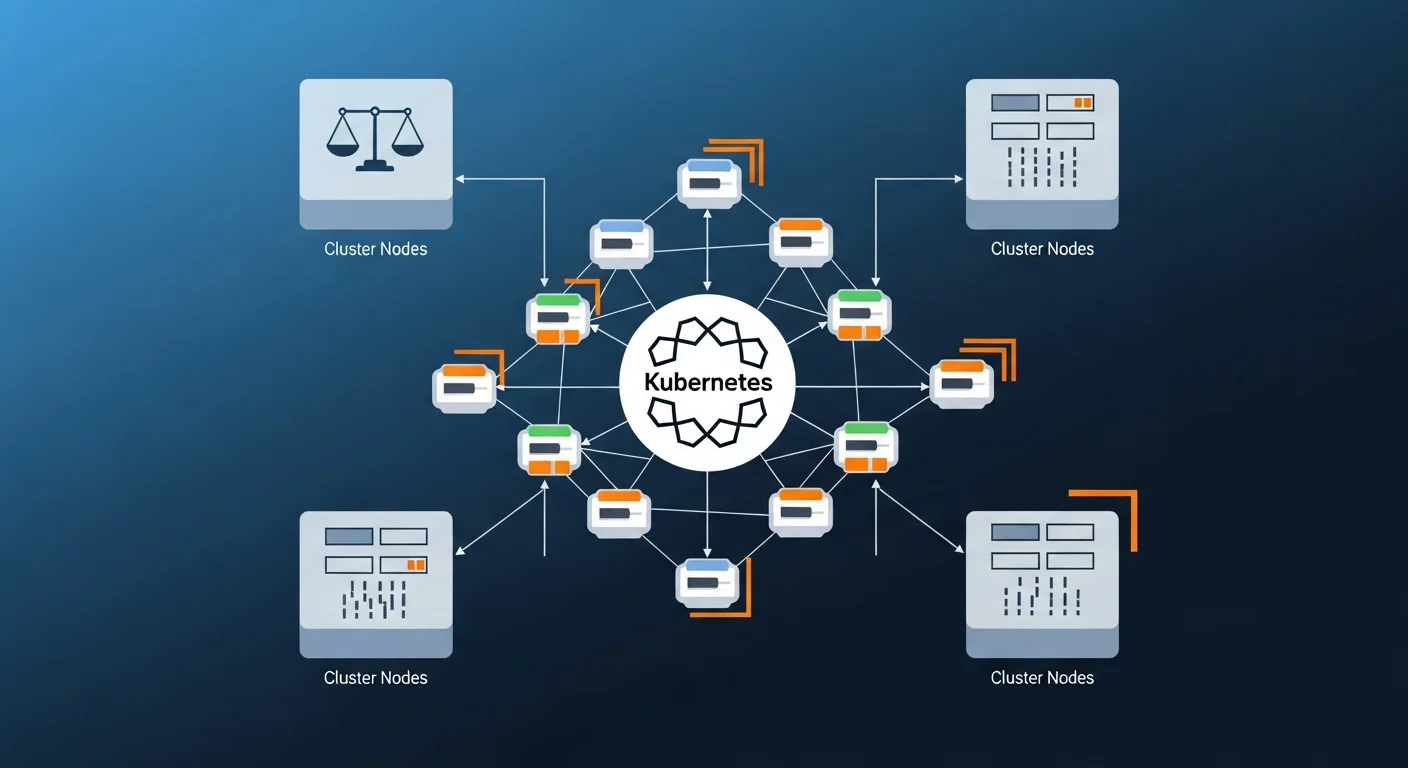
Kubernetes: The Operating System of the Cloud
Kubernetes has become the de facto standard for container orchestration, with over 96% of organizations either using or evaluating it. Originally developed by Google and now maintained by the Cloud Native Computing Foundation (CNCF), Kubernetes automates the deployment, scaling, and management of containerized applications. Understanding Kubernetes is essential for modern DevOps and platform engineering roles.
Container Fundamentals with Docker
Before diving into orchestration, mastering container fundamentals is essential. Docker containers package applications with their dependencies into portable, lightweight units that run consistently across environments. Key skills include writing efficient Dockerfiles with multi-stage builds, managing images and registries, configuring networking and volumes, and understanding container security principles like running as non-root users and scanning for vulnerabilities.
Docker Compose provides a stepping stone to orchestration, enabling multi-container application definitions in a single file. Understanding Compose prepares you for Kubernetes concepts like services, volumes, and environment configuration, with a gentler learning curve.
Kubernetes Architecture Deep Dive
Understanding Kubernetes architecture is fundamental to effective cluster management. The control plane consists of the API server (the front door for all operations), etcd (the distributed key-value store holding all cluster state), the scheduler (placing pods on nodes), and controller managers (ensuring desired state matches actual state). Worker nodes run the kubelet agent, container runtime, and kube-proxy for networking.
Core Kubernetes objects include Pods (the smallest deployable unit), Deployments (managing rolling updates), Services (stable networking endpoints), ConfigMaps and Secrets (configuration management), PersistentVolumeClaims (storage), and Namespaces (multi-tenancy). Understanding how these objects interact and compose together is the foundation of Kubernetes proficiency.
Production Kubernetes Operations
Running Kubernetes in production requires attention to reliability, security, and observability. Health checks (liveness, readiness, and startup probes) ensure unhealthy pods are restarted or removed from service. Resource requests and limits prevent noisy neighbors and enable the scheduler to make intelligent placement decisions. Pod Disruption Budgets maintain availability during voluntary disruptions like node upgrades.
Cluster autoscaling adjusts capacity based on demand: Horizontal Pod Autoscaler scales workloads, Vertical Pod Autoscaler optimizes resource requests, and Cluster Autoscaler adds or removes nodes. Understanding these autoscaling components and their interactions enables cost-effective, responsive infrastructure.
Kubernetes Networking and Service Mesh
Kubernetes networking follows a flat network model where every pod can communicate with every other pod. Ingress controllers manage external traffic routing, while Network Policies implement microsegmentation. Service mesh technologies like Istio, Linkerd, and Cilium add advanced capabilities: mutual TLS for zero-trust networking, traffic management for canary deployments, and observability with distributed tracing.
GitOps and Continuous Delivery
GitOps has emerged as the standard deployment methodology for Kubernetes. Tools like ArgoCD and Flux continuously reconcile cluster state with Git repositories, ensuring your cluster always matches the declared configuration. This approach provides audit trails, rollback capabilities, and self-healing infrastructure. Combined with Helm charts or Kustomize for templating, GitOps creates a powerful and reliable deployment pipeline.
Your Container Orchestration Journey
Our curated collection covers the complete container orchestration journey — from your first Docker container to managing production Kubernetes clusters. Whether you are a developer learning to containerize applications, a DevOps engineer building CI/CD pipelines, or a platform engineer designing internal developer platforms, these resources provide the knowledge you need to succeed.
Recommended Books 5
Related Articles 2
Cheat Sheets 7
Kubernetes kubectl Cheat Sheet
Essential kubectl commands for Kubernetes cluster management. Covers cluster context, pods, deployme...
Download Free →Kubernetes YAML Cheat Sheet
Common Kubernetes manifest templates and patterns. Covers Pod specs, Deployments, Services, ConfigMa...
Download Free →Kubernetes Beginner's Complete Guide
A comprehensive 6-page Kubernetes reference covering pods, deployments, services, scaling, ConfigMap...
Download Free →Kubernetes Intermediate Guide
A 9-page guide to production Kubernetes. Covers deployment strategies, rolling updates, HPA autoscal...
Download Free →PowerShell Advanced Guide
Expert-level PowerShell covering classes with inheritance, Desired State Configuration (DSC), runspa...
Download Free →Redis Beginner's Complete Guide
A 3-page beginner guide to Redis covering strings with expiry, lists for queues, sets for unique val...
Download Free →Debian 13 Trixie Complete Guide
Comprehensive 20-page Debian 13 Trixie cheat sheet covering installation, APT package management, sy...
Download Free →