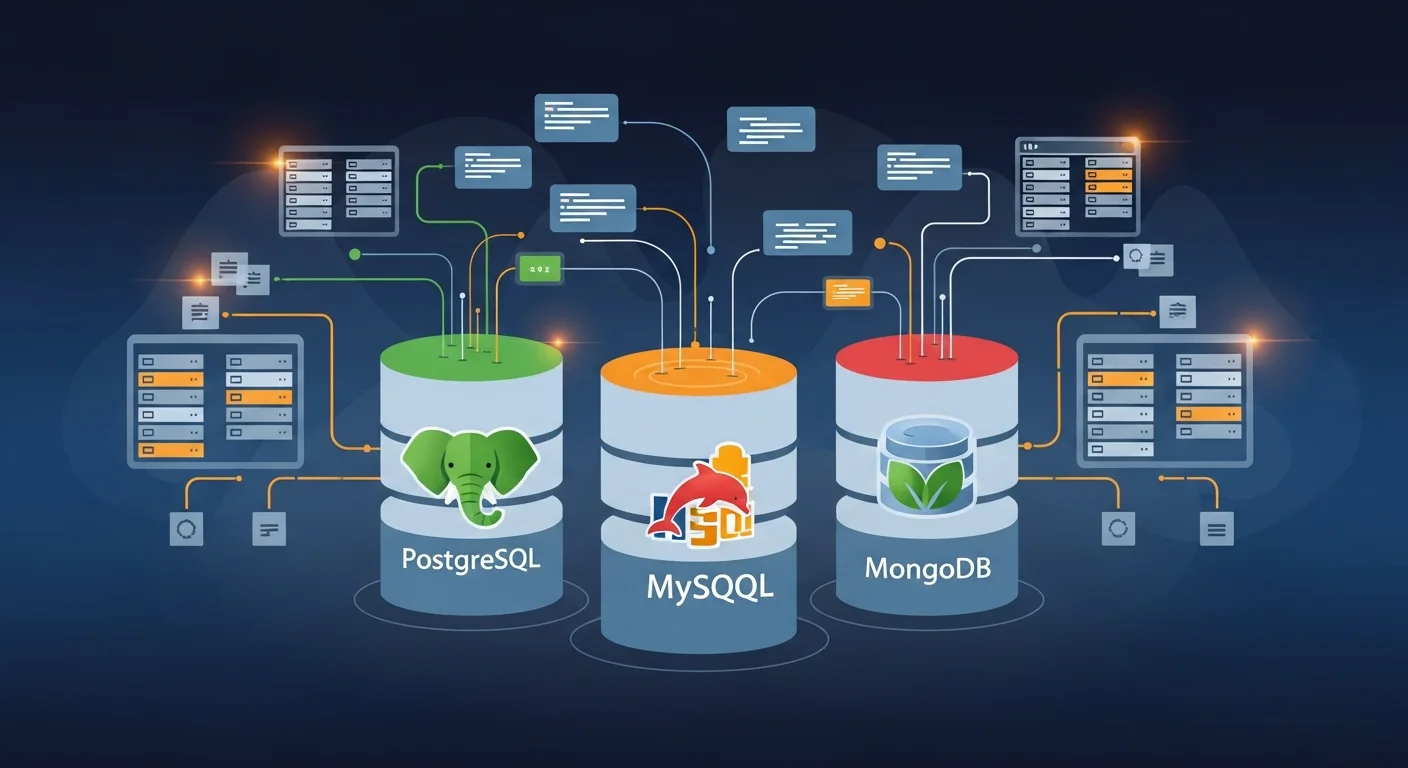
Database Administration: The Foundation of Every Application
Every modern application depends on databases to store, retrieve, and process data reliably. Whether you are managing a small PostgreSQL instance or architecting a globally distributed database cluster, database administration skills are among the most valuable in the IT industry. The average DBA commands a premium salary because data is the lifeblood of every organization.
Choosing the Right Database Engine
The database landscape offers a rich variety of engines, each optimized for different workloads. PostgreSQL has emerged as the most versatile open-source relational database, offering advanced features like JSONB, full-text search, and extensibility. MySQL remains the most widely deployed database in the world, powering a massive share of web applications. Commercial options like Oracle and SQL Server dominate in enterprise environments with their rich tooling and support.
Beyond relational databases, NoSQL engines address specific use cases: MongoDB for flexible document storage, Redis for in-memory caching and real-time data, Cassandra for massive write-heavy workloads, and Neo4j for graph-based relationships. Modern architectures often use polyglot persistence — combining multiple database types to serve different parts of an application.
SQL Mastery for Professionals
SQL remains the universal language of data. Mastering SQL means going beyond basic CRUD operations to leverage advanced features: window functions for analytical queries, Common Table Expressions (CTEs) for readable complex queries, recursive queries for hierarchical data, and lateral joins for correlated subqueries. Understanding how the query optimizer works — and how to read execution plans — transforms you from someone who writes queries to someone who writes efficient queries.
Performance-critical applications demand careful attention to indexing strategies. B-tree indexes handle most use cases, but partial indexes, covering indexes, expression indexes, and GIN/GiST indexes for full-text and JSONB queries can dramatically improve specific workloads. The art of indexing is balancing read performance against write overhead and storage costs.
Database Administration Essentials
Production database administration covers a wide spectrum of responsibilities: installation and configuration, user management and security, backup and recovery planning, monitoring and alerting, capacity planning, and upgrade management. Each area requires both theoretical knowledge and hands-on experience.
Backup strategy is perhaps the most critical DBA responsibility. Implementing a solid backup plan means combining logical backups (pg_dump/mysqldump) for portability with physical backups (pg_basebackup/Percona XtraBackup) for speed. Point-in-time recovery (PITR) using write-ahead logs or binary logs adds granular recovery options. Testing restores regularly is non-negotiable — an untested backup is not a backup.
High Availability and Replication
Production databases must be highly available. Streaming replication creates real-time copies of your database, enabling failover in seconds. PostgreSQL offers synchronous and asynchronous replication options, while MySQL provides Group Replication and InnoDB Cluster for automated failover. Tools like Patroni, Orchestrator, and cloud-managed services simplify HA management.
Read replicas scale read-heavy workloads by distributing queries across multiple servers. Connection pooling with PgBouncer or ProxySQL reduces connection overhead and improves resource utilization. For global applications, multi-region replication ensures low-latency data access worldwide.
Performance Tuning and Optimization
Database performance tuning starts with understanding your workload. OLTP workloads need fast individual queries and high concurrency, while OLAP workloads need efficient batch processing and aggregation. Tuning memory allocation (shared_buffers, work_mem, innodb_buffer_pool_size), connection limits, checkpoint intervals, and I/O settings can yield dramatic improvements without changing a single query.
Monitoring is the foundation of proactive DBA work. Tools like pg_stat_statements, Performance Schema, Prometheus with database exporters, and specialized platforms like pganalyze or Percona Monitoring and Management provide the visibility needed to identify and resolve performance issues before they impact users.
Your Database Learning Path
Our curated collection of database books and resources covers everything from SQL fundamentals to advanced database architecture. Whether you are a developer wanting to write better queries, a junior DBA building your skills, or a senior engineer designing distributed data systems, you will find the right resources to advance your database expertise.
Recommended Books 13
Related Articles 2
Cheat Sheets 13
PostgreSQL Queries Cheat Sheet
Essential SQL commands for PostgreSQL. Covers database connection, CRUD operations, joins, aggregate...
Download Free →MySQL Queries Cheat Sheet
Essential SQL commands for MySQL and MariaDB. Covers connections, CRUD operations, joins, subqueries...
Download Free →Java Beginner's Complete Guide
A 3-page beginner guide to Java covering data types, control flow, OOP (classes, inheritance, interf...
Download Free →Go (Golang) Beginner's Complete Guide
A 3-page beginner guide to Go covering variables, types, functions with multiple returns, error hand...
Download Free →Rust Beginner's Complete Guide
A 3-page beginner guide to Rust covering ownership, borrowing, lifetimes, structs, enums, pattern ma...
Download Free →PostgreSQL Beginner's Complete Guide
A comprehensive 6-page PostgreSQL reference covering connections, table creation, CRUD operations, J...
Download Free →MySQL Beginner's Complete Guide
A comprehensive 5-page MySQL reference covering connections, tables, CRUD operations, JOINs, aggrega...
Download Free →VPS Setup Complete Guide 2026
A comprehensive 15-page VPS setup guide covering provider selection, initial configuration, SSH hard...
Download Free →Claude Code Complete Guide 2026
Master Claude Code, Anthropic's AI coding agent for the terminal. 12-page guide covering installatio...
Download Free →Claude Code Workflow Cheatsheet 2026
Master 14 essential Claude Code workflows for professional developers. Covers bug fixing, refactorin...
Download Free →Vim Advanced Guide
Expert-level Vim covering Vimscript programming, plugin development and autoload patterns, LSP integ...
Download Free →PHP Quick Reference
A 1-page quick reference for PHP: variables, types, string functions, array functions (map, filter, ...
Download Free →Prometheus & Grafana Monitoring Guide
Complete monitoring setup with Prometheus and Grafana. Covers PromQL queries, alert rules, dashboard...
Download Free →