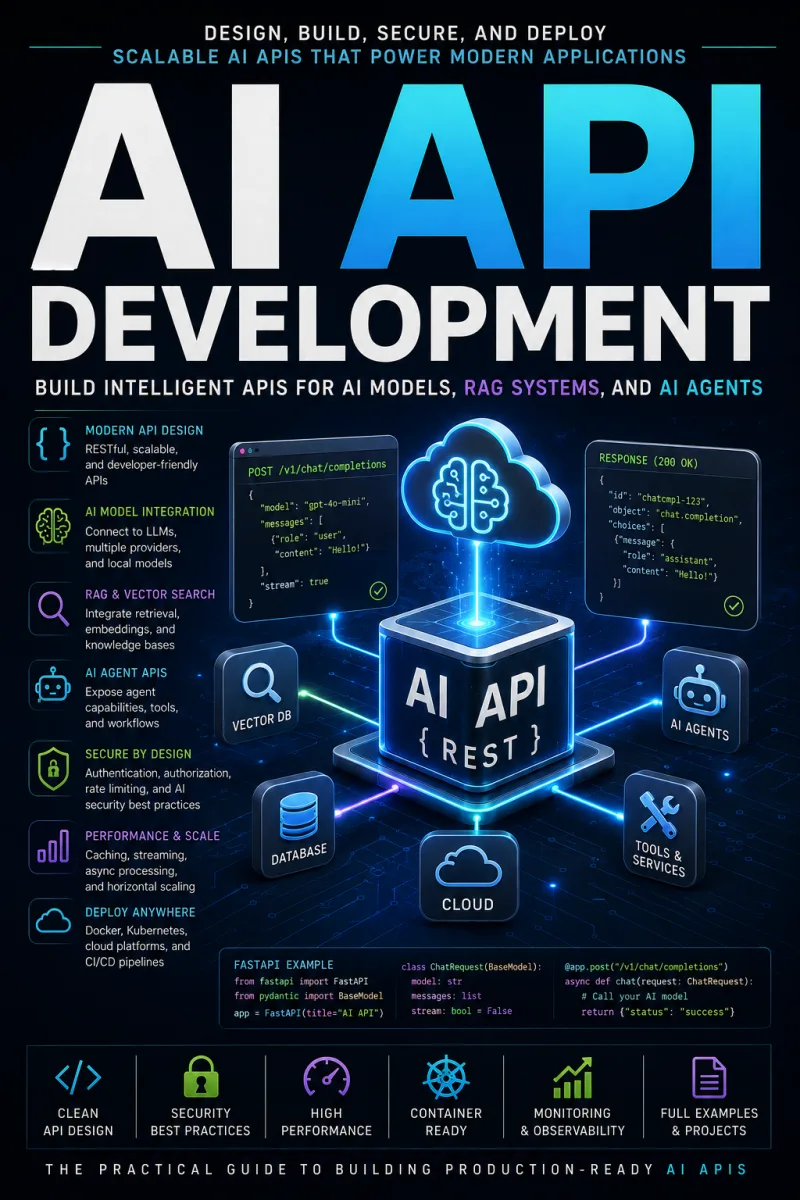
AI API Development
Designing, Building, Securing, and De- ploying Modern AI APIs
What's Included:
At a Glance
AI API Development is a professional DATA & AI eBook by Dargslan AI Team, 460 pages, available as an instant PDF and EPUB download for €22.90 with lifetime access and free updates. Designing, Building, Securing, and De- ploying Modern AI APIs.
- Length: 460 pages
- Format: PDF and EPUB (instant download)
- Language: English
- Topic: DATA & AI
- Price: €22.90
Key Highlights
- A single, coherent, development-first path from fundamentals to enterprise deployment
- Understand how AI applications differ structurally from traditional APIs
- API design principles and clean request/response models for AI
- Connecting AI models and managing prompts as a first-class layer
- Building retrieval-augmented (RAG) APIs and integrating vector databases
- Building AI agent APIs and integrating the Model Context Protocol (MCP)
- API security: authentication, authorization, and error handling
- AI-specific security: prompt injection, data leakage, and model abuse
- Scaling AI APIs and optimizing performance
- Deployment, plus CI/CD pipelines built for AI workloads
- Monitoring and day-to-day operations for production AI systems
- The practical craft of building AI APIs and extending it to enterprise platforms
- Ten reference appendices: REST cheat sheet, design/security/deployment checklists, auth guide, monitoring guide, error handling reference, OpenAPI best practices, architecture patterns, and a developer roadmap
Overview
Design, build, secure, and deploy production-grade AI APIs. This hands-on guide covers AI application architecture, API design, connecting models, prompt management, RAG and agent APIs, MCP integration, API and AI security, scaling, CI/CD, monitoring, and enterprise AI platforms.
The Problem
AI has moved into production systems that millions of people rely on—but the knowledge of how to actually build the APIs that expose those capabilities is frustratingly scattered. It lives in blog posts, half-current vendor docs, conference talks, and the heads of teams who learned the hard way. There's no coherent path from "I can call a model" to "I've shipped a secure, scalable, maintainable AI API."
That gap bites at every stage. AI applications differ structurally from traditional APIs, so familiar patterns don't quite fit—prompt layers, retrieval pipelines, and agents introduce new design questions. Security is a moving target, with both classic API risks and AI-specific threats like prompt injection and data leakage. And the leap from a working prototype to a production service—scaling, CI/CD, monitoring, operations—is exactly where AI projects stall. Piecing all of this together from fragments is slow, risky, and leaves dangerous gaps in systems real users depend on.
The Solution
AI API Development consolidates that scattered knowledge into a single, coherent, development-first path—from foundational concepts to enterprise-grade deployment. It's a hands-on guide, not machine learning theory: the development lifecycle is the spine, and every chapter maps to a real decision you'll face building these systems.
You'll master AI application architecture and API design, then develop intelligent capabilities—connecting models, managing prompts, building RAG and agent APIs, integrating vector databases and MCP. Security is treated as first-class, covering both API security and AI-specific threats like prompt injection and data leakage. Then you'll conquer the operational side that stalls most projects: scaling, performance, deployment, CI/CD for AI workloads, monitoring, and operations—culminating in enterprise platforms. With ten reference appendices of checklists, guides, and patterns, this book gives you a development framework you can apply immediately.
About This Book
AI API Development: Designing, Building, Securing, and Deploying Modern AI APIs consolidates the scattered, hard-won knowledge of building production AI systems into a single, coherent path. Artificial intelligence has moved from research labs into systems that millions of people use every day—yet the development practices that make this possible remain spread across blog posts, vendor documentation, and team experience. This book brings them together, taking you from foundational concepts to enterprise-grade deployment with a consistent, practical lens on how modern AI-powered APIs are actually built.
This is not a theoretical treatise on machine learning. It's a hands-on development guide for engineers who need to design, build, secure, and ship APIs that expose AI capabilities—whether that means wrapping a large language model behind a REST endpoint, orchestrating a retrieval-augmented pipeline, or standing up an autonomous agent that talks to dozens of internal systems. The development lifecycle is the spine of the book: every chapter maps to a real decision you'll face while building these systems.
Guided by Practical Development Themes
Several threads run throughout: architectural clarity, understanding how AI applications differ structurally from traditional APIs and how to design request/response models, prompt layers, and retrieval systems that scale; practical integration, connecting AI models, vector databases, agent frameworks, and emerging standards like MCP into cohesive, maintainable systems; security as a first-class concern, treating both API security and AI-specific security as core responsibilities rather than afterthoughts; operational excellence, scaling, optimizing, deploying, and monitoring with the rigor applied to any mission-critical software; and enterprise readiness, moving beyond prototypes toward governed, reliable, maintainable platforms.
What You'll Build and Learn
The book opens with AI API fundamentals, architecture, and design principles—including how to structure request and response models. From there you'll develop intelligent capabilities: connecting AI models, managing prompts, building retrieval-augmented APIs, integrating vector databases, standing up AI agent APIs, and integrating the Model Context Protocol (MCP). You'll then treat security from both angles—API security and AI-specific threats like prompt injection, data leakage, and model abuse—before moving into the operational side: scaling, performance optimization, deployment, CI/CD built for AI workloads, monitoring, and day-to-day operations. The final chapters bring everything together around the practical craft of building AI APIs and extending it to enterprise platforms.
Security Built In, Not Bolted On
AI APIs expose a broad and unusual attack surface, so security is treated as a core development responsibility throughout. Dedicated chapters cover both traditional API security—authentication, authorization, and error handling—and AI-specific concerns like prompt injection, data leakage, and model abuse. You'll build systems that are safe to expose to real users from the start.
Operational Excellence for AI Workloads
A demo endpoint and a production AI API are very different things. This book gives the operational side the attention it deserves: scaling AI APIs, optimizing performance, deploying reliably, building CI/CD pipelines suited to AI workloads, and monitoring systems in production. These are the practices that turn an impressive prototype into a service you can depend on.
A Development Framework You Can Apply Immediately
By the end, you'll have a development framework you can put to work right away: principles for designing clean AI API contracts, patterns for integrating retrieval and agentic behavior, checklists for security and deployment, and operational playbooks for keeping AI systems healthy in production. Each chapter builds competence incrementally, so you're always moving from what you know toward what you need next.
Reference Companions for Mid-Project Moments
Ten appendices close the book as durable references for the moments when you need answers fast: a REST API cheat sheet, an AI API design checklist, an authentication and authorization guide, an AI security checklist, a deployment checklist, a monitoring and logging guide, an API error handling reference, OpenAPI and documentation best practices, AI API architecture patterns, and a developer roadmap.
Why This Book
Whether you're writing your first AI-powered endpoint or architecting an enterprise platform, this book is a working companion for your entire development journey—development-first, practical, and grounded in the real decisions engineers face when shipping AI. Let's begin.
Who Is This Book For?
- Backend and API engineers building AI-powered endpoints and services
- Software engineers integrating LLMs, RAG, and agents into production APIs
- AI and ML engineers moving from models to deployable API services
- Platform and infrastructure engineers operating AI APIs at scale
- DevOps engineers building CI/CD and monitoring for AI workloads
- Architects designing enterprise AI platforms
- Developers who want a coherent, end-to-end path for shipping AI APIs
Who Is This Book NOT For?
- Readers seeking machine learning theory or the math behind model training
- Complete non-developers looking for a high-level, non-technical AI overview
- Those wanting to build foundation models rather than APIs that expose them
- Frontend-only developers with no interest in backend/API development
- Anyone wanting pure prompt tips without architecture, security, and operations
Table of Contents
- Introduction to AI APIs
- AI Application Architecture
- API Design Principles
- Request & Response Models
- Connecting AI Models
- Prompt Management
- Retrieval-Augmented APIs
- Vector Database Integration
- AI Agent APIs
- MCP Integration
- API Security
- AI Security
- Scaling AI APIs
- Performance Optimization
- Deploying AI APIs
- CI/CD for AI APIs
- Monitoring AI APIs
- Operations
- Building AI APIs
- Enterprise AI Platforms
- Appendix: REST API Cheat Sheet
- Appendix: AI API Design Checklist
- Appendix: Authentication & Authorization Guide
- Appendix: AI Security Checklist
- Appendix: Deployment Checklist
- Appendix: Monitoring & Logging Guide
- Appendix: API Error Handling Reference
- Appendix: OpenAPI & API Documentation Best Practices
- Appendix: AI API Architecture Patterns
- Appendix: AI API Developer Roadmap
Requirements
- Working software development experience, ideally with backend or API work
- Familiarity with REST APIs and general web development concepts
- Comfort with a programming language, the command line, and development workflows
- Basic understanding of how LLMs and AI systems work is helpful but built up as needed
- Access to AI model APIs (or a local model) to follow the practical examples
- General understanding of cloud, containers, or CI/CD helps for the operational chapters
- No AI research or advanced math background required—the focus is development practice