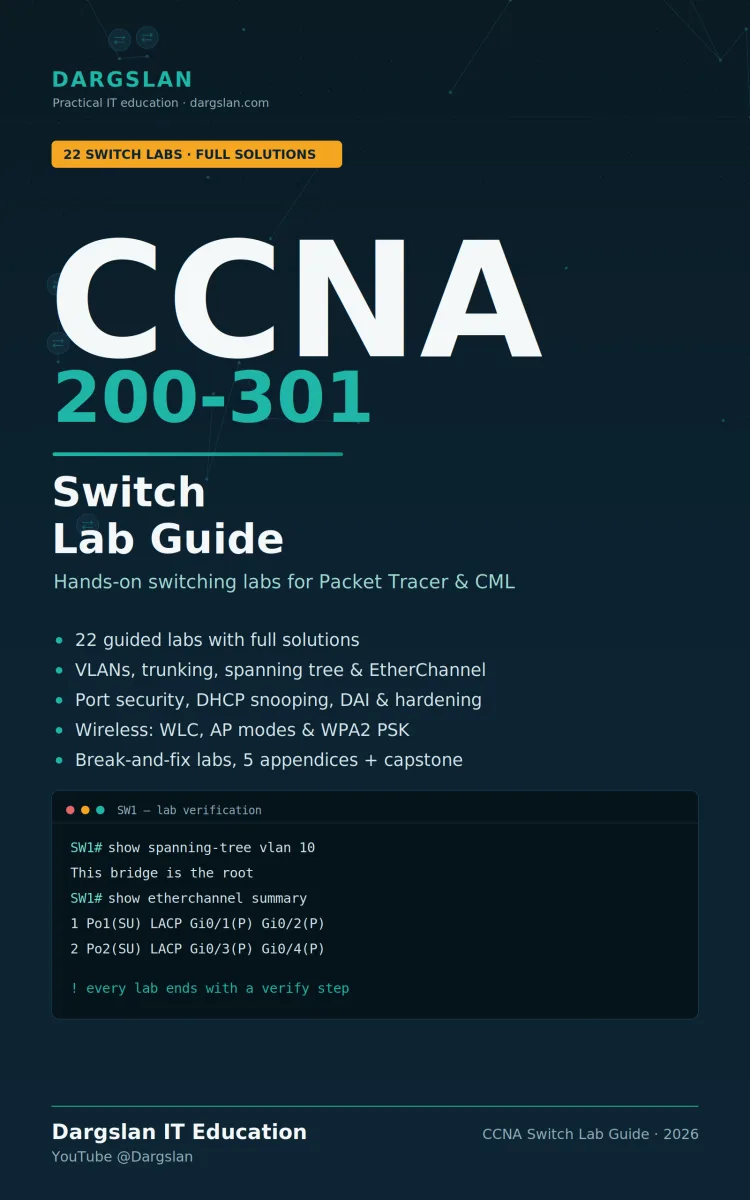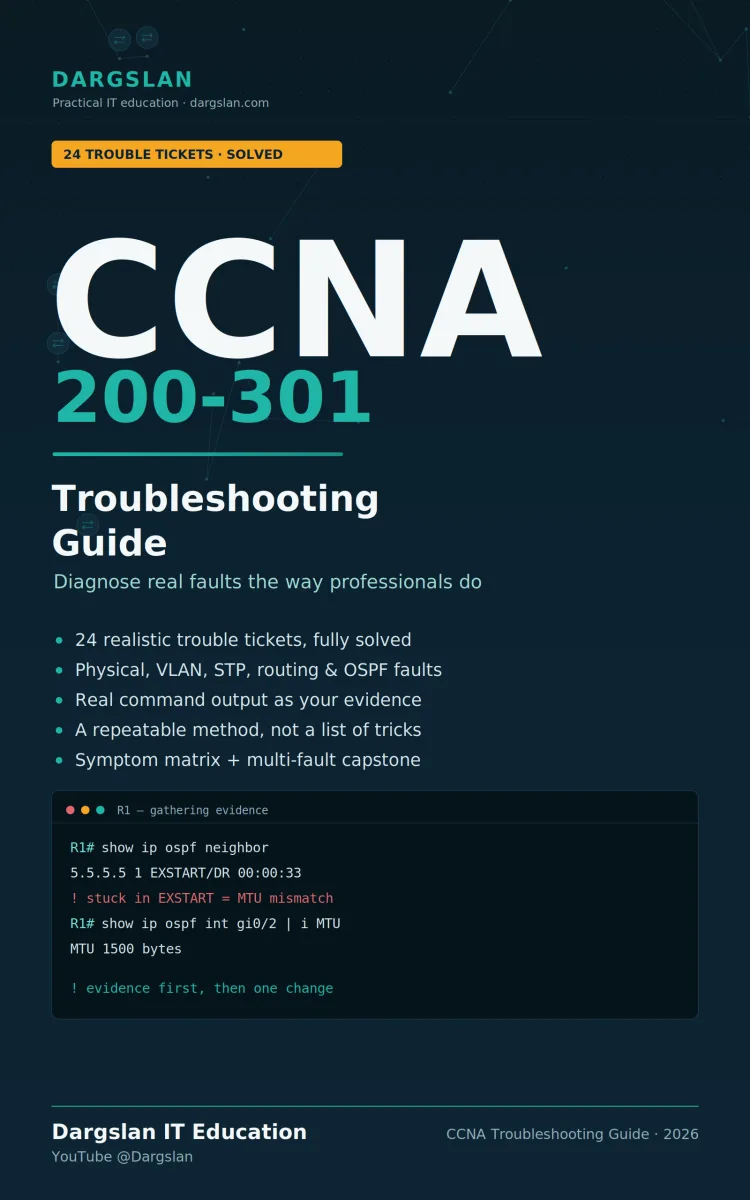
CCNA 200-301 - Troubleshooting Guide
What's Included:
At a Glance
CCNA 200-301 - Troubleshooting Guide is a professional NETWORKING & SECURITY eBook by Dargslan, 100 pages, available as an instant PDF and EPUB download for €10.90 with lifetime access and free updates. Master network troubleshooting as a repeatable process, not a bag of tricks. This CCNA 200-301 guide presents real faults as user tickets—report, evidence, reas...
- Length: 100 pages
- Format: PDF and EPUB (instant download)
- Language: English
- Topic: NETWORKING & SECURITY
- Price: €10.90
Key Highlights
- Teaches troubleshooting as a repeatable process, not a bag of tricks
- Realistic tickets that arrive as user complaints, just like the real world
- Every ticket: report, evidence, reasoning, diagnosis, fix, verification, and lesson
- A structured method: narrow the fault domain, the OSI ladder, and the ping ladder
- Try-first approach that builds genuine diagnostic instinct
- Tickets labelled by severity (Low/Medium/High/Critical) and OSI layer
- Physical and data link faults, including reading interface counters
- VLAN and trunk faults
- Spanning tree and EtherChannel faults
- IP and routing faults, and OSPF adjacency problems
- Service faults: DHCP, NAT, and DNS
- Security and access faults, including lockouts and failed rollouts
- A critical multi-fault capstone scenario
- Real command output from broken networks throughout
- Reference appendices: symptom-to-cause matrix, diagnostic command reference, method card, exam-day recall card, and glossary
Overview
Master network troubleshooting as a repeatable process, not a bag of tricks. This CCNA 200-301 guide presents real faults as user tickets—report, evidence, reasoning, diagnosis, fix, and verification—across physical, VLAN, spanning tree, routing, OSPF, service, and security layers.
The Problem
Most CCNA preparation teaches you how to configure a network. Almost none teaches you what to do when that network breaks—which is exactly what the exam's troubleshooting questions, and every real networking job, actually demand. There's a world of difference between building a working topology from a clean slate and being handed a vague complaint like "the internet is down" with no idea where to start.
Faced with a broken network, candidates who only memorized commands panic. They poke at random settings, fixate on the wrong layer, and burn time chasing symptoms instead of causes. Under exam pressure, or with a room full of users unable to work, that lack of method is costly. The knowledge to fix the fault might be in their head—but without a repeatable process to reason from symptom to cause, they can't reach it when it counts.
The Solution
This CCNA 200-301 Troubleshooting Guide is built on one principle: troubleshooting is a process, not a collection of tricks. It teaches you a repeatable method—narrowing the fault domain, using the OSI ladder as a checklist, working the ping ladder—then has you apply it to realistic tickets that arrive exactly as they do in real life: as user complaints.
Every ticket walks you from the report through real command output, guided reasoning, the diagnosis, the exact fix, and verification that it's genuinely resolved. You cover the answer and try first, because the instinct is built in the struggle. Tickets are labelled by severity and by the OSI layer where the fault lives, so you can target your weak areas across physical, VLAN, spanning tree, routing, OSPF, service, and security faults—culminating in a multi-fault capstone. With a symptom-to-cause matrix and a method card for use on the job, this guide builds the diagnostic instinct the exam and real networks both reward.
About This Book
This CCNA 200-301 Troubleshooting Guide is built around one idea: troubleshooting is a process, not a collection of tricks. On the exam and on the job, what separates capable engineers isn't memorizing more commands—it's knowing how to reason from a symptom to a cause and prove the fix worked. This guide builds exactly that instinct, one realistic ticket at a time.
Every Fault Arrives Like Real Life
Each ticket presents a fault the way you'd actually meet it: as a user complaint. From there, the guide walks you through the evidence, the reasoning, and the fix. Every ticket follows the same proven shape:
- The report — the symptom, exactly as a user would describe it
- Gather the evidence — real command output from the broken network
- Think it through — questions to answer before you read on
- Diagnosis — the actual cause, clearly explained
- The fix — the exact commands to resolve it
- Verify — proof the problem is genuinely resolved
- The lesson — what to carry forward to the next fault
Try First, Then Read On
The value is in the gap between reading the evidence and knowing the answer. That's why you're encouraged to cover the diagnosis and work each ticket yourself before reading on—because that productive struggle is what builds the instinct the exam and the job both reward. This isn't a book you read passively; it's one you solve.
A Method You Can Rely On
Before the tickets begin, the guide establishes the method itself: why method beats knowledge, three different approaches to the same fault, using the OSI ladder as a checklist, narrowing the fault domain first, and the ping ladder. Once you internalize this structured approach, you can attack any fault systematically instead of guessing—the single most valuable skill a troubleshooter can have.
Labelled So You Can Target Your Weak Areas
Each ticket carries a severity—Low, Medium, High, or Critical, indicating how much of the network is affected—and the layer where the fault lives: Physical, Data Link, Network, Transport, Application, or Multi-Layer. This lets you pace yourself and deliberately target the areas where you're weakest.
Comprehensive Fault Coverage
The guide works through the full range of faults you'll face on the CCNA 200-301 exam and in production networks:
- Physical and data link faults — reading interface counters, dead ports, slowness, and drops
- VLAN and trunk faults — isolation, mismatches, and traffic appearing in the wrong VLAN
- Spanning tree and EtherChannel faults — instability, strange slow paths, and channels that add no bandwidth
- IP and routing faults — the three questions of Layer 3, gateway reachability, and asymmetric traffic
- OSPF faults — the adjacency checklist, neighbours stuck short of FULL, and missing networks
- Service faults — DHCP, NAT, and DNS problems told apart and resolved
- Security and access faults — features that fail closed, lockouts, and security rollouts that break DHCP
- Multi-fault capstone — a critical scenario where several faults compound at once
Suggested Paths for Every Reader
The guide adapts to your goal. For exam preparation, work straight through, then repeat the routing, OSPF, and service sections without reading the diagnoses. If you're already experienced, start with the OSPF and multi-fault sections, then fill gaps. On the job, keep the symptom matrix and the method card open while you work.
Reference Material for the Real World
A practical set of appendices supports you during study and on the job: a symptom-to-cause matrix, a diagnostic command reference, the method card, an exam-day recall card, and a glossary.
Why This Guide
Anyone can memorize commands; few can reason calmly from a vague user complaint to a verified fix. By working real tickets across every layer with a repeatable method, you'll build the diagnostic instinct that the CCNA rewards and that makes you genuinely valuable on the job. Cover the diagnosis, open the first ticket, and start solving.
Who Is This Book For?
- CCNA 200-301 candidates preparing for troubleshooting-heavy exam questions
- Learners who can configure a network but freeze when one breaks
- Aspiring network engineers building real diagnostic instinct
- Help desk and NOC staff who resolve network tickets daily
- Self-study students using Packet Tracer or CML who want to practice faults
- Working technicians who want a repeatable troubleshooting method
- Anyone pairing CCNA study and lab guides with troubleshooting practice
Who Is This Book NOT For?
- Complete beginners with no exposure to networking or the Cisco CLI (start with configuration first)
- Readers wanting configuration labs rather than fault diagnosis (pair this with a lab guide)
- Those seeking pure conceptual theory without hands-on problem solving
- Engineers preparing for advanced certifications like CCNP or CCIE
- Anyone wanting only multiple-choice questions rather than realistic troubleshooting scenarios
Table of Contents
- Section 0 — The Method: why method beats knowledge, three approaches to one fault, the OSI ladder as a checklist, narrowing the fault domain, the ping ladder
- Section 1 — Physical & Data Link Faults: reading interface counters, no network at all, slow and dropping, a dead port
- Section 2 — VLAN & Trunk Faults: isolation, guest Wi-Fi reachability, broadcast traffic in the wrong VLAN
- Section 3 — Spanning Tree & EtherChannel Faults: network-down instability, strange slow paths, links with no added bandwidth
- Section 4 — IP & Routing Faults: the three questions of Layer 3, gateway-only reachability, connected routers that can't ping, asymmetric traffic
- Section 5 — OSPF Faults: the adjacency checklist, neighbours that never reach FULL, a missing network
- Section 6 — Service Faults: DHCP, NAT, and DNS problems told apart and fixed
- Section 7 — Security & Access Faults: features that fail closed, switch lockout, a rollout that broke DHCP
- Section 8 — Multi-Fault Capstone: "Half the company can't work"
- Appendix A — Symptom to Cause Matrix
- Appendix B — Diagnostic Command Reference
- Appendix C — The Method Card
- Appendix D — Exam-Day Recall Card
- Appendix E — Glossary
Requirements
- Foundational CCNA knowledge (configuration basics), ideally from a study or lab guide
- Comfort reading Cisco IOS command output (show commands)
- Cisco Packet Tracer or CML is helpful if you want to recreate and practice the faults
- Basic understanding of the OSI model, IP addressing, and subnetting
- A willingness to solve each ticket before reading the diagnosis
- A goal of passing the CCNA 200-301 exam or sharpening real-world troubleshooting skills