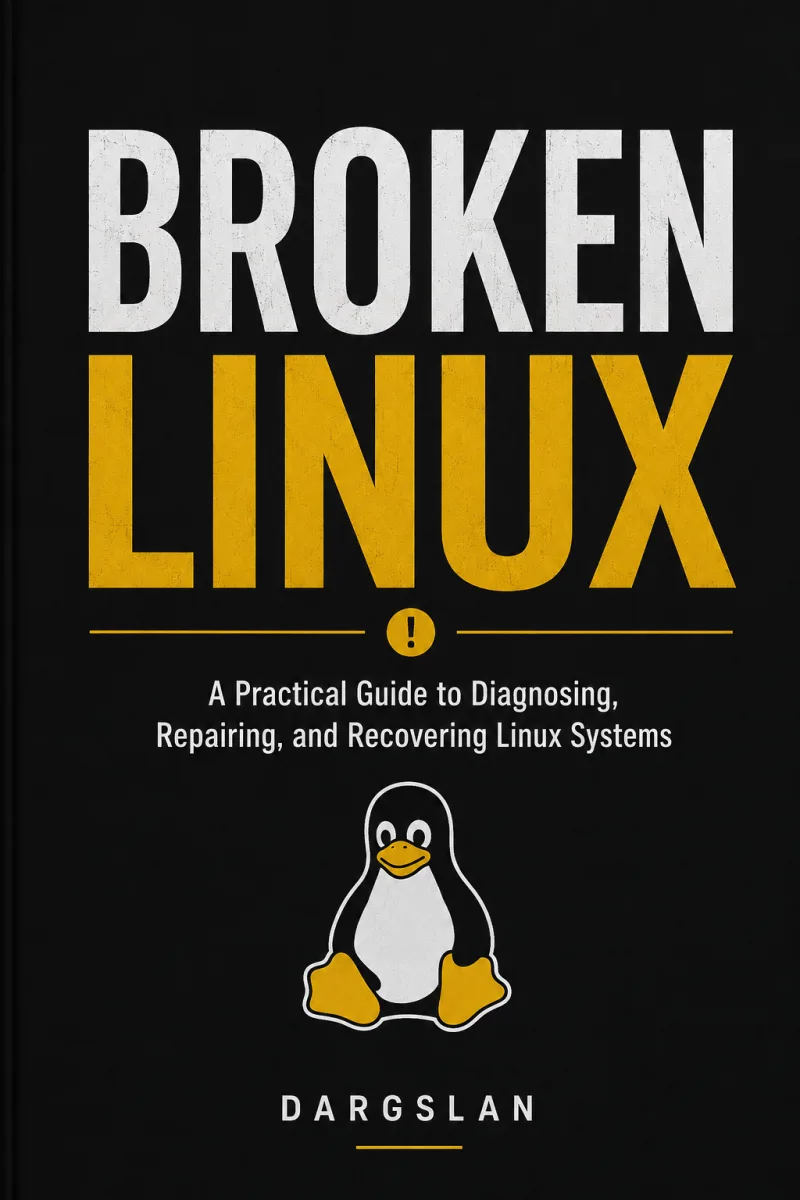
Broken Linux
A Practical Guide to Diagnosing, Repairing, and Recovering Linux Systems
What's Included:
At a Glance
Broken Linux is a professional Linux Administration eBook by Dargslan, 704 pages, available as an instant PDF and EPUB download for €29.90 with lifetime access and free updates. A Practical Guide to Diagnosing, Repairing, and Recovering Linux Systems.
- Length: 704 pages
- Format: PDF and EPUB (instant download)
- Language: English
- Topic: Linux Administration
- Edition: 1st Edition
- Price: €29.90
Key Highlights
- Crisis-first: every chapter assumes your system is already broken and walks you forward
- Practical throughout—what to run, what to expect, and what the output means
- A troubleshooting mindset and emergency toolkit to work calmly under stress
- Boot failures: GRUB, kernels that won't boot, and systemd boot problems
- Storage failures: filesystems, full disks, vanished partitions, LVM, and RAID
- Networking: "the network is down," IP and routing, DNS, and firewalls
- Access: SSH failures, broken SSH keys, login problems, permissions, and broken sudo
- Packages and services: failed updates, package managers, and downed web servers and databases
- Performance: CPU, memory, disk I/O, and runaway processes
- Logging and debugging, including when logging itself breaks
- Containers (Docker and Podman) and security (SELinux/AppArmor, compromise detection)
- Full-system rescue, data recovery, backup and disaster recovery, and broken VPS/cloud VMs
- A dedicated chapter of 25 recognizable broken Linux scenarios
- Troubleshooting under pressure and preventing the next failure
- Twelve reference appendices, including distro-specific recovery commands and 100 troubleshooting commands
Overview
When Linux breaks—and it always does—this is the book you reach for. A practical, crisis-first guide to diagnosing, repairing, and recovering broken systems: GRUB and boot failures, filesystems, RAID and LVM, networking, SSH, sudo, packages, performance, containers, security, and full-system rescue.
The Problem
Every Linux system eventually breaks. It's 3 a.m., a production server won't boot, and the excellent books that taught you how Linux is supposed to work are suddenly useless—because your system isn't working, and they don't cover that. GRUB won't load, systemd hangs, a disk is full, a RAID array has failed, or sudo itself is broken and you can't even fix the problem the normal way.
This is where careers are made and reputations are lost. Troubleshooting knowledge is scattered across forum threads, buried in man pages, and locked in the muscle memory of engineers who learned it the hard way—none of which helps when you're panicking under pressure with a downed system and stakeholders waiting. Most learning material assumes a working machine and walks forward; almost nothing starts from the assumption that everything has already gone wrong and shows you the calm, ordered path back.
The Solution
Broken Linux starts exactly where other books stop: with your system already broken. It's a crisis-first guide that transforms the panic of a failed system into a methodical, confident process of diagnosis and recovery—organized so you can jump straight to the chapter matching your current emergency.
The emphasis is relentlessly practical: what commands to run, what output to expect, and what that output actually means. Dedicated chapters cover every category of failure—boot, storage, RAID and LVM, networking, DNS, SSH, sudo, permissions, packages, services, performance, logging, containers, and security—plus broken VPS and cloud VMs, full-system rescue, and data recovery. Chapters on troubleshooting under pressure and preventing the next failure turn recovery into lasting discipline. With appendices built to sit open next to a broken terminal—cheat sheets, flowcharts, distro-specific recovery commands, and 100 troubleshooting commands—this is the first thing you reach for when something breaks.
About This Book
Broken Linux: A Practical Guide to Diagnosing, Repairing, and Recovering Linux Systems exists because breakage is not the exception in a system administrator's career—it's the rule. Every Linux system, no matter how carefully built, eventually fails. A kernel refuses to boot. A disk fills up at 3 a.m. A service crashes silently, leaving nothing but a cryptic log entry. This book meets that reality head-on, transforming the panic of a failed system into a methodical, confident process of diagnosis and recovery.
This is not a book about how Linux is supposed to work—plenty of excellent books already cover that ground. This is a book about what happens when it doesn't: when GRUB won't load, when systemd hangs, when RAID arrays fail, when sudo itself is broken and you can't even fix the problem the normal way. "Broken" is the thread that ties every chapter together and the lens through which the entire book is written.
Broad by Design, Because Breakage Doesn't Respect Boundaries
The scope here is deliberately wide. You'll find dedicated chapters on broken boot processes, broken filesystems, broken networking, broken permissions, broken package managers, broken performance, and broken containers. The book examines servers under active attack, broken cloud VMs, and VPS instances stripped of console access. It even devotes an entire chapter to 25 broken Linux scenarios, because sometimes the fastest way to learn is to see a problem you recognize immediately.
Relentlessly Practical
Throughout, the emphasis stays on the practical: what commands to run, what output to expect, and what that output actually means. Each chapter assumes your system is already broken and walks you forward from there. This is the opposite of theory—it's the calm, ordered process you wish you had the last time everything went sideways at midnight.
What You'll Be Able to Handle
The book moves from a foundational troubleshooting mindset and emergency toolkit through every major category of failure:
- Boot failures — the Linux boot process, broken GRUB, kernels that won't boot, and systemd boot failures
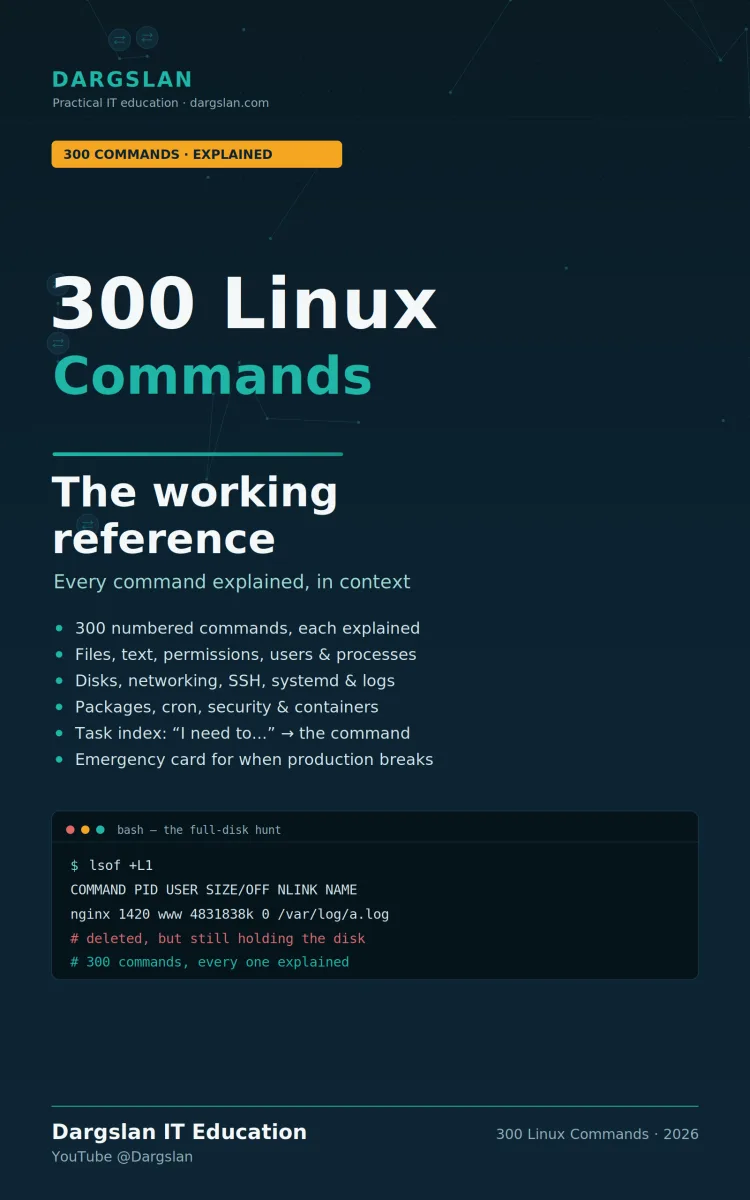
- Storage failures — filesystem corruption, full disks, disappeared partitions, broken LVM, and RAID failures
- Networking failures — "the network is down," IP and routing problems, broken DNS, and firewall problems
- Access and permissions — SSH that doesn't work, broken SSH keys, users who can't log in, permission problems, and broken sudo
- Packages and services — package management failures, updates that broke the server, services that won't start, and downed web servers and databases
- Performance — "Linux is slow," CPU, memory, and disk I/O problems, and processes gone wrong
- Logging and debugging — reading logs that tell the story, and what to do when logging itself breaks
- Containers and security — Docker and Podman troubleshooting, SELinux and AppArmor problems, and answering "has the server been compromised?"
- Rescue and recovery — rescuing a completely broken system, recovering lost data, backup and disaster recovery, and broken VPS and cloud VMs
Turning Recovery Into Discipline
By the time you finish, you won't just know how to fix a broken Linux system—you'll understand why it broke, how to prevent it from happening again, and how to stay calm while doing it. The final chapters, including Troubleshooting Under Pressure and Preventing the Next Failure, are built specifically to turn hard-won recovery experience into lasting operational discipline.
Reference Material for the Broken Terminal
The extensive appendices are designed to sit open next to a broken terminal, not just on a shelf: a Linux emergency command cheat sheet, a boot recovery cheat sheet, a networking troubleshooting flowchart, storage and SSH recovery checklists, a performance troubleshooting checklist, a systemd troubleshooting reference, a log locations reference, distribution-specific recovery commands for Debian/Ubuntu and RHEL/Fedora/Rocky/AlmaLinux, an incident response checklist, and 100 Linux troubleshooting commands.
Written for the Real World, at Real Hours
This book is direct, unglamorous, and occasionally a little dark-humored—because anyone who has stared at a kernel panic at midnight knows gallows humor is part of the job. The goal is clarity under stress, not academic completeness. Whether you're a junior sysadmin facing your first broken production server, a DevOps engineer maintaining fleets of half-broken cloud instances, or a seasoned engineer who just wants a faster reference when things go sideways, this book meets you exactly where the system has already failed.
Why This Book
Read it cover to cover, or jump straight to the chapter matching your current crisis. Either way, when something breaks, this book is meant to be the first thing you reach for.
Who Is This Book For?
- System administrators facing broken production systems
- Junior sysadmins tackling their first serious server failure
- DevOps and SRE engineers maintaining fleets of cloud and VPS instances
- Seasoned engineers who want a faster reference when things go sideways
- Self-hosters and home lab builders recovering their own broken systems
- On-call staff who need calm, ordered recovery under pressure
- Anyone responsible for keeping Linux systems running—and bringing them back when they don't
Who Is This Book NOT For?
- Complete beginners who haven't yet learned how Linux normally works (start with a fundamentals book)
- Readers wanting a tidy, theory-first introduction to Linux administration
- Those seeking a Windows or macOS troubleshooting guide
- Users who only use a Linux desktop casually and don't administer systems
- Anyone wanting conceptual reading rather than hands-on, command-level recovery
Table of Contents
- The Art of Linux Troubleshooting
- Your Linux Emergency Toolkit
- Understanding the Linux Boot Process
- GRUB Is Broken
- Kernel Won't Boot
- systemd Boot Failures
- Filesystem Failures
- The Disk Is Full
- Disks and Partitions Disappeared
- LVM Is Broken
- RAID Failures
- "The Network Is Down"
- IP & Routing Problems
- DNS Is Broken
- Firewall Problems
- SSH Doesn't Work
- SSH Keys Are Broken
- Users Can't Log In
- Permission Problems
- sudo Is Broken
- Package Management Failures
- The Update Broke My Server
- Service Won't Start
- Web Server Is Down
- Database Is Down
- "Linux Is Slow"
- CPU Problems
- Memory Problems
- Disk I/O Problems
- Processes Gone Wrong
- Debugging Applications
- When the Logs Tell the Story
- When Logging Itself Breaks
- Docker Troubleshooting
- Podman Troubleshooting
- SELinux & AppArmor Problems
- Has the Server Been Compromised?
- Rescue a Completely Broken Linux System
- Recovering Lost Data
- Backup & Disaster Recovery
- Broken VPS
- Broken Cloud Linux VM
- 25 Broken Linux Scenarios
- Troubleshooting Under Pressure
- Preventing the Next Failure
- Appendix: Linux Emergency Command Cheat Sheet
- Appendix: Boot Recovery Cheat Sheet
- Appendix: Networking Troubleshooting Flowchart
- Appendix: Storage Recovery Checklist
- Appendix: SSH Recovery Checklist
- Appendix: Performance Troubleshooting Checklist
- Appendix: systemd Troubleshooting Reference
- Appendix: Log Locations Reference
- Appendix: Debian/Ubuntu Recovery Commands
- Appendix: RHEL/Fedora/Rocky/AlmaLinux Recovery Commands
- Appendix: Linux Incident Response Checklist
- Appendix: 100 Linux Troubleshooting Commands
Requirements
- Working knowledge of how Linux normally operates (this book covers when it doesn't)
- Comfort with the Linux command line and reading command output
- Access to Linux systems—physical, virtual, VPS, or cloud—that you administer
- Root or sudo access (and an understanding of recovery when even sudo is broken)
- Familiarity with core components (boot, filesystems, networking, systemd) is helpful
- A willingness to work hands-on at the command line under real conditions
- Not aimed at absolute beginners—some Linux administration background is assumed