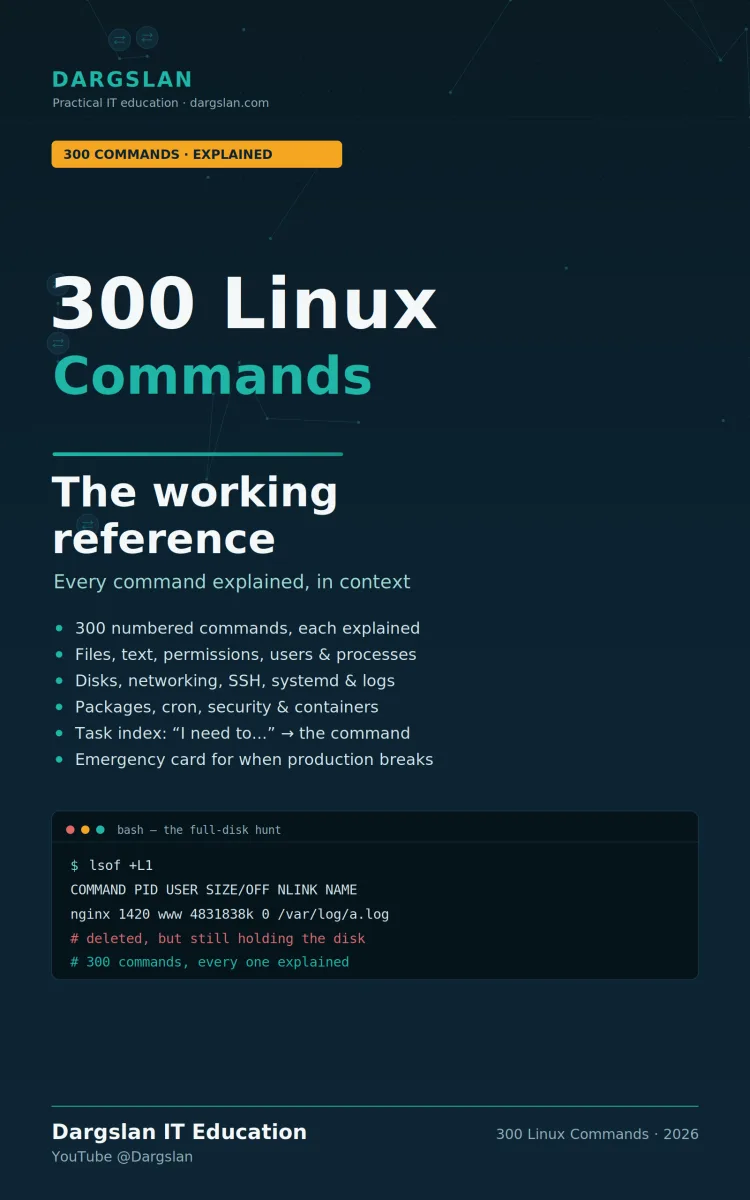
300 Linux Commands
The working reference
What's Included:
At a Glance
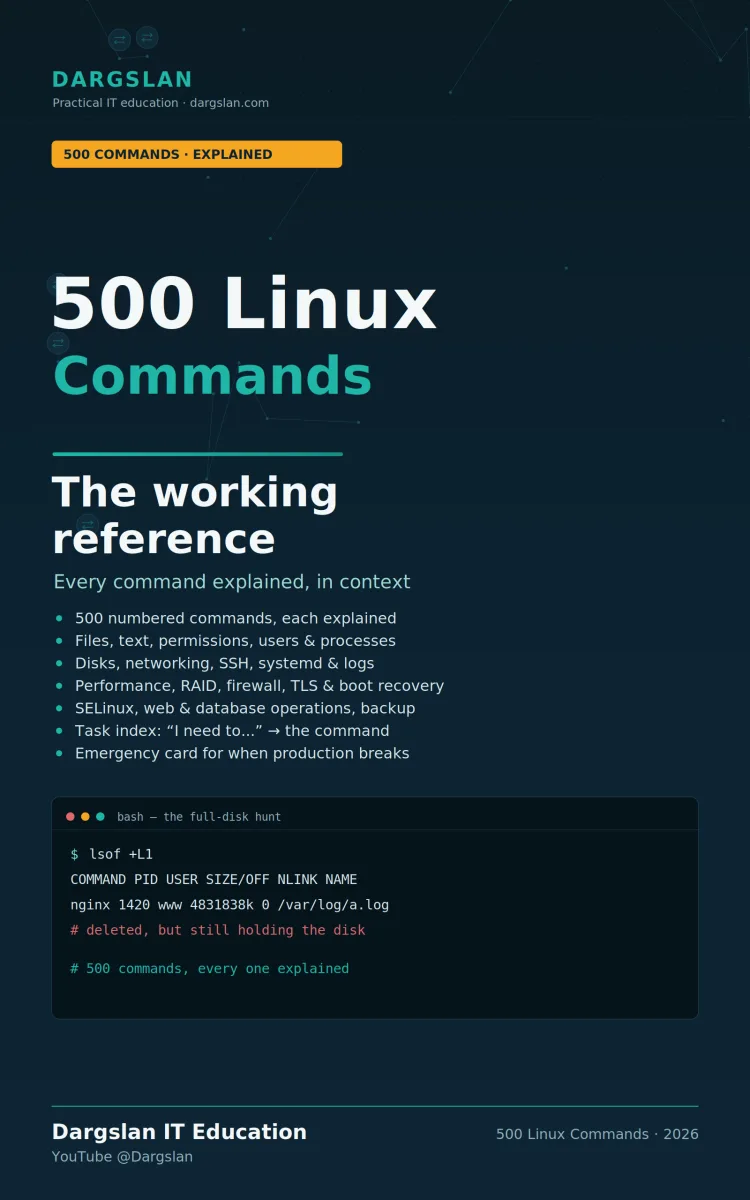
300 Linux Commands is a professional Linux Fundamentals eBook by Dargslan, 89 pages, available as an instant PDF and EPUB download for €0.00 with lifetime access and free updates. The working reference.
- Length: 89 pages
- Format: PDF and EPUB (instant download)
- Language: English
- Topic: Linux Fundamentals
- Edition: 1st Edition
- Price: €0.00
Key Highlights
- 300 numbered Linux commands, every one explained in context
- Plain explanations of what each does and when to reach for it—not a man-page rehash
- Notes that flag the trap, the caveat, or the reason a command matters
- Grouped by what you actually do: files, text, permissions, processes, disks, networking, services, logs, and more
- Three ways in: by topic, by task ("I need to…" index), and under pressure (emergency card)
- An emergency triage card for when production is broken and you have five minutes
- The full-disk emergency and what NOT to do under pressure
- Clear conventions: uppercase to substitute, sudo only where truly required
- Tested on current Debian/Ubuntu and RHEL-family systems, with differences noted
- Shell fundamentals, reading permission strings, and running commands safely
- Bash patterns worth memorizing and the quoting rule that prevents most bugs
- Written for the terminal, not the exam—no certification objectives
- Appendices: task index, emergency card, quick reference, and glossary
Overview
300 essential Linux commands, every one explained in context—not a rehash of the man pages. Grouped by what you're actually doing (files, text, permissions, processes, disks, networking, services, logs), with the traps that catch people flagged. A working reference for the terminal, not the exam.
The Problem
Linux has thousands of commands, each with dozens of options, and the official documentation tells you about all of them equally. Man pages are exhaustive and precise—and almost useless when you just need to remember the one command that does the thing, with the two flags people actually use. You end up searching the web, copying a snippet you don't fully understand, and hoping it doesn't have a trap you didn't see.
That gap costs you constantly. You know the command exists but not the exact syntax; you know the flag but not the caveat that makes it dangerous; you're staring at a full disk under pressure and can't recall the incantation that finds what's eating the space. Scattered knowledge, half-remembered options, and man pages that bury the useful 5% under the rarely-used 95% mean you're slower and less certain than you should be—especially when it matters most.
The Solution
300 Linux Commands is the working reference that gap has been missing. Three hundred commands administrators genuinely type, each shown exactly as you'd enter it and explained in plain language—what it does, when you'd reach for it, and the trap that catches people. No certification objectives, no options nobody uses, just the practical core.
It's built to get you to the right command three ways: by topic (grouped by files, text, permissions, processes, disks, networking, services, and logs), by task (an "I need to…" index straight to the command number), and under pressure (an emergency triage card for when production is broken and you have five minutes). Uppercase means substitute your value, sudo appears only where truly needed, and everything is tested on current Debian/Ubuntu and RHEL-family systems. It's the experienced colleague looking over your shoulder—next to your keyboard, whenever you need it.
About This Book
300 Linux Commands: The Working Reference is exactly what its title promises—three hundred numbered commands, every one explained in context, built for the terminal rather than the exam. Each entry shows the command exactly as you'd type it, followed by a plain explanation of what it does and when you'd reach for it. Not a restatement of the manual page—a real explanation of why it matters and what trips people up.
This is a reference you keep open while you work. There are no certification objectives here. Every command earned its place by being one administrators genuinely type, and the notes point out the traps that catch people, not the options nobody uses.
Organized Around What You Actually Do
The three hundred commands are grouped by task, following the areas you really work in: files and directories, finding files, text processing, permissions and ownership, users and groups, processes, system and hardware, disks and filesystems, networking, SSH and transfers, packages and archives, systemd services, logs and journald, scheduling and security, and containers and scripting. When you're looking for the right tool, it's where you'd expect it to be.
Three Ways In
The book is designed to get you to the right command fast, three different ways. By topic, the sections follow the areas you work in. By task, an "I need to…" index takes you straight to the command number. And under pressure, an emergency triage card is built for when production is broken and you have five minutes—including the full-disk emergency and, just as important, what not to do under stress.
Explanations That Point Out the Traps
What sets this reference apart is the notes. Below each entry, italic lines flag the trap, the caveat, or the reason a command matters—the practical knowledge that turns a command you've seen into a command you can use safely. It's the difference between knowing that lsof +L1 exists and understanding that it's how you find the deleted file a process is still holding open while your disk fills up.
Clear, Consistent Conventions
Everything is written to be typed. Uppercase means substitute your own value (FILE, USER, HOST, PID). sudo appears only where root privileges are genuinely required. Commands are tested on current Debian/Ubuntu and RHEL-family systems, with differences noted where they exist—so what you read works on the systems you actually run.
Foundations and Patterns Worth Memorizing
Beyond the command entries, the book grounds you in the shell fundamentals used throughout, how to read a permission string, and running commands safely. The scripting section includes bash patterns worth memorizing and the quoting rule that prevents most bugs—the small, high-leverage knowledge that makes everything else more reliable.
Reference Material for the Long Haul
The appendices are built to be reached for again and again: a task index that maps "I need to…" straight to the command, an emergency card for triage under pressure, a quick reference, and a glossary.
Who This Is For
Whether you're a system administrator who wants a faster reference, a developer who lives partly in the terminal, a DevOps engineer, or anyone building real fluency at the Linux command line, this book meets you where the work happens. It's not a tutorial to read once and shelve—it's a working reference that earns its place next to your keyboard.
Why This Book
Man pages tell you every option a command has; they rarely tell you which ones you'll actually use, or the mistake that's about to cost you an hour. This book fills that gap—300 commands, each explained the way an experienced colleague would explain it, so you spend less time searching and more time getting the job done.
Who Is This Book For?
- System administrators who want a fast, practical command reference
- DevOps and SRE engineers working across many Linux systems
- Developers who live partly in the terminal and want to work faster
- Aspiring sysadmins building real command-line fluency
- Support and operations staff who need the right command under pressure
- Self-hosters and home lab enthusiasts running their own Linux servers
- Anyone tired of digging through man pages for the 5% they actually use
Who Is This Book NOT For?
- Complete beginners who have never used a terminal (some command-line familiarity is assumed)
- Readers wanting a narrative, tutorial-style course rather than a reference
- Those seeking certification exam objectives and practice questions
- Users looking for a Windows or macOS command reference
- Anyone wanting exhaustive coverage of every option rather than the practical core
Table of Contents
- Section 0 — Before You Begin: how to read an entry, running commands safely, shell fundamentals used throughout
- Section 1 — Files & Directories
- Section 2 — Finding Files
- Section 3 — Text Processing
- Section 4 — Permissions & Ownership
- Section 5 — Users & Groups
- Section 6 — Processes
- Section 7 — System & Hardware
- Section 8 — Disks & Filesystems
- Section 9 — Networking
- Section 10 — SSH & Transfers
- Section 11 — Packages & Archives
- Section 12 — systemd Services
- Section 13 — Logs & journald
- Section 14 — Scheduling & Security
- Section 15 — Containers & Scripting (bash patterns and quoting)
- Appendix A — Task Index ("I need to…")
- Appendix B — Emergency Card: triage in order, the full-disk emergency, what not to do under pressure
- Appendix C — Quick Reference
- Appendix D — Glossary
Requirements
- Basic familiarity with a Linux terminal and shell navigation
- Access to a Linux system (Debian/Ubuntu or RHEL-family recommended) to try commands
- Sudo or root access for the commands that require elevated privileges
- General understanding of files, processes, and permissions is helpful
- No prior command mastery required—each entry stands on its own
- Best used hands-on, with a terminal open beside the book